
Ante post betting 2026: a working cost guide for British bettors
 Available in US
Every price on an ante-post market carries the same hidden tax as any other sports bet, plus a sting the day-of-race market never carries: if the horse doesn’t run, the stake stays lost. That single rule is the reason ante-post betting looks generous on Tuesday morning and costs the average punter by Saturday afternoon. This page works through how the market is built, which licensed bookmakers offer it in Great Britain, and what the rulebook actually costs the reader who takes it on.
Data current as of 26 October 2026, verified against the Gambling Commission’s public register of remote betting licences.
How an ante-post bet is built and settled
Ante-post means a market offered well before the event takes place — sometimes weeks, sometimes months out. Sky Bet’s own support pages describe the threshold as “at least a day before a horse race,” which is the everyday working definition British bookmakers apply. Cheltenham ante-post prices appear before Christmas; Grand National ante-post betting markets open the previous summer. The market exists because the bookmaker wants the punter’s money tied up early, and the punter gets paid for that tie-up in the form of a longer price than the same horse would carry on the morning of the race.
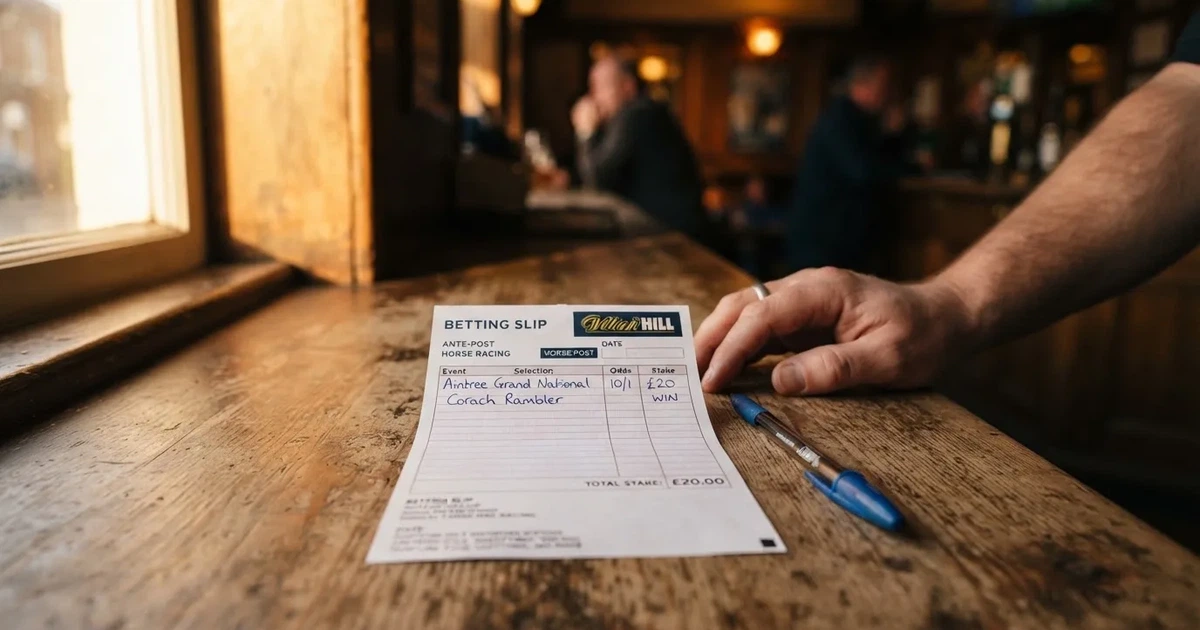
That longer price is the headline. It is also where the cost hides. Two costs sit inside every ante-post ticket: the bookmaker’s margin, which lives inside every price on every market anywhere, and the non-runner rule, which is unique to ante-post. The non-runner rule says, in the plain English of the Sky Bet terms, that a selection that does not run loses the bet — the stake is not returned.
The non-runner rule and what it costs
The arithmetic of the non-runner rule is straightforward and punishing. Take a four-runner ante-post race at Cheltenham, with all four runners priced around 4/1 (5.00 decimal). A £10 win bet on one horse pays £40 profit if that horse wins. If the horse is declared a non-runner on the morning of the race, the £10 is gone. On a same-day market, the same outcome would see the bet voided and the £10 returned.

A non-runner is not rare. Horses are withdrawn for ground conditions, for slight injuries, for the jockey changing mind, and for the trainer deciding the race has come too soon. Across a typical Cheltenham festival week, somewhere between ten and twenty per cent of ante-post selections end up declared non-runners on any given day. The punter who has spread £10 across ten ante-post bets at the festival knows the maths: two of those bets are very likely to disappear before the tape goes up, with no compensation.
This is the single biggest cost on the page. The bookmaker’s margin is visible in the price; the non-runner cost is hidden in the rule.
Settling at the price taken, not at starting price
Ante-post bets settle at the price the punter took when placing the bet. The starting price — the SP that settles day-of-race bets when no fixed price was taken — does not apply. So a punter who took a horse at 10/1 ante-post in September for the Cheltenham Gold Cup keeps that 10/1 if the horse wins in March, even if the SP on the day was 5/1.
This is the upside the non-runner rule is balanced against. The longer ante-post price is the punter’s reward for taking the non-runner risk; the SP does not later adjust the deal.
Rule 4 deductions
Rule 4 is the bookmaker rule that adjusts winning payouts when a horse is withdrawn from a race close to the off, reducing the payout on winning bets by a stated amount per remaining runner depending on how short the withdrawn horse was. The deduction applies to bets placed at the track and at the meeting; it does not apply to ante-post bets in the usual case, because the ante-post book closed before the Rule 4 window. That detail matters in this market: a punter who took 16/1 ante-post on a horse that wins will not see that payout trimmed by Rule 4 if a 3/1 favourite was pulled out on the morning of the race.
The exception is a Rule 4 condition the bookmaker has written into the ante-post market itself — some firms reserve the right to apply Rule 4 in unusual circumstances, and the punter reads the specific terms before staking.
Place-only, forecasts and conditionals
Place-only bets, conditional bets and forecast bets are not accepted on ante-post markets as a general rule. The same Sky Bet terms page says so plainly. Place terms on ante-post exist in a different shape — they vary by race and operator, and a punter who wants each-way cover on a future race reads the race card carefully rather than assuming the standard place terms apply.
What happens when a race is abandoned or moved
An ante-post bet is void — stake returned — if the race is abandoned or moved to a different course. The race going ahead on a different date at the same course does not trigger the void: the bet stands. Moving across courses does.
Accumulators and ante-post
A non-runner in an ante-post accumulator is treated differently from a non-runner in a single bet. A leg of the accumulator that is balloted out or whose horse is declared a non-runner leaves the bet running on the remaining legs at the original prices. A four-fold becomes a treble; a treble becomes a double; a double becomes a single. The accumulator survives, the leg drops out, and the price the punter took on the surviving legs stands too.
A single ante-post bet on the same withdrawn selection is not so lucky: the bet loses, the stake is gone. The accumulator rule is the one break the bookmaker gives on the non-runner cost.
The bookmaker’s margin on an ante-post market
The margin is the second cost. Every price on every market carries it, and the ante-post market is no exception. The margin on horse-racing ante-post markets tends to run higher than on day-of-race markets — the firms have less information on the eventual field, the liquidity is thinner, and the punter pays for that.
Reading a margin from two prices
Take a two-way market at decimal odds 1.90 against 1.90 — an even-money contest, for illustration. The “true” probability of the two outcomes between them must add up to one (one of them must win). The bookmaker’s “implied probabilities” at 1.90 each are 1 ÷ 1.90, twice — that is 0.5263 plus 0.5263, which equals 1.0526. The payout share to the bettor on a unit staked on the winner is 1 ÷ 1.0526, which is 0.95. The bookmaker keeps 1 minus 0.95, which is 0.05. Five per cent of every pound bet on this illustrative market stays with the bookmaker, on average across many bets.
That 5 per cent is the example’s result, and it generalises. The lower the margin, the more of every pound the punter keeps; the higher the margin, the less. Day-of-race horse-racing markets on liquid UK and Irish meetings tend to run margins in the high single digits as a percentage of turnover. Ante-post markets on smaller fields, or on long-range markets weeks before the race, can run margins well into the teens.
The shape of the cost
A punter staking £100 across an ante-post market at a 12 per cent margin expects, on average across many such bets, to receive back £88 in winning payouts and lose £12 to the margin. That is the shape of the cost on every bet that runs; it is the price the punter pays for the bookmaker making the market in the first place. The non-runner cost sits on top: of that £100, the punter expects perhaps £10 to vanish in non-runner stakes that did not even make it to the start. £12 to the margin, £10 to non-runners, and £78 comes back as winning payouts — before accounting for the fact that not every runner that starts actually wins.
The arithmetic here is an estimate, not a promise. It averages across many bets; a single ticket can win or lose at any ratio. The point is the shape: the margin is the silent cost, the non-runner rule is the loud cost, and the punter who ignores both of them is paying retail for a market that exists to give him longer prices.
Selecting an ante-post bookmaker in Great Britain
The set of bookmakers reviewed below holds a Gambling Commission remote licence to take bets from customers in Great Britain. A brand is licensed only if its name, trading name or domain appears against a Commission account number on the Commission’s public register. The fact that a brand is licensed does not mean it is good. The comparison is of the ante-post offer as the operator’s own terms and apps state it, against the cost the punter pays in the rules of each market.
Why the licence matters first
A GB licence costs the operator money and binds it to rules. The bettor’s protection layer — name and address verified before the first deposit, GAMSTOP self-exclusion, the Commission’s enforcement, the approved alternative dispute resolution route — sits on top of that licence. An unlicensed brand carries none of those protections: no GAMSTOP coverage, no Commission complaints route, no ADR route, no British consumer redress if funds are withheld, no cap on bonus wagering, no £150 vulnerability check at all. The punter who uses an unlicensed brand trades those protections for whatever price edge the brand claims to offer, and the edge is rarely there once the maths is done.
That does not make every licensed brand a good bet on ante-post. It makes the licence the floor of the comparison.
What each licensed brand does on ante-post
The block below ranks ten licensed bookmakers against how their ante-post offer stacks up — what the market looks like on the app, what the rules do on non-runners, and what the firm asks the punter to give up in return. Each review closes on a verdict about the brand, not about the reader’s suitability.
| Brand | Gambling Commission licence | Licence holder | Ante-post terms |
|---|---|---|---|
| Fitzdares | Account 400 | Fitzdares Limited | Horse racing ante-post markets are listed on the app alongside football, tennis, rugby, cricket, golf and American football; in-play live odds run separately. |
| Tote | Account 54779 | TDCO Limited | Ante-post markets on UK and Irish racing; pool-betting wrapper changes how a winning payout is calculated. |
| Geoff Banks | Account 54095 | GB Sports Advisors Limited | Ante-post prices on future events listed alongside live in-play prices; small book, narrow ante-post range. |
| Lottoland | Account 38991 | EU Lotto Limited | Lottery-led app; sports betting and ante-post sit inside a casino and lottery wrapper. |
| Betmaster | Account 65699 | BM Solutions GB Ltd | Sportsbook-led app; ante-post offered within the standard sportsbook. |
| 10bet | Account 43173 | Blue Star Planet Limited | Horse racing ante-post among football and tennis; Bet Builder and Cash out run alongside. |
| bet365 | Account 55148 | Hillside (UK Sports) ENC | Bet Builder+, Super Boosts and Winnings Boosts; ante-post markets on the major festivals and meetings. |
| Copybet | Account 53774 | Copybet UK Limited | Best Odds Guaranteed all day on UK and Irish racing; first past the post paid even if the winner is disqualified. |
| London Bet | Account 66162 | Thistle Bet Limited | Sportsbook with a casino wrapper; ante-post range varies. |
| BetMGM | Account 39198 | LeoVegas Gaming PLC | Sportsbook with casino; ante-post markets on racing and football among the standard set. |
The rows above run in the order of how each firm presents ante-post to the punter, not by ranking. The punter compares them by what each operator’s own terms say about the market — not by which holds the best licence, because every licence above is the same kind of licence.
Fitzdares — premium-priced ante-post on the major festivals
Fitzdares operates under a Gambling Commission account held by Fitzdares Limited, with remote general betting standard (real events) on the Commission’s public register. The Fitzdares app lists horse racing, football, tennis, rugby, cricket, golf and American football as ante-post categories, with in-play live odds sitting alongside rather than inside the ante-post section. Cash out, accumulators, Lucky 15s and specials round out the betting menu. The cost to the punter on Fitzdares is the premium pricing the brand charges for its position: ante-post prices tend to be tighter than the market average on the headline meetings, and the non-runner cost is the standard ante-post cost. For a punter who values the racing-specific depth and accepts the premium, Fitzdares is the right shop. For a punter price-shopping the market, it is not.
Tote — pool-betting mechanics change the ante-post settlement
Tote operates under a Gambling Commission account held by TDCO Limited. The Tote site is the British pool-betting brand, and the ante-post market sits inside the pool-betting wrapper rather than a fixed-odds book. The settlement on a winning ante-post Tote ticket is the pool dividend declared after the race, not the fixed price the punter took. The non-runner cost is still there in the form of the pool rules, but the payout shape differs: a Tote ante-post winner is paid on the dividend, not on the price. For a punter who likes the pool mechanic, Tote is the natural ante-post home; for a punter who wants the fixed price paid, the wrapper is the wrong shape.
Geoff Banks — narrow ante-post on a small book
Geoff Banks operates under a Gambling Commission account held by GB Sports Advisors Limited. The Geoff Banks app offers ante-post prices on future events alongside live in-play prices, and the brand sits inside a small book. The cost is the range: the major festivals are priced, but the depth of the meeting card is thinner than at a big sportsbook. For a punter with a specific ante-post angle on a small field, Geoff Banks is worth a look; for a festival-scale punter, this platform is a niche choice.
Lottoland — ante-post inside a lottery wrapper
Lottoland operates under a Gambling Commission account held by EU Lotto Limited. The Lottoland UK app combines casino, lottery betting, sports betting and scratchcards, with sports betting and ante-post markets listed inside the wrapper. The licence is the standard GB remote licence; the cost to the punter is that ante-post sits inside a brand whose centre of gravity is lottery betting. The markets exist; the depth is thinner than at a sportsbook-first brand. For a punter who already uses Lottoland for lottery, the sportsbook is there; for a punter shopping the ante-post market, it is not where the prices are tightest.
Betmaster — sportsbook-led, standard ante-post
Betmaster operates under a Gambling Commission account held by BM Solutions GB Ltd. The brand’s home page states it holds Gambling Commission account 65699 and is registered in Malta; the GB licence is the test of who serves customers in Great Britain. Betmaster offers ante-post within a sportsbook-led menu. The non-runner cost is the standard ante-post cost; the brand’s profile is unremarkable against the operator. For a punter looking for a sportsbook-led ante-post shop with a standard licence, Betmaster is a candidate; for a punter seeking deep market data, the comparison is against the bigger books.
10bet — ante-post with the modern feature set
10bet operates under a Gambling Commission account held by Blue Star Planet Limited; the 10bet app is published by 10bet Limited and states 10bet.co.uk is licensed by the Great Britain Gambling Commission under licence 43173. The sportsbook covers football, tennis and horse racing with Cash out, Bet Builder and Live Streaming. Ante-post markets on racing sit inside that wrapper. The cost to the punter is the standard ante-post cost; the upside is the in-play and bet-builder tooling. For a punter who wants the modern feature set alongside ante-post, 10bet is worth a look.
bet365 — the deep book ante-post
bet365 operates under a Gambling Commission account held by Hillside (UK Sports) ENC. The bet365 app offers Bet Builder+ (combining markets from one event into a single bet, available pre-match and in-play), Super Boosts, Winnings Boosts on Bet Builders and selected singles, and daily Bet Boosts. Ante-post markets on the major festivals run alongside. The cost to the punter is the standard ante-post cost on a deep book, with the brand’s typical pricing on the headline meetings. For a festival-scale punter, bet365 is the natural shop; for a punter with smaller interest, the brand’s data is more than is needed.
Copybet — best odds guaranteed plus first past the post
Copybet operates under a Gambling Commission account held by Copybet UK Limited. The Copybet app offers Best Odds Guaranteed all day, every day on all UK and Irish racing, and pays first past the post on horse racing even if the winner is later disqualified. Ante-post markets sit alongside. The cost to the punter on the ante-post side is the standard cost; the upside is the BOG and FPTP terms — although the punter reads the specific market rules, because ante-post and day-of-race BOG do not always behave identically across firms. For a punter who values the safety net of BOG and FPTP, Copybet is worth a look; for an ante-post punter, the headline BOG terms do not always apply to long-range bets.
London Bet — standard sportsbook ante-post
London Bet operates under a Gambling Commission account held by Thistle Bet Limited. The London Bet app states it is licensed and regulated in the UK, with a 17+ App Store age rating. The sportsbook wrapper is the standard shape, with ante-post markets on the major events. The cost to the punter is the standard ante-post cost. For a punter already using London Bet, the ante-post is there; for a punter shopping the market, it is one of several.
BetMGM — ante-post inside the MGM sportsbook wrapper
BetMGM operates under a Gambling Commission account held by LeoVegas Gaming PLC; the BetMGM UK app lists Gambling Commission account number 39198. The sports welcome offer for new UK customers who deposit £10 or more and place a sports bet within 7 days is four £10 free bets (two football accumulators of 4+ selections and two sports multiples of 2+), valid for 7 days with minimum odds and opt-in required. Ante-post markets sit inside the sportsbook wrapper. The cost to the punter on the ante-post side is the standard cost; the brand profile is that of a US-name sportsbook running on a GB licence. For a punter who likes the MGM wrapper, the ante-post is there; for an ante-post punter comparing prices, the comparison is against the deep books.
The fundamentals of ante-post betting
The fundamentals of ante-post betting start with what the market is and end with what it costs. The market is a long-range fixed-odds book offered by a bookmaker on an event still some way off. The price is the reward for taking the non-runner risk. The settlement is at the price taken, not at the SP.

The threshold that defines the market
A bet placed at least a day before a horse race is treated as ante-post. The threshold is operational rather than legal — the bookmaker’s own rulebook defines it, not statute. Day-of-race bets are not ante-post, and they are settled under the standard non-runner rule (the bet voids, the punter is returned), with Rule 4 deductions applying where the conditions are met.
What the punters get that day-of-race does not offer
The longer price is the obvious upside. A horse that would be 5/1 on the morning of a race is often 8/1 ante-post the week before. The difference is the punter’s reward for taking the non-runner risk early. On a horse that runs, the punter keeps the longer price. On a horse that does not, the punter loses the stake.
What the punters give up
The non-runner risk is the obvious downside. The Rule 4 deduction that would trim a day-of-race winning payout does not usually apply to ante-post, which is a small upside — but it does not compensate for the non-runner cost on a horse that does not run at all. The punter also gives up the BOG safety net: best-odds-guaranteed promotions typically apply to day-of-race bets, not ante-post, so the punter does not get paid out at a higher SP if the ante-post price is shorter than the SP on the day. William Hill’s own help pages make this explicit: Best Odds Guaranteed on UK and Irish horse racing runs from 8 AM on the day of the race, on both single and multiple bets, and does not apply to ante-post, tote or pari-mutuel bets.
The accumulator effect
The ante-post accumulator is the one shape where the non-runner rule bends in the punter’s favour. A non-runner drops out of the accumulator and the bet continues on the remaining legs; the price taken on each surviving leg stands. A four-fold at 50/1 ante-post where one leg is a non-runner becomes a treble at the prices the punter took on the three surviving legs. The accumulator mechanic is the punter’s hedge against the non-runner cost, at the cost of having all four selections already correct before the bet pays.
The legal frame in Great Britain
The legal frame for ante-post betting in Great Britain sits on top of the Gambling Act 2005, the Gambling (Licensing and Advertising) Act 2014, the Licence Conditions and Codes of Practice (LCCP), and the Gambling Commission’s public register. The frame applies to betting, including ante-post, offered to customers in Great Britain.
The Gambling Commission licence
Every bookmaker reviewed on this page holds a Gambling Commission remote licence for real-event betting. The licence is required of any operator whose remote facilities are used in Great Britain, wherever the operator is based — so a Gibraltar-registered company running a .co.uk site still needs the GB licence. The licence categories that matter for ante-post are remote general betting standard (real events) and, for pool-betting brands like Tote, the relevant pool-betting category. A spread-betting brand is separately regulated for financial products by the Financial Conduct Authority; the betting side sits with the Commission.
The public register
The Commission’s public register can be searched by business name, trading name, domain or account number; this register acts as the definitive test of whether a brand holds a licence. The punter checks the register before opening an account — particularly on a brand whose name or domain is unfamiliar — because a licensed brand carries the protection layer and an unlicensed brand carries none of it.
Verification and the no-anonymity rule
A licensed operator verifies the punter’s name, address and date of birth before the first deposit, and that verification has been mandatory since 7 May 2019 — including where the first transaction is a free bet or bonus. The rule applies to ante-post the same as it applies to any other market. The cost to the punter is the loss of anonymity; the benefit is the protection layer that comes with the licence.
Credit cards and payments
Credit cards are banned for gambling in Great Britain — including credit-card-funded payments through an e-wallet — and the ban has been in force since 14 April 2020. Debit cards and bank-based payments are not covered by the ban. Cryptocurrency deposits at licensed operators are not established as banned or permitted; the punter reads the operator’s terms. A British named-account rule and a state list of permitted payment methods are not established; payments are described from each operator’s terms rather than from a single rule.
In-play and what may be bet on
There is no statutory list of permitted bets or markets. An operator holds a licence for a category and offers markets under its own rules and the LCCP. In-play betting is offered by GB bookmakers and the controls are the operator’s licence conditions and customer-protection duties; in-play is not “unrestricted” as a legal conclusion. Esports are treated like any other event; virtual events are a separate licence category. Bets on politics, TV shows and novelty markets are offered by GB bookmakers and no statutory prohibition was found.
Tax and the punter
The punter pays no tax on betting winnings in Great Britain. General Betting Duty is the operator’s tax on gross profits; it is not the punter’s liability. The punter who treats betting as a profession asks HMRC or a tax adviser.
Advertising and the bonus cap
Wagering requirements on bonuses are capped at 10x since 19 January 2026. A £10 bonus with a 50x wagering requirement would need £500 of qualifying bets to clear; under the cap, no more than £100. Mixed-product promotions — an offer that requires gambling on two or more product types — are banned. Whether the cap applies to free bets with no wagering condition, and any cap on the money value of a bonus, are not established: the punter reads the offer terms.
Safer gambling on ante-post markets
The safer-gambling frame is the same for ante-post as for any other betting market, with two ante-post-specific points. The first is the longer settlement window: an ante-post bet placed in September for a race in March is money tied up for six months, and that length is a feature of the market rather than a bug. The second is the temptation to “chase” a non-runner loss with another ante-post bet to recover the stake, which is the ante-post-specific shape of the tilt pattern.
GAMSTOP and self-exclusion
GAMSTOP is the national multi-operator online self-exclusion scheme. Since 31 March 2020 it has been a mandatory licence condition for online operators licensed in Great Britain. Every licensed online bookmaker takes part. A punter who has self-excluded cannot open an account, deposit or bet at any participating site for the period chosen — six months, one year, five years, or five years with auto-renewal — and after the minimum period the exclusion stays in place for a further seven years unless the punter asks GAMSTOP to remove it. The scheme covers online sites and apps; betting shops use a separate service.
Financial vulnerability checks
A financial vulnerability check applies to licensed remote betting when a punter’s deposits minus withdrawals exceed £150 in a rolling 30 days, since 28 February 2025. The check is a public-record check (bankruptcy, county court judgments and the like), not an income check and not a credit reference check. The punter who crosses the £150 threshold is asked for the check. The check is a Commission condition; offshore brands do not run it.
Financial risk assessments
Financial risk assessments — sometimes called “affordability checks” in the press — are announced in a staged plan, with no start date at present. The Commission’s statement of 7 July 2026 names the stages. The punter who reads press coverage of “affordability checks in force” treats that coverage as describing an announcement rather than an active rule.
Deposit limits
Deposit limits are the customer’s choice. There is no state-set deposit or loss ceiling for betting in Great Britain; the operator offers a limit-setting tool on its site and the punter sets the limit. Changes to the Commission’s Remote Technical Standards on deposit limits have applied in stages since 31 October 2025, with a second phase postponed to 30 September 2026; whether that second phase is live is not established at the time of writing.
Help
The National Gambling Helpline (GamCare), GambleAware, NHS gambling clinics, and Gamblers Anonymous are the standard help routes. The licensed bookmakers run their own safer-gambling pages with signposting to those routes. A punter who feels the ante-post bet is becoming a habit rather than a market choice finds it before the six-month settlement window does.
Predictions, tips and strategy
The punter who searches “ante post betting tips” wants a tip. The honest answer is that nobody knows the future, and a tip is a guess wrapped in confidence. What the punter can do is sharpen the decision around the guess.
What a tip is worth
A tip is one person’s view, priced into the market alongside everyone else’s view. If a tipster named the winner of every Cheltenham Gold Cup in advance, the price on that horse would shorten until the tipster’s edge disappeared — that is how a market works. The punter who follows tips is paying for the tipster’s stake in the opinion, with no guarantee the opinion is right. A tip that wins pays the ante-post price; a tip that loses pays the non-runner rule.
What a strategy looks like
A working ante-post strategy is built on three pieces: a price the punter is willing to take, a stake sized to a fraction of the punter’s betting bank, and a rule for stopping. The price discipline is the part most punters skip — they take whatever price is on offer, rather than the price that makes the bet worth taking. The stake discipline is the part that protects the bank from the non-runner cost: the punter who stakes £10 across ten ante-post selections knows that one or two will be non-runners, and the stake is sized so that loss is affordable. The stopping rule is the part that stops the tilt after a non-runner loss: the punter walks away from the next ante-post market rather than chasing the stake back.
What a forecast does, and why the punter reads it
A forecast — a bet on which horse finishes first and second in order — is not accepted on ante-post markets as a general rule. The punter who wants a forecast bet takes it on the day-of-race market, not the ante-post. The forecast is a separate market type, with separate mechanics, and the ante-post shape does not accept it.
The accumulator as a strategy
The ante-post accumulator is a strategy in its own right, because the non-runner rule bends in the accumulator’s favour. A non-runner drops out of the accumulator and the bet continues; the price taken on each surviving leg stands. A punter who likes the accumulator shape pays the price of needing every other leg to win, and gains the protection of the leg that drops out. A punter who likes the single-bet shape pays the price of the non-runner cost and gains the simplicity of needing only one selection to win.
The data behind the decision
The punter who takes ante-post bets seriously reads form, reads the going report, reads the trainer’s record in the race, and reads the bookmaker’s terms. None of that is a tip — it is the data the punter’s own decision runs on. The punter who reads the data and still loses pays the ante-post cost; the punter who skips the data and wins has been lucky, and the next bet pays the same cost either way.
Bet types, odds formats and the practical price
The bet types and odds formats on an ante-post market are the same as on any other UK fixed-odds market, with two ante-post-specific points: place-only bets and forecasts are not accepted as a general rule, and accumulators treat a non-runner differently from a single bet.
Odds formats
UK bookmakers offer fractional and decimal odds. Fractional 5/1 means £5 profit for every £1 staked, returning £6 in total. Decimal 6.00 means £6 returned for every £1 staked, including the £1 stake. The conversion is decimal = fractional first number ÷ fractional second number + 1. Both formats carry the same bookmaker’s margin. The punter uses whichever format is easier to read; the price is the same.
Single bets
A single bet on an ante-post market is one selection, one stake, settled at the price taken. A non-runner loses the stake. A winner pays the price taken, not the SP.
Each-way
An each-way bet is two bets of equal stake — one on the win, one on the place. The total stake is double the unit stake. The place terms vary by race and by operator; on ante-post the place terms are stated by the operator in the market details, and the punter reads the race card before staking. A non-runner on the win part of an each-way bet: the bet loses on the win, the place part depends on the operator’s terms.
Accumulators
An accumulator (or “acca”) is a bet on four or more selections, all of which must win. The odds multiply into one price. A four-fold at 5/1, 4/1, 6/1 and 3/1 has combined odds of 361/1 — a £1 stake returns £362. A non-runner on an ante-post accumulator drops out and the bet continues on the remaining legs at the original prices. A four-fold becomes a treble; a treble becomes a double; a double becomes a single. A single ante-post bet on a non-runner selection is not so lucky — the bet loses.
System bets
A Patent is seven bets across three selections (three singles, three doubles, one treble). A Yankee is eleven bets across four selections (six doubles, four trebles, one four-fold). A Lucky 15 is fifteen bets across four selections (four singles, six doubles, four trebles, one four-fold). A Heinz is fifty-seven bets across six selections. A Goliath is two hundred and forty-seven bets across eight selections. The total stake on any system bet is the unit stake multiplied by the number of bets in the system — a Lucky 15 at £1 per bet is £15, not £1.
Cash out
Cash out is the bookmaker’s offer to settle a bet before the event has finished, at a price the bookmaker sets. The cash-out price is the bookmaker’s price, not the punter’s, and the price typically reflects the bookmaker’s margin. Cash out on ante-post is unusual: the bet is long-range, and most bookmakers do not offer cash out on ante-post markets before the day of the race. The punter checks the bet details for the cash-out option.
Bet Builder and Same-Game Multi
Bet Builder (or Same-Game Multi) is a bet combining multiple markets from one event into a single bet. The combined odds multiply into one price. Bet Builder+ is bet365’s branded version of the same mechanic. Bet Builder markets on ante-post are unusual; the mechanic is most often used on day-of-race markets. The punter checks the event card for the Bet Builder option.
Price boosts
A price boost is a bookmaker’s offer of a longer price on a specific selection, for a limited stake. Super Boosts and Winnings Boosts on Bet Builders are bet365’s branded versions. The boost is a marketing offer, and the punter reads the terms: maximum stake, eligible markets, settlement rules. The boost applies to single bets and selected multiples on day-of-race markets; the ante-post price-boost market exists on some brands but is not universal.
What a winning ante-post bet pays back
The arithmetic of a winning ante-post bet is the same as any other fixed-odds bet. The return is the stake multiplied by the decimal odds. The profit is the stake multiplied by the decimal odds minus one.
Worked example
Take a £10 win bet at decimal odds 6.00 (5/1 fractional). The return is £10 multiplied by 6.00, which is £60. The profit is £60 minus £10, which is £50. That is what the punter receives if the bet wins.
For a combination bet, the odds of the legs multiply into one price. A double at decimal odds 3.00 and 4.00 has combined odds of 12.00. A £10 stake returns £120 if both legs win; the profit is £110.
What the price contains
The price the punter takes contains the bookmaker’s margin. The margin is the difference between the “true” probability of all outcomes adding up to 1 and the implied probabilities of the prices the bookmaker offers. The lower the margin, the more of every pound the punter keeps. The ante-post market tends to carry a higher margin than the day-of-race market on the same race, because the field is less certain and the liquidity is thinner.
Where to check the maths
The punter checks the return on a winning bet by multiplying the stake by the decimal odds, or by multiplying the stake by the fractional odds’ first number, dividing by the fractional odds’ second number, and adding the stake back. The maths is the same on every bet, and the punter runs it before placing it.
Frequency, and how often the punters lose
The punter who reads the rulebook and the maths knows the shape of the cost. The bookmaker’s margin is silent and constant; the non-runner rule is loud and variable. The punter who accepts both pays the price the ante-post market charges, and the punter who beats the price has done so on the merits of the picks rather than by ignoring the rules.
Where to check the bookmaker’s licence
The punter checks the Gambling Commission’s public register by business name, trading name, domain or account number. This is the test of whether a brand holds a licence. A brand is licensed only if its name or domain appears against a Commission account number on that register. Every bookmaker reviewed on this page holds such a licence. The punter who reads a brand’s own homepage for a “we are licensed” claim treats that claim as a pointer to the register, not as the licence itself — the register is the source.
Closing the comparison
The comparison closes with the same point it opened: the non-runner rule and the margin are the two costs, and the punter who accepts both pays the price. The bookmaker with the deepest ante-post book is the natural shop for a festival-scale punter. The bookmaker with the narrow ante-post book and the racing-specific terms is the natural shop for a punter with a specific angle on a smaller field. The licensed status is the floor; the depth and the terms are the comparison.
Frequently asked questions
What is an ante post bet?
An ante-post bet is a fixed-odds bet placed on an event at least a day before it takes place — usually weeks or months in advance. The price the punter takes is the price that settles the bet, regardless of the starting price on the day. The non-runner rule applies: if the horse doesn’t run, the stake is lost rather than returned. This is the working definition most UK bookmakers apply.
What is ante post betting?
Ante-post betting is the practice of placing bets on future events at fixed odds offered in advance. It is most common in horse racing — Cheltenham, the Grand National, Aintree — where the ante-post markets open weeks or months before the meeting. The non-runner rule is the cost; the longer price is the reward.
Does Rule 4 apply to ante post bets?
Rule 4 is the bookmaker rule that adjusts winning payouts when a horse is withdrawn close to the off. It applies to bets at the track and at the meeting; it does not usually apply to ante-post bets because the ante-post book closed before the Rule 4 window. Some firms reserve the right to apply Rule 4 in unusual circumstances — the punter reads the specific market terms.
How can it be checked that a bookmaker holds a Gambling Commission licence?
The Gambling Commission’s public register can be searched by business name, trading name, domain or account number. A brand is licensed only if its name or domain appears against a Commission account number on that register; checking this register provides the definitive verification of a brand’s licensed status.
How is the return on a bet worked out from the stake and the odds?
The return is the stake multiplied by the decimal odds. At decimal odds 6.00 (5/1 fractional), a £10 stake returns £60. The profit is the return minus the stake — £50 in this case. For a combination bet, the odds of the legs multiply into one price. The maths is the same on every bet, and the punter runs it before staking.
What is the bookmaker’s margin and how can it be seen in the odds?
The margin is the share of every pound staked that the bookmaker keeps on average. It is visible in the prices: take a two-way market at 1.90 against 1.90, the implied probabilities add up to 1.0526 rather than 1.0000, and the difference — 0.0526, or about 5 per cent — is the margin. The lower the margin, the more the punter keeps; the higher, the less. Ante-post markets tend to carry a higher margin than day-of-race markets because the field is less certain and the liquidity is thinner.
Bet types & in-play – AI Betting
Content created by the «AI Betting» team
