
Football Accumulator Bets in 2026 — How Accas Are Built, Settled and Paid Out
 Available in US
Verified against the Gambling Commission’s public register on 26 October 2026. The page treats the Commission register as the test of who holds a remote licence in Great Britain.
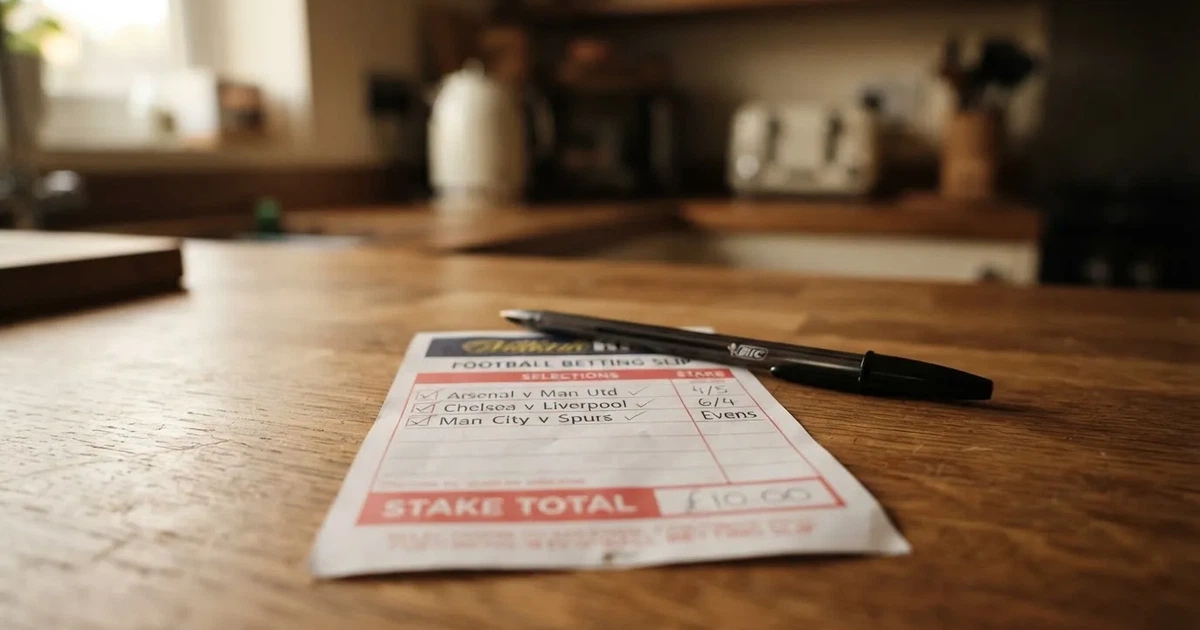
An accumulator is a single bet that links two or more selections together. Every leg has to win for the bet to pay, the odds of the legs multiply into one price, and the payout is the stake multiplied by that combined price. The shape is simple, but two figures inside it decide everything that follows: the number of legs and the decimal odds on each one. What changes between operators is rarely the mechanism — it is the menu of leg types, the price boosts and the insurance on offer when one leg lets the bet down. This page is for readers who want to understand that mechanism, see how it pays on a worked example, and check which bookmakers hold a Gambling Commission licence before staking anything.
Safer gambling and the protections around a football accumulator
A punter who is building an acca on a Saturday afternoon is not thinking about the Gambling Commission, GAMSTOP or a financial check at the checkout — and most weeks that does not matter. The pages that follow this one explain how the bet works and who will take it, but a short section on the safeguards around it sits first because the rest of the guide assumes the reader has a way to step back from a losing streak when one starts.

The Gambling Commission is the regulator of commercial gambling in Great Britain under the Gambling Act 2005. Every operator named on this page holds a remote licence issued by the Commission and appears on its public register, which can be searched by business name, trading name, domain or account number. The register is the test of whether a brand is licensed, and it is the only place a reader needs to check. The minimum age is 18, and licensed operators verify name, address and date of birth before the first deposit or bet, including when the bet is paid for with a free bet or bonus. Identity verification is the price of using a licensed site: no anonymous play, no shortcuts.
GAMSTOP is the national multi-operator self-exclusion scheme and a mandatory licence condition for online operators. A punter who registers with GAMSTOP is barred from every GB-licensed online betting site and app for the chosen period: six months, one year, five years, or five years with auto-renewal. After the minimum period the exclusion stays in place for a further seven years unless the customer asks GAMSTOP to remove it. GAMSTOP is the single most effective tool a reader who needs to stop has, and using it costs nothing.
A financial vulnerability check has applied to licensed remote betting since 30 August 2024, and from 28 February 2025 it is triggered when a customer’s deposits minus withdrawals exceed £150 in a rolling 30 days. The check is a public-record one — bankruptcy, county court judgments — not a credit reference check and not an income check. A wider set of financial risk assessments has been announced by the Commission and is being introduced in stages; no start date is set. Operators must offer a gross deposit limit on a fixed time frame; the first changes applied on 31 October 2025 and a second phase was postponed to 30 September 2026. State-set deposit or loss ceilings do not exist in Great Britain: limits are the customer’s own choice.
The help lines and services that matter are GamCare and the National Gambling Helpline, GambleAware, the NHS gambling clinics network, and Gamblers Anonymous. The protections above are described in the section that follows, in the rules under which the bookmakers on this page operate, and in the operator reviews themselves — refer back to them by name rather than repeating the detail.
Strategy, forecasts and the case for treating tips as one input among several
“Football accumulator tips” is one of the most-searched phrases around accas, and the request underneath it is honest: a punter wants someone to do the selection work, fold several matches into a four-fold or a five-fold, and hand back something to back. The honest answer is that no tipster, model or preview can remove the compounding effect of an acca’s odds. Each leg is its own bet with its own probability, and the probability of the whole thing winning is the product of those probabilities. Two short-priced favourites multiply into a smaller combined probability than either one alone; a long-priced outsider tagged on the end pulls it lower still. The bookmaker’s margin is in every price, and it compounds with the legs.

What a tipster or a model can do is reduce the noise around each leg. Form, expected goals, line-up news, fixture congestion, weather, the referee’s card record — every one of these moves the probability of a leg, and a tip that names them and weighs them is doing real work. A tip that names “a confident four-fold” with no reasoning behind it is closer to a coupon than to analysis, and the difference shows in the long run.
Bankroll discipline is the lever the tipster does not control. A punter who stakes a fixed unit — say, one per cent of a defined bank — on every acca smooths the variance of an acca strategy. A punter who doubles after a loss chases it and burns through a bank faster than any tip can refill it. The acca is a high-variance bet, and the only working strategy around it treats it as such.
The trade-off between fewer legs and more legs is the cleanest way to think about acca construction. A four-fold at short prices is closer to a series of singles than a true accumulator; its probability of winning is higher and its return is lower. A nine-fold at mixed prices is the shape of the dream ticket, and its probability is the product of nine small probabilities. Both are legitimate bets, and which one a punter picks depends on what they are actually buying — a steadier return, or a longer-priced one. The arithmetic in the section on bet types shows what each one pays on a worked example.
Forecast content — previews, predicted line-ups, expected line movements — is more useful for the legs at the edge of an acca than for the short-priced anchors. The anchors are prices around 1/2 (1.50 decimal) and the market has done most of the work on them already. The legs that decide whether an acca wins are the legs whose prices have drifted from the morning line, and a reader who watches those movements is the one who benefits from a tip rather than relying on it.
Forecasts and previews are inputs, not instructions. A reader who treats them that way — and keeps the staking honest too — gets the use out of them without paying the price of over-reliance. The bet types section explains what a winning acca actually returns, which is the figure a tipster’s reputation rests on.
Bet types, odds formats and how a football accumulator pays out
The mechanics of an accumulator (or acca, parlay, combo bet, multi — four names for one bet) are simple enough to state in a sentence and detailed enough to take a section. Two or more selections are linked into a single bet. Every leg has to win, the odds multiply, and the payout is the stake multiplied by the combined price. A losing leg loses the whole bet. A leg that ties — a “push” — is removed and the combined price is recalculated on the legs that remain. In Great Britain odds are written as fractions (5/1, 11/4, evens) and the page works in decimal form, where 5/1 becomes 6.00 and evens becomes 2.00, because the multiplication that makes an acca work is straightforward in decimals and clumsy in fractions.
A worked example is the clearest way to see what an acca does to a stake. Three selections at decimal odds of 1.50, 2.00 and 2.50 — fractional 1/2, evens and 6/4 — multiplied together give a combined price of 7.50. A £10 stake returns £75, of which £10 is the original stake and £65 is profit. The same three selections in singles would pay £5 profit on the first, £10 on the second and £15 on the third — £30 in profit on a £30 outlay. The accumulator pays more than the sum of singles would, which is the point of it, and the higher payout is the price the bettor pays for compounding the risk.
The page’s prescribed calculation is a band, not a single figure, because the calculation depends on the legs the punter picks. The illustrative four-fold used above — three legs at 1.50, 2.00 and 2.50 plus a fourth at the same short price — gives a combined price of 11.25. A £10 stake pays £112.50 including the original stake, of which £102.50 is profit. The same four legs at a slightly longer set of prices — 2.00, 2.50, 3.00 and 3.50, say — multiply into 52.50, and the same £10 stake pays £525, of which £515 is profit. Both are realistic accumulators; the spread between them is the spread between a conservative acca and an ambitious one.
Full cover bets take the same selections and arrange them in combinations. A Trixie covers three selections in four bets (three doubles and a treble); a Yankee covers four selections in eleven bets; a Lucky 15 covers four in fifteen, with singles on top of a Yankee. A Heinz covers six selections in fifty-seven bets and a Super Heinz covers seven in a hundred and twenty. The unit stake on a full cover bet is the stake per line, and the total outlay is the unit stake multiplied by the number of bets — £2 per line on a Lucky 15 is a £30 total stake. The trade-off is that a full cover bet pays something when only two of the legs win, which a straight accumulator never does; the cost is the much larger total stake for the same unit.
Each-way accumulators are a separate case. An each-way bet is two bets at equal stakes: one on the win, one on the place. On a horse race the place terms are set by the bookmaker and vary with the number of runners; on a football acca the same logic applies to whatever each-way market the bookmaker offers. The stake doubles when the bet is placed each-way, and the payout runs along both branches. A punter laying an each-way acca is laying two accumulators at once.
Bet builders and same-game multis fold several markets from one match into a single bet. A bet builder on a Premier League match might combine a home win with both teams to score and over 2.5 goals, all priced into one accumulator-style ticket on a single fixture. The mechanism is the same — each leg has to hit, the prices multiply — and the bookmaker’s margin sits inside every leg as it does on a multi-match acca.
Cash out is the feature that lets a punter settle an acca before the final leg. A bookmaker offers a price based on the current state of the bet — what the remaining leg would have to land, what the live odds are on it — and the punter takes the price or leaves the bet to run. Cash out is not guaranteed on every market: if the bookmaker cannot offer a price, the bet stands. That detail is in the small print of every operator that offers the feature, and the section on bookmakers returns to it.
The bookmaker’s margin is what sits inside every leg of an acca. On a single outcome — a home win, say — the margin is the share of every pound staked that the bookmaker keeps on average. On a three-way market (home win, draw, away win) the margin is built from the overround across all three prices: the inverse of the sum of the reciprocals of the decimal odds, subtracted from one. A margin of 5 % on a market means the bookmaker keeps 5p of every pound staked on that market over the long run. The margin is not a fee charged to the punter; it is the difference between the true probability of the outcomes and the prices the bookmaker quotes. A punter who picks shorter-priced selections pays less margin per leg than one who picks long-priced outsiders, and an accumulator built from short prices is materially cheaper in margin terms than one built from long ones.
The legal framework inside which these mechanics operate is the subject of a later section, and the operator reviews that follow it describe how each bookmaker applies them.
The shortlist of licensed bookmakers for football accumulators
Ten bookmakers hold a Gambling Commission remote licence and run a football betting service aimed at UK customers. Each one is licensed by name and on the Commission’s public register, each one takes part in GAMSTOP, and the table that follows names the licence and the operator’s own position on accumulators. The list is not a ranking and the publishers behind it do not endorse any brand. Where one brand does something the others do not — Bet Builder, Acca Insurance, Best Odds Guaranteed on football — that is named in the table and developed in the operator reviews.
| Operator | Licence holder (account no.) | Accumulators and related features on the operator’s own terms |
|---|---|---|
| Betfred | Petfre (Gibraltar) Limited (39544) | Bet Builder, Extra Places, Acca Booming tools in app |
| Lottoland | EU Lotto Limited (38991) | Sports betting sits alongside casino, lottery and scratchcards |
| Sporting Index | Sporting Index Limited (27343) | Fixed-odds accas plus spread-bet legs on goals and favourites |
| Swifty Sports | Swifty Global (UK) Ltd (58957) | Best Odds Guaranteed, Cash Out, daily price boosts, Bet Builder coming soon |
| BetMGM | LeoVegas Gaming PLC (39198) | Welcome offer of four £10 free bets, two on football accas of 4+ legs |
| Fafabet | Taichi Tech Limited (57385) | Best Odds Guaranteed on UK and Irish horse racing; football accas offered |
| Ladbrokes | LC International Limited (54743) | Acca Boosts, odds boosts, Best Odds Guaranteed on horse racing, in-play |
| DAZN Bet | DZBT Limited (48756) | Bet Builder, Cash Out, daily bet boosts, in-play betting |
| Dabble | Dabble Sports UK Ltd (65677) | Acumulators and sports multiples, social features in app |
| Fitzwilliam Sports | SBKI Limited (48760) | Prices set against the Oddschecker average for each selection |
Every licence number above is on the Commission’s public register, and the section on legality explains how to check a brand against that register in three steps. Several of the licence holders above run more than one consumer brand, and a brand that appears twice in the Commission’s records because of licence design has been written once.
Betfred — the high-street legacy with a full app
Betfred is the high-street name that took its counter book into an app, and the app carries the counter’s features with it: Bet Builder for same-game multis, Extra Places on selected horse races, and the Sub Switch feature that lets a punter change a player-based market when a named selection drops out. The licence is held by Petfre (Gibraltar) Limited under Commission account 39544, and the brand has been a familiar one on UK rails for decades. The relevant thing for an acca builder is the depth of the markets — Betfred’s football coverage runs through the EFL, the Premier League and the European leagues — and the Acca Boost-style features that pay extra on winning multiples.
The offer is described in the operator’s own terms rather than re-priced on the page: a new-customer offer attaches to the first bet and the free-bet rules are in the small print. The relevant reader profile is the punter who wants a long-established name with a deep football book and the in-app tools to build a same-game multi or to switch a player out of an acca leg without rebuilding the ticket. The verdict is that Betfred appeals to a punter who values market depth over the latest feature set.
Lottoland — lottery first, sports book as a sideline
Lottoland is a brand most UK readers know for lottery betting, and the sports book sits beside the lottery and scratchcards on the same app. The licence is held by EU Lotto Limited under Commission account 38991, and the same Commission site covers the sports book because the operator holds a remote general betting standard (real events) licence. The relevant detail for a punter is that the sports book is a smaller part of a wider offering, and the depth of the football market is not the same as a brand whose only business is sports.
The offer is described in the operator’s own terms. The verdict is that the right reader is a punters who already uses Lottoland for lottery products and wants a sports book on the same account rather than as a separate product — for a punters whose primary interest is a deep football book, a dedicated sports book is the better fit.
Sporting Index — the spread-betting hybrid
Sporting Index is unusual in this list because it carries two regulatory regimes. Fixed-odds football betting sits under the Gambling Commission’s account 27343, held by Sporting Index Limited. Spread betting on sports sits under a separate regulatory framework, and the FCA regulates the financial-spread side of the business. The same app carries both, and a punter on Sporting Index can lay a fixed-odds acca and a spread bet on the same fixture.
The offer the app describes is a £10 fixed-odds qualifying bet at minimum odds of 1/2 unlocking three £10 fixed-odds free bets, three £5 Total Goals spread bets, three £5 Winning Favourites spread bets and a £1 Race Index spread bet, with the qualifying bet excluded from in-play and from cash-out. The relevant detail for a punters is that the welcome is a bundle of free bets across two product types, and the qualifying bet is restricted to pre-match fixed odds. The verdict is that Sporting Index is a solid choice for a punter who wants fixed-odds and spread betting on the same account and is happy to learn the spread side before staking on it — for a punter who wants a straight fixed-odds acca book, a single-product operator is the cleaner choice.
Swifty Sports — the new-entrant app with the older features
Swifty Sports is a newer name in this list, and the app is the primary product. The licence is held by Swifty Global (UK) Ltd under Commission account 58957, and the relevant features on the operator’s own terms are Best Odds Guaranteed, Cash Out on markets including horse racing and football, daily price boosts and live streaming. Bet Builder is described as coming soon, which the page notes as a current state rather than a permanent one. The relevant detail for a punters is that the app’s feature list is moving fast, and the small print on each feature is worth reading.
The verdict is that Swifty Sports caters to a punter who wants a mobile-first app with the established acca features and is comfortable that Bet Builder is still being rolled out. If a same-game multi is the priority, a brand with Bet Builder already live is a better option.
BetMGM — the transatlantic brand on a UK licence
BetMGM is the US-facing brand carried into the UK market by LeoVegas Gaming PLC under Commission account 39198. The relevant detail for a punters is the welcome offer: four £10 free bets — two on football accas of 4+ selections and two on sports multiples of 2+ — to new UK customers who deposit £10 or more and place a sports bet within 7 days. The free bets are valid for 7 days, with minimum odds and an opt-in. The stake is not returned with a winning free bet, and that detail is part of the small print every free-bet punter should read.
The verdict is that BetMGM is well-suited to a punter who plans to build four-leg accas as the default shape — the welcome offer is built around that — and who is comfortable with the seven-day expiry on the free bets. For a punter who builds accas of two or three legs by default, half the welcome is irrelevant.
Fafabet — Best Odds Guaranteed on the racing, football on the book
Fafabet’s signature feature is Best Odds Guaranteed on UK and Irish horse racing, win and each-way, from 9am on race days: if the starting price is bigger than the price the punter took, the bigger price is paid. Football sits alongside the racing product on the same app. The licence is held by Taichi Tech Limited under Commission account 57385. The relevant detail for a punters is that the BOG mechanism is on horse racing, not on football, and a football acca builder is not the same trade as a racing punter taking early value. The football book is solid but the brand’s edge is on racing.
The verdict is that Fafabet is a strong contender for a punter who builds horse-ranking accas as well as football ones and wants BOG on the racing side; for a football-only acca builder, a brand with football-specific price boosts is the better fit.
Ladbrokes — the established name with the deep acca product
Ladbrokes is the long-established name in this list and the licence is held by LC International Limited under Commission account 54743, the same licence holder that runs Coral on a sister licence arrangement. The relevant detail for a punters is the acca product: Ladbrokes runs odds boosts on horse and greyhound bets, Best Odds Guaranteed on UK and Irish horse races, in-play betting, and an Acca Boost mechanism that pays extra on winning multiples. The football book is deep and the in-play product carries the same scale. The brand has been on UK rails for generations and the app carries the counter’s reach.
The verdict is that Ladbrokes suits a punter who wants a deep football book with an Acca Boost on top and is comfortable with the established app. A four-fold on the Premier League each weekend makes Ladbrokes a logical choice.
DAZN Bet — the broadcaster’s book with the cash-out caveat
DAZN Bet is the betting arm of the DAZN broadcaster, and the licence is held by DZBT Limited under Commission account 48756. The relevant features on the operator’s own terms are Cash Out, Bet Builder, daily bet boosts and in-play betting. The relevant detail for a punters is the cash-out caveat: cash-out availability is not guaranteed and bets stand if it is unavailable. That detail is in the small print of every operator that offers cash out, and DAZN Bet’s wording makes it explicit. A punter who relies on cash out to settle a winning acca early should know that the feature may not be there when they want it.
The verdict is that DAZN Bet is the right pick for a punters who values a broadcaster-backed brand with Bet Builder live and is comfortable with the cash-out caveat. For a punters whose acca strategy depends on locking in profit at the penultimate leg, a brand that does not caveat cash out is the safer pick.
Dabble — the social app with the simple welcome
Dabble is a social sports-betting app and the licence is held by Dabble Sports UK Ltd under Commission account 65677. The relevant detail is the welcome offer: a £10 fixed-odds bet for a £10 free bet on the first deposit, with minimum odds applying, a 7-day expiry on the free bet and the stake not returned. The social features let punters follow other users’ bets, which is a different shape from the rest of this list and the relevant detail for a punters who wants to see what other app users are backing. The verdict is that Dabble caters to a punter who wants a social layer on top of an acca book and is comfortable with the seven-day free-bet expiry. For a punter whose acca strategy is private, a brand without the social feed is the cleaner fit.
Fitzwilliam Sports — the price-following book
Fitzwilliam Sports is the unusual one in this list because its pricing model is different. The brand names its prices against the Oddschecker average for each selection, which means the prices on the app move with the market average rather than being set in isolation. The licence is held by SBKI Limited under Commission account 48760. The relevant detail for a punters is that prices follow the average, which means Fitzwilliam is rarely the best price on a leg but rarely the worst either. The app is available on iOS and Android.
The verdict is that Fitzwilliam Sports is a viable alternative for a punter who wants to anchor an acca on a market-average price rather than chase the best price on every leg. For a punter whose edge is finding the best price per leg, a brand that sets its own prices is the better fit.
What an accumulator actually is and where it sits in the betting landscape
An accumulator is the most-used bet type in UK football betting and the most-misunderded. The shape is simple: two or more selections linked into one bet, every leg has to win, the odds multiply, the payout is the stake multiplied by the combined price. The misunderstanding is in the price. A four-fold at four short prices is not the same trade as a four-fold at four long prices; the first is a low-margin series of probable outcomes, the second is a high-margin series of improbable ones, and the payout difference between the two is the difference between a steady acca and a dream ticket.
The market for football accumulators in Great Britain is the licensed market. The Gambling Commission issues remote licences to operators that apply and meet its conditions, and a brand that holds a remote general betting standard (real events) licence can offer football markets under its own rules and the Licence Conditions and Codes of Practice. There is no statutory list of permitted markets. There is no cap on the number of licences. There is no monopoly. The market is the licensed market, the brands in it are the brands on the Commission’s register, and a brand that is not on that register is offering its product without a Great Britain licence.
The ten brands in this guide’s shortlist are the licensed bookmakers the page covers. They are not the only licensed bookmakers in Great Britain, and naming them is not an endorsement. A reader who wants a brand outside this list should check the Commission’s register directly: the section on legality explains how. The fact that none of these ten is “the only licensed brand” is a sentence worth saying once and not repeating.
The structure of an acca is the structure of a probability tree. Each leg has its own probability of winning, and the probability of the whole bet winning is the product of those probabilities. A punter who picks four legs at 1.50 (an implied probability of about 67 %) is building an acca with a winning probability of about 19 %, before the margin. The same four legs at 2.00 (50 %) drops the winning probability to 6.25 %, and the same four at 3.00 (33 %) drops it to about 1.2 %. The high payout of a long-priced acca is the compensation for the small probability of winning it, and the trade-off is honest.
What a bookmaker offers on top of the basic acca is the variation that distinguishes one brand from another. Betfred offers Bet Builder; Ladbrokes offers Acca Boosts; BetMGM offers a welcome built around accas of four legs or more; Swifty Sports is rolling out its own bet builder. The mechanism is the same across all of them; the wrapper is different. A punter who knows what shape of acca they want to build — a four-fold on the Premier League, a same-game multi, a Lucky 15 on the weekend’s racing — can pick the bookmaker that wraps that shape best.
The payout is calculated the same way at every desk. Decimal odds are the working format because the multiplication is clean. A £10 stake at combined odds of 7.50 returns £75, £65 of which is profit; at combined odds of 11.25, the same stake returns £112.50, including £102.50 profit, while at combined odds of 52.50 it yields £525, or £515 profit. Every one of those is a real acca payout; the spread between them is the spread between a conservative acca and an ambitious one.
The legal frame inside which these mechanics operate is the subject of the section that follows. The frame is short, it is well-established, and it is the same for every brand on the page. The relevant details are the operator-set maximum stakes, the GAMSTOP coverage, the bonus cap, the credit-card ban and the absence of a statutory stake ceiling. They are described once, in the section that owns them, and the operator reviews refer back to them rather than repeating them.
Legality, regulation and what a Gambling Commission licence actually means
The Gambling Act 2005 is the statute that governs commercial gambling in Great Britain, and the Gambling Commission is the regulator it sets up. The Commission is a non-departmental public body sponsored by the Department for Culture, Media and Sport. Northern Ireland is outside the Act and has its own older law; a Great Britain licence does not regulate Northern Ireland and a page that writes “UK licence” is misleading on this point. The relevant wording is “Great Britain licence” or “GB-licensed”.
Since the Gambling (Licensing and Advertising) Act 2014, an operator whose remote facilities are used in Great Britain needs a Commission licence wherever the operator itself is based. Sections 33 and 36 of the 2005 Act, as amended, are the provisions that create this point-of-consumption requirement. A Curaçao, Maltese or Gibraltar licence is not a substitute; a brand with one of those licences alone cannot lawfully provide gambling facilities to customers in Great Britain. The Commission’s public register can be searched by business name, trading name, domain or account number, and a brand that does not appear on it is not licensed to take bets from customers in Great Britain.
A check against the register takes three steps and does not require any special access. First, search by the brand’s trading name — Betfred, Ladbrokes, BetMGM and so on — or by the domain the punter would use. Second, confirm the account number against the operator’s own small print. Third, confirm the licence categories cover the product the punter wants to use. For football accumulators the relevant category is remote general betting standard (real events); a brand licensed only for virtual events cannot offer Premier League football. A punter who is unsure has a single resource to consult, and the resource is the register itself.
The licence categories that matter for an acca builder are remote general betting standard (real events), remote general betting standard (virtual events), remote general betting limited, remote pool betting, and remote betting intermediary. The last of these is the exchange licence — Betfair and Smarkets run under it — and the rates and rules of exchanges are stated only from each exchange’s own terms. Spread betting that is not a financial product is inside General Betting Duty. Financial spread betting is regulated by the Financial Conduct Authority, not the Commission, and the relevant operator is Spreadex for sports spread betting alongside fixed odds.
The minimum age is 18. Identity verification — name, address, date of birth — has applied before the first deposit or bet since 7 May 2019, including when the bet is paid for with a free bet or bonus. A punter who cannot verify is not betting at a licensed site, and a brand that does not verify is not licensed. The verification is the price of the consumer protections that come with the licence.
GAMSTOP is a mandatory licence condition for online operators, in force since 31 March 2020. A self-exclusion runs for six months, one year, five years, or five years with auto-renewal. After the minimum period the exclusion stays in place for a further seven years unless the customer asks GAMSTOP to remove it. GAMSTOP covers online sites and apps; betting shops run a separate service. The detail is worth restating because the seven-year tail is the part of the scheme that punter who are considering registration most often miss.
A financial vulnerability check has applied to licensed remote betting since 30 August 2024. From 28 February 2025 it is triggered when a customer’s deposits minus withdrawals exceed £150 in a rolling 30 days. The check is a public-record check — bankruptcy, county court judgments — and is not a credit reference check. A wider set of financial risk assessments has been announced by the Commission and is being introduced in stages; no start date is set, and the page writes “announced, staged, no start date” rather than “in force”. Operators must offer a gross deposit limit on a fixed time frame; the first changes applied on 31 October 2025 and a second phase was postponed to 30 September 2026. There is no state-set deposit or loss ceiling; limits are the customer’s own choice.
Bonuses at licensed operators have been subject to a cap since 19 January 2026. Wagering requirements are capped at 10x — a £10 bonus at 50x wagering needed £500 of qualifying bets, and under the cap no more than £100. Mixed-product promotions, where an offer requires gambling on two or more product types — “bet on football to get free spins”, for example — are banned. Whether the cap applies to free bets with no wagering condition, and any cap on the money value of a bonus, are not established from the public record. The detail that is established is the cap and the mixed-product ban.
Advertising is not licensed by the Commission; it is regulated through the CAP Code (non-broadcast) and the BCAP Code (broadcast), enforced by the ASA, alongside the LCCP marketing conditions. CAP Code section 16 sets the social responsibility rules: marketing must not be of strong appeal to under-18s, and no one who is or seems to be under 25 may be featured gambling or play a significant role. The rule is about who appears in the advertisement, not about who may bet. The “whistle-to-whistle” ban on TV betting advertising around live sport has applied since 1 August 2019: no betting ads from five minutes before a live sporting event to five minutes after, before the 9pm watershed; horse and greyhound racing are excluded. The Premier League clubs’ withdrawal of gambling sponsorship from the front of matchday shirts from the 2026/27 season is voluntary, not law.
Credit cards are banned for gambling in Great Britain since 14 April 2020, including credit-card-funded payments through an e-wallet. Debit cards and bank-based payments are not covered by the ban. The identity-verification rule means there is no anonymous play at a licensed site, and source-of-funds questions at higher spend are normal under the money-laundering rules. Whether a British named-account rule, a state list of permitted payment methods or a rule on cryptocurrency deposits at licensed operators exists is not established from the public record; the page describes payments qualitatively and only from each operator’s own terms.
The player pays no tax on betting winnings in Great Britain. General Betting Duty is the operator’s tax on gross profits and is currently 15%; from 1 April 2027 a new remote betting rate of 25% applies within it, while remote bets on UK horse racing, bets on self-service betting terminals in licensed premises, pool betting and in-person betting stay at 15%. Spread betting has its own rates (3% financial, 10% other). Whether operators pass duty on through odds is not established, and the page does not write that the player is charged duty. The Commission’s statutory levy is a separate charge, not a tax.
A brand that offers its product to customers in Great Britain without a Commission licence is committing an offence under section 33 of the Gambling Act 2005 — on summary conviction, up to 51 weeks’ imprisonment, a fine up to level 5, or both; six months in Scotland. The offence is aimed at the operator, not at the customer who bets on an unlicensed site. A punter on an unlicensed site loses the protections a licence carries: no GAMSTOP coverage, no Commission complaints route, no approved dispute-resolution body, no British consumer redress if funds are withheld, no 10x bonus cap, no £150 vulnerability check. The honest framing is that an unlicensed site is not “the safe choice”; it is a choice without the protections a licensed site carries. Whether to use one is the punter’s decision, and the decision should be made with the protections in mind.
Enforcement against unlicensed operators is disruption, not blocking. The Commission’s tools are cease-and-desist notices, search-engine referrals, and work with registrars, hosts and payment providers. Court-order DNS blocking powers have been given, or are about to be given, to the Commission; the page does not write that ISP blocking is in operation. The test of whether a brand is licensed is the public register, and the test does not depend on which enforcement tools are in use on the day a punter checks.
Frequently asked questions about football accumulator bets
How do football accumulator bets work?
An accumulator links two or more selections into a single bet, and every leg has to win for the bet to pay. The decimal odds of each leg multiply into one combined price, and the payout is the stake multiplied by that combined price. A losing leg loses the whole bet, while a leg that ties is removed and the combined price is recalculated on the legs that remain. The page’s worked example uses 1.50, 2.00 and 2.50 to give a combined price of 7.50; a £10 stake pays £75 including the original stake.
Where can I place football accumulator bets?
A punter in Great Britain can place a football accumulator at any operator that holds a Gambling Commission remote licence covering remote general betting standard (real events). The ten operators reviewed on this page — Betfred, Lottoland, Sporting Index, Swifty Sports, BetMGM, Fafabet, Ladbrokes, DAZN Bet, Dabble and Fitzwilliam Sports — all hold that licence. The Commission’s public register is the test of who else does, and a brand outside this list should be checked against the register before use.
How does an accumulator work in football betting?
The mechanism is the same as in any sport: two or more selections linked into a single bet, every leg has to win, the odds multiply. The football-specific detail is the menu of markets on each leg — match result, both teams to score, over/under on goals, player markets — and the in-play product, which lets a punter add legs to an acca after the matches have kicked off. The bet builder feature on several operators in this guide is the same mechanism applied to one match.
How can it be checked that a bookmaker holds a Gambling Commission licence?
Open the Commission’s public register and search by trading name, business name, domain or account number. Cross-check the account number against the operator’s own small print and confirm the licence categories cover the product. For football accumulators the relevant category is remote general betting standard (real events). The register is the only test that matters and a brand that does not appear on it is not licensed for Great Britain, whatever its own marketing says.
How is the return on a bet worked out from the stake and the odds?
In decimal odds the return is the stake multiplied by the combined price. On a £10 stake at decimal odds of 2.50 the return is £25, of which £15 is profit. On an accumulator of three legs at 1.50, 2.00 and 2.50 the combined price is 7.50 and a £10 stake returns £75, of which £65 is profit. The same calculation runs for every leg added: the prices multiply, the stake is paid once, and the return scales with the combined price.
Bet types & in-play – AI Betting
Content created by the «AI Betting» team
