
Betting on Corners in the UK: Markets, Margins and the Bookmakers That Price Them
 Available in US
A corner kick looks like a footnote to a football match. Ten or twelve of them in a single game, and the scoreline still tells you more than the count. For a punter, though, the corner count is the whole point: a market that does not care who scores, only where the ball last left the field. That independence from goals is what makes corners a market in their own right, and it is why the bigger UK bookmakers now price them with the same depth as a match result or a goalscorer line.
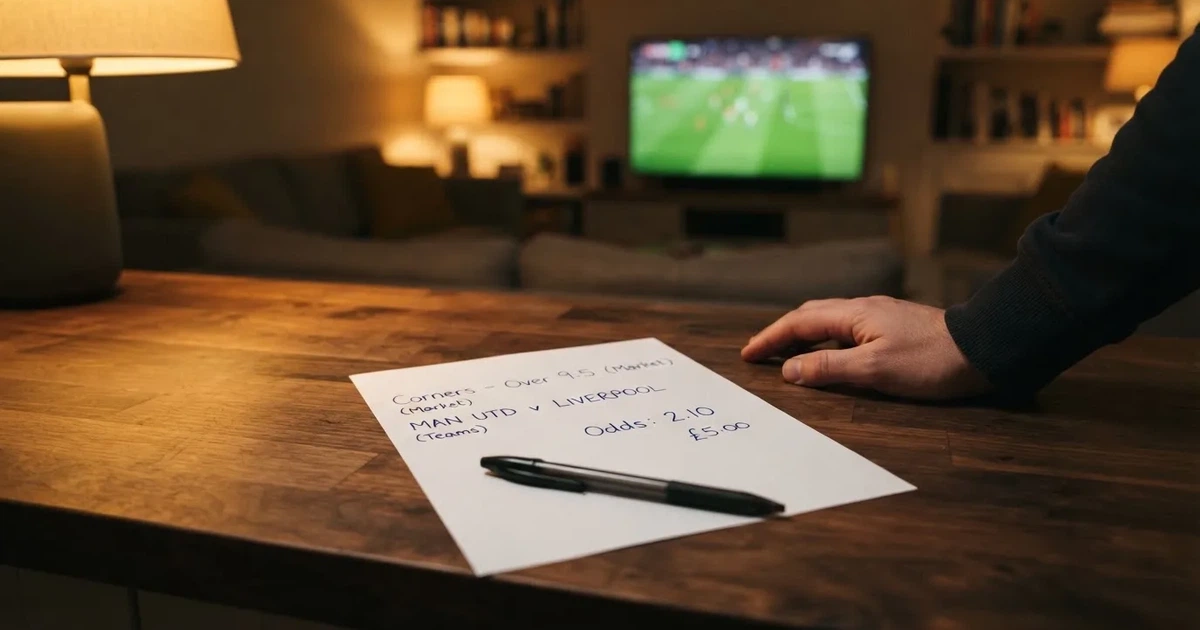
The current register of bookmakers licensed by the Gambling Commission for remote betting in Great Britain is the only list a corner punter needs to start from. Every brand reviewed below sits on that register; the licence numbers, the licence holders and the operators’ own terms on corner markets are in the comparison table further down. What follows is the substance: how a corner market is built, what the bookmaker’s margin actually costs, where in-play changes the picture, and which operator makes sense for which kind of bettor.
This page was checked against the Gambling Commission’s public register on 26 October 2026. Every brand below holds a current licence.
The UK’s ten strongest corner betting brands
The list below covers ten Gambling Commission-licensed bookmakers that price corner markets on football fixtures in Britain. The order is editorial — it reflects what each operator offers on the corner market specifically, not a global ranking — and the comparison table beneath the ranking sets the side-by-side facts that decide it.

Dabble
Dabble’s sportsbook sits on a Commission remote licence under Dabble Sports UK Ltd, with corner markets offered across the Premier League and the English Football League. The platform’s “Bet £10, Get £10 in Free Bets” welcome credits new customers only and runs a 7-day expiry on the free-bet portion, with the stake not returned on a winning free bet. The minimum odds requirement on the qualifying bet is a condition the punter reads before clicking, not after. For the corner punter, Dabble’s appeal is the social-feed format — punters follow tipsters and copy positions rather than build a slip from scratch — which suits a bettor who wants an opinion-led ride through the corner market rather than a traditional bookmaker interface.
The terms are tightly written and the corner markets are priced around matchday rather than 72 hours out. That suits an in-play corner bettor and frustrates an ante-post planner.

Coral
Coral, run by LC International Limited, has been a high-street name for decades and now runs a Commission-licensed remote bookmaker alongside its betting shops. The “Get £40 in Free Bets when you bet £20” welcome requires a sports bet of £20 or more at minimum odds of 2.0 (1/1), issues £40 in free bets within 7 days and expires them 7 days after issue. Coral’s football corner markets cover the match outright, the team total, the over/under line and the handicap, plus an in-play board updated by the second. The platform’s Bet Builder, where available, lets a punter fold a corner selection into a same-game multi with goalscorer, card and BTTS legs.
For the corner punter Coral is a sturdy all-rounder — markets priced early, in-play depth, and a free-bet welcome that converts at full price into another corner bet if the punter chooses. The catch is the 7-day expiry on both the issue and the use of the free bets, which a casual punter can miss.
10bet
10bet, run by Blue Star Planet Limited, runs a Commission remote licence that covers football, tennis and horse racing, and the app bundles Cash Out, Bet Builder and Live Streaming into the football product. Corner markets on 10bet include the match total, the team total and the race-to-X variant; the in-play board refreshes quickly and Cash Out is available on most pre-match corner bets. The welcome offer was not in the file at the snapshot date, so terms — minimum odds, expiry, stake return — need to be checked on 10bet’s own promotions page before a deposit.
10bet suits a corner punter who wants Cash Out on a position that has gone wrong, and the Bet Builder makes it a credible second-leg of a same-game multi. The thinner welcome offer is the trade-off.
Geoff Banks
Geoff Banks is a smaller, sharper shop. Published by GB Sports Advisors Limited under a Commission remote licence, the brand offers live in-play prices and ante-post prices on future events — a combination most high-street brands have stopped bothering with. Corner markets are priced around the English leagues, the Champions League and the internationals; ante-post corner markets on tournament totals exist for the major competitions. The welcome offer was unavailable in the file, so terms need a check on the operator’s own page.
For a corner punter who bets on tournament totals rather than individual matches — a World Cup, a European Championship, a season-long league — Geoff Banks is a credible shop. The bettor who only bets Saturday 3pm Premier League matches will find less depth than at Coral or Paddy Power.
Paddy Power
Paddy Power, run by PPB Counterparty Services Limited, is the loudest brand in the comparison. The app’s Bet Builder+ and Popular Bet Builders sit alongside Super Sub — a corner-adjacent mechanism where a bet rolls over to the replacement player if the selected name is substituted — and the platform offers expanded Win More markets plus player and acca stats. Corner markets are priced across the match outright, the over/under, the handicap, the race-to-X and the team total. The welcome offer was missing from the file, so the qualifying terms are read off Paddy Power’s own page.
For the corner punter the Super Sub feature is the differentiator. A bet on a player to score from a corner does not die when that player is hauled off at half-time; the bet moves to the substitute. Combined with Popular Bet Builders — Paddy Power’s curated same-game multi presets that include corner legs — the brand suits a bettor who builds same-game multis around corners rather than betting the corner market outright.
Bet Ahoy
Bet Ahoy, run by Bet Ahoy Ltd under a Commission remote licence, runs a “Bet £10 & Get £10 in Free Bets” welcome built from a £5 sports bet and a £5 acca. Corner markets are priced on the standard Premier League and English Football League slate, with the in-play board updating at a sensible tempo. The platform is a smaller, more focused shop than the big-three names, and the welcome is sized accordingly.
For a corner punter who likes to split a stake between a single corner bet and a small accumulator, the welcome’s split format is genuinely useful. The punter who wants deep market coverage across European leagues will find less here than at Paddy Power or Coral.
LiveScore Bet
LiveScore Bet, run by LiveScore Betting and Gaming (Gibraltar) Limited under a Commission remote licence, takes its name from the LiveScore scores-and-stats platform and prices corners as part of a tightly built Bet Builder that allows up to 10 selections across match result, both teams to score, corners, total goals, player scoring and card markets. Corner legs can sit inside a same-game multi alongside goals and cards — useful for a bettor who thinks a 0-0 grind with 12 corners is more likely than a 2-2 with 8.
LiveScore Bet suits a corner punter who treats corners as one leg of a larger thesis on a match rather than the whole bet. The welcome offer was not in the file at the snapshot date, so terms are checked on the operator’s own page.
BetTom
BetTom, run by Bet Tom Limited under a Commission remote licence, runs a sports welcome of 50% back as a free bet of up to £50, matched by 50% back as free slot funds of up to £50 for casino play. Corner markets are part of the football product alongside the standard match and goalscorer lines. The platform is a mid-sized shop — bigger than Bet Ahoy, smaller than Coral — and the welcome’s matched casino half will not interest a corner-only punter.
For a corner punter the sports half of the welcome is straightforward: bet, get half back as a free bet if it loses, plough the free bet into a corner selection. The matched casino half is opt-in rather than compulsory.
Betfred
Betfred, run by Petfre (Gibraltar) Limited under a Commission remote licence, is one of the British high-street’s larger names. The app offers Bet Builder, Sub Switch, Racing Post data, Extra Places, live casino and bingo. Corner markets on football are priced across the standard slate, with Bet Builder allowing corner legs inside a same-game multi. The welcome offer was not included in the file snapshot, so terms are read off Betfred’s own page.
For the corner punter the Sub Switch feature is the parallel to Paddy Power’s Super Sub — a bet on a player-driven market transfers to the substitute if the named player comes off. Betfred’s depth on English football is the selling point for a corner bettor, and the Bet Builder is the route into a corner-laden same-game multi.
DragonBet
DragonBet, run by DragonBet Ltd under a Commission remote licence, takes its lead from Welsh sport — Welsh football and Welsh rugby are priced alongside the standard racing and American football markets — and the app offers in-play betting and Bet Builder markets. Corner markets on the football product follow the standard match total, team total, handicap and race-to-X pattern; in-play updates are sensible.
For a corner punter DragonBet is a niche shop: the depth on Welsh football is genuine, the depth on the Premier League is shallower than at Coral or Paddy Power. The welcome offer was not documented in the file snapshot.
The corner bookmakers at a glance
The table below sets the brands side by side on three matters: the Gambling Commission remote licence number and the licence holder named on the public register, and what each operator’s own terms state on corner markets.
| Brand | Gambling Commission licence and holder | What the operator’s own terms state on corner markets |
|---|---|---|
| Dabble | Remote licence under Dabble Sports UK Ltd | Corner markets on Premier League and English Football League; 7-day free-bet expiry; stake not returned on winning free bet; minimum odds on the qualifying bet apply |
| Coral | Remote licence under LC International Limited | Match, team, handicap, race-to-X and over/under corner markets; in-play board; Bet Builder accepts corner legs; £40 in free bets within 7 days, expires 7 days after issue; minimum odds 2.0 (1/1) |
| 10bet | Remote licence under Blue Star Planet Limited | Corner markets on the football slate; Cash Out, Bet Builder and Live Streaming bundled into the football product; welcome terms — check on the operator’s page |
| Geoff Banks | Remote licence under GB Sports Advisors Limited | Live in-play corner prices plus ante-post corner markets on tournament totals; welcome terms — check on the operator’s page |
| Paddy Power | Remote licence under PPB Counterparty Services Limited | Match, team, handicap, race-to-X and over/under corner markets; Bet Builder+, Popular Bet Builders, Super Sub and Win More markets; welcome terms — check on the operator’s page |
| Bet Ahoy | Remote licence under Bet Ahoy Ltd | Standard Premier League and English Football League corner markets; in-play board; welcome split into a £5 sports bet and a £5 acca |
| LiveScore Bet | Remote licence under LiveScore Betting and Gaming (Gibraltar) Limited | Bet Builder accepts up to 10 selections across corners, goals, cards, BTTS and player scoring; welcome terms — check on the operator’s page |
| BetTom | Remote licence under Bet Tom Limited | Corner markets on the football product; welcome is 50% back as a free bet up to £50, matched by 50% back as free slot funds up to £50 |
| Betfred | Remote licence under Petfre (Gibraltar) Limited | Bet Builder, Sub Switch, Racing Post data, Extra Places and corner markets on the football slate; welcome terms — check on the operator’s page |
| DragonBet | Remote licence under DragonBet Ltd | Welsh football and rugby focus; standard Premier League corner markets; in-play board and Bet Builder; welcome terms — check on the operator’s page |
The pattern the table shows: every brand on the reviewed books holds a current Commission licence, every brand prices a corner market of some shape, and the difference between them is the welcome offer, the in-play depth and the same-game-multi features. A bettor who only wants a corner market will be served well by any of them; the choice is the welcome and the feature set.
What a corner bet actually is
A corner kick is awarded when the ball wholly crosses the goal line outside the goal frame, having last touched a defending player — the touch does not have to be deliberate. It is taken from the corner of the field nearer to the point where the ball crossed the goal line, with the ball stationary within a quarter circle of one yard (about one metre) drawn at the corner flag. Opposing players must stay at least 10 yards (9.15 metres) from the ball until the kick is in play, and an attacker who receives the ball directly from a corner cannot be penalised for offside. Scoring directly from a corner — the so-called Olimpico goal — is allowed and was legalised by the International Football Association Board on 14 June 1924. Scoring an own goal directly from a corner is not.
That is the event the bookmaker is pricing. The corner is one of the simplest set-pieces in football to count, which is why a corner market is one of the cleanest markets on the book: every corner is awarded, every award is shown on the broadcast, and every bookmaker settles to the same number. The shape of the market — over a total, a team total, a handicap, a race-to-X, a match outright — varies by operator, and the depth varies by fixture. For a Premier League Saturday 3pm kick-off, every brand on the reviewed books prices a match corner total, a team total, a handicap, a race-to-X and an in-play market. For a midweek Championship fixture, the depth shrinks to the match total and the in-play board.
The first corner is the simplest market of all: which side wins the first corner of the match. It is settled on the first corner awarded, not the first corner taken — a deflection that sends the ball back across the line for a fresh corner counts as the first. The over/under line on the total is set by the bookmaker, and the punter backs over or under a number — over 10.5 corners, under 10.5 corners. Half-point lines (10.5) are the standard; integer lines (10) are offered less often and mean a stake is returned on the exact number.
The corner match bet is a simpler two-way market: which side wins more corners. Draws are typically returned as a stake, or carried as a third outcome (the “3-way corner”) depending on the operator.
How the rule book treats corner betting
Great Britain regulates gambling under the Gambling Act 2005. The Gambling Commission, a non-departmental public body sponsored by the Department for Culture, Media and Sport, licenses the whole commercial market. There is no state monopoly and no statutory cap on the number of licences. A bookmaker whose remote facilities are used in Great Britain needs a Commission licence wherever it is based — that requirement dates from the Gambling (Licensing and Advertising) Act 2014 — and a Curaçao, Maltese or Gibraltar licence is not a substitute for serving British customers.
There is also no statutory list of permitted bets or markets. An operator holds a licence for a category — remote general betting standard (real events) is the one every brand on the reviewed books holds — and offers markets under its own rules and the Commission’s Licence Conditions and Codes of Practice. Corner markets are not named in statute; they are a market the operator chooses to price, and the operator chooses how to settle them. That is the legal shape of a corner bet: not a regulated product, a market offered under a regulated licence.
The identity check before the first deposit is the part that surprises new customers. Since 5 May 2019 a bookmaker serving British customers has to verify the customer’s name, address and date of birth before they can deposit or gamble, including with a free bet or bonus. The check covers the free-bet welcome offers above — the £10 free bet on Dabble’s welcome, the £40 free bets on Coral’s, the £10 free bet on Bet Ahoy’s. Anonymous play at a licensed British bookmaker no longer exists.
The minimum age is 18. The Commission’s public register is searchable by business name, trading name, domain or account number, and it is the whole test of whether a brand holds a licence. Every brand reviewed above sits on that register. The register is also where a bettor checks the licence number quoted on the operator’s own page — if the number does not appear, the brand does not hold a Commission licence, and the protections that come with one are not in force.
The financial-conduct picture has shifted in the last two years. A financial vulnerability check under Licence Condition 3.4.4, in force since 30 August 2024, applies to licensed remote betting when a customer’s deposits minus withdrawals exceed £150 in a rolling 30 days (since 28 February 2025). It is a public-record check — looking for bankruptcies, county court judgments and the like — not an income check and not a credit reference check. Financial risk assessments, the affordability checks that have been in the press for years, are announced in a staged plan published by the Commission on 7 July 2026, with no start date. Deposit limits are partly in force: operators must offer a gross deposit limit on a fixed time frame, and the first changes have applied since 31 October 2025, with a second phase postponed to 30 September 2026. There is no state-set ceiling on what a customer may deposit or lose: the limits are the customer’s own choice.
How the bonus rules affect a corner punter
Since 19 January 2026 the Commission’s promotion rules cap wagering requirements on bonuses at 10x. A £10 bonus with a 50x requirement meant £500 of qualifying bets before withdrawal; under the cap, no bonus requires more than £100 of qualifying bets. Mixed-product promotions — an offer that requires gambling on two or more product types such as betting, casino, bingo and lottery, “bet on football to get free spins” being the classic shape — are banned.
The cap covers bonuses, not free bets with no wagering condition, and the file does not establish a cap on the money value of a bonus. The corner punter reads the small print on the wagering requirement and the minimum odds on the qualifying bet: the figures vary by operator and the audit elsewhere on the page sets them where the source carries them.
“Risk-free” and “free” are marketing words. A free bet is a free bet: the stake is usually not returned with a winning free bet, so a £10 free bet at 3.0 returns £30 — £20 of profit, not £30. A “risk-free” bet refunded as a free bet is not a refund in money; it is a free bet on the same terms. A welcome offer that credits a free bet rather than cash keeps the punter inside the wagering requirement and the minimum-odds gate.
Where the protection sits — and where it does not
GAMSTOP is the national multi-operator online self-exclusion scheme, and it is a mandatory licence condition for online operators in Great Britain since 31 March 2020. The exclusion periods are six months, one year, five years, or five years with auto-renewal, and after the minimum period the exclusion stays in place for a further seven years unless the customer asks GAMSTOP to remove it. GAMSTOP covers online sites and apps; betting shops use a separate self-exclusion service. Every brand on the reviewed books is a GAMSTOP member.
Help for a corner punter who feels the betting has gone past fun is free. GamCare runs the National Gambling Helpline; GambleAware funds treatment and education; the NHS runs gambling clinics; Gamblers Anonymous runs peer-support meetings. The corner market is the same market whichever way it is played, and a punter who has self-excluded via GAMSTOP cannot place a corner bet at any of the brands on the reviewed books.
The credit-card ban is the other piece of customer protection worth knowing. Since 14 April 2020 (Licence Condition 6.1.2) gambling with a credit card has been banned in Great Britain, including credit-card-funded payments through an e-wallet. Debit cards and bank-based payments are not covered by the ban. The corner punter pays with a debit card or a bank transfer; an attempt to deposit with a credit card will be declined.
There is no state-set maximum stake or maximum loss on a corner bet. Operators set their own maximum stakes and may restrict a customer — a bookmaker’s right to limit or close an account is part of its terms of business and is enforceable in Britain under the operator’s own contract.
In-play corner betting and cash out
In-play corner betting is the live market: the corner total updates as the match progresses, the race-to-X board resets after each award, and the over/under line moves with the count. A punter who watches the match — the way the broadcast shows every corner awarded, the way a side under pressure concedes a string of corners in the last 20 minutes — has information the pre-match price did not. The bookmaker has the same information, and the in-play price adjusts within seconds. The corner count is one of the cleanest in-play markets to settle because every award is shown on the broadcast; the delay between award and price update is what costs the punter, and that delay varies by operator.
Cash Out on a corner bet is the same mechanism as on any other football market: the bookmaker offers to settle the bet early at a price the operator sets. A punter who has taken over 10.5 corners at 1.85 before kick-off and the count is 8-2 at 70 minutes can lock in a profit by taking the Cash Out offer; a punter whose bet is losing at 3-9 with 20 minutes left can cut the loss. The Cash Out price is set by the operator and is rarely the true price at the underlying market — that is the trade-off. The punter who wants the true price uses a betting exchange; the punter who wants the convenience takes the Cash Out.
LiveScore Bet’s Bet Builder accepts up to 10 selections and lets a punter fold a corner leg into a same-game multi alongside goals, cards, BTTS and player scoring — useful for a punter who wants a position on the whole shape of a match rather than the corner count alone. Coral and 10bet bundle Bet Builder, Live Streaming and Cash Out into their football products, and Paddy Power’s Bet Builder+ and Popular Bet Builders are the curated version of the same idea.
The in-play strategy question is whether the live information is worth more than the live price adjustment. A punter watching a side under pressure concede three in five minutes can react before the next set-piece, and a bet at 1.50 on the next corner is a real price. The other side of the trade is that the bookmaker’s algorithm has already priced in the pressure, and the price a punter sees is the price after the algorithm has adjusted.
What a corner punter can actually know about a match
There is no formula for picking a corner total. A side that plays long balls and crosses from wide wins more corners than a side that plays through the middle; a side under pressure for the last 20 minutes concedes more than it wins; a referee who gives soft free-kicks produces more corners than a referee who plays a tight whistle; a match played in wind and rain produces more deflections and more corners than one played in calm conditions.
The strategy is to combine those factors with the team-level data: a side’s average corners won and conceded at home and away, the opposition’s average corners won and conceded, the league’s average corner count per match. A punter who builds a model from those inputs and tests it against closing prices has an edge over a punter who backs “over 10.5” because the broadcaster said the side had 14 corners last week. The model is a process, not a tip; the tip is the output of the model on a specific match.
The accumulator question is the same as on any other market. A four-fold corner accumulator at 4.0, 3.5, 5.0 and 4.5 multiplies to 252.0 — a tempting price. The combined probability of four correct selections is the product of the four individual probabilities, and the margin compounds across the four markets. A corner accumulator is a punt, not an investment; a corner punter who bets singles on the matches the model rates as the best prices will make more over a season than the same punter betting four-folds on matches the model likes less.
The forecast question — who wins the next corner — is unanswerable in advance. A corner is a function of the last touch before the ball crosses the line, which is a function of the previous pass, which is a function of the shape of the play. The first corner of the match is closer to a coin flip than a match result, and the price on it reflects that: both sides priced around 1.85, with the bookmaker’s margin sitting inside both.
Corner markets across the football season
The Premier League is the deepest corner market in Britain. Every brand on the reviewed books prices a match total, a team total, a handicap, a race-to-X and an in-play board for a Saturday 3pm kick-off, and the major fixtures (the Manchester clubs, the Merseyside clubs, Arsenal, Tottenham, Chelsea) carry extra markets — most corners in a half, exact corner count, corners in the first 10 minutes. The English Football League Championship, League One and League Two are priced at the top of the reviewed books but at narrower depth.
The European competitions — the Champions League, the Europa League, the Conference League — are priced on football matches with the major markets across the top European leagues. The corner count on a Champions League knockout tie is typically higher than on a Premier League fixture; the margins the bookmaker charges are typically tighter because the liquidity is higher. The international tournaments — the World Cup, the European Championship, the Copa América — are priced heavily around the knockout rounds, and the early rounds of a tournament (the group games) are the best fixtures to back if the model rates a side high on corner count.
The Welsh football and Welsh rugby markets on DragonBet are a niche: priced because the operator is British and the market is underserved, with smaller liquidity and wider bookmaker margins. A punter whose model covers Welsh football will find value there that the major brands do not price.
The non-football corner market is small. The MMA corner market — the corner of the cage, not the corner of the football field — is a separate product and is not priced on the brands reviewed here.
The mechanics of placing a corner bet
A corner bet works the same way as any other football single: the punter selects the market, the selection and the stake; the bet is placed at the price shown on the slip at the moment the bet is confirmed. The price is a decimal price (1.85, 3.50, 6.00) or a fractional price (4/5, 5/2, 11/4) — every bookmaker on the reviewed books shows both. The stake returns the profit plus the stake at decimal odds: a £10 bet at 3.50 returns £35 — £25 profit plus the £10 stake. The same bet at fractional odds of 5/2 returns the same £35.
The return on a winning bet is stake × odds. The net profit on a winning bet is stake × (odds − 1). A combination bet multiplies the odds of the legs into a single price: a four-fold at 2.0, 3.0, 4.0 and 5.0 carries combined odds of 120.0, and a £10 stake returns £1,200.
The settlement is the count of corners at full time, plus any stoppage-time corners the operator counts in its settlement rules. A corner awarded in the 90th minute and taken in the 93rd counts as a corner for the match total; a corner awarded after the final whistle does not. Each operator publishes its settlement rules on its own help pages, and the corner punter reads them once.
What the bookmaker’s margin actually looks like
Every price carries the bookmaker’s margin. On a two-way market with decimal odds of 1.90 and 1.90, the payout share — the share of every unit staked that the bookmaker returns to winning bettors on average — is 1 ÷ (1/1.90 + 1/1.90), which works out at about 0.526. The margin — the share of every unit staked that the bookmaker keeps on average — is 1 − 0.526, which is about 47.4%. That is a high margin by football-market standards, and a corner market at 1.90 on both sides is a poor price for the punter.
The reason: a two-way corner market at exactly even money is a bookmaker’s dream — the punter backs both sides at the same price and the bookmaker keeps nearly half the pool. The realistic corner market at evens the two sides around 1.85 and 1.95, with the payout share working out at around 0.97 and the margin around 3%. That is a tighter market and a fairer price, and the corner punter’s job is to back into the prices the bookmaker prices tightest.
The margin sits inside every price. A corner punter who backs three singles at 1.85, 1.85 and 1.85 — a model that rated each as a 50% chance — sees the combined margin compound across the three bets. The punter who backs a four-fold at combined odds of 120.0 — a model that rated each leg as a 60% chance — sees the margin compound across all four. The accumulator pays more because the margin has been loaded onto the price; the punter who backs singles at higher prices with the same model makes more over a season than the punter who backs the four-fold.
The condition on the margin number above is important: it is the margin on an illustrative two-way market at evens, used to show what the bookmaker’s edge looks like. A corner match bet priced at 1.85 / 1.95 carries a margin of around 3%; an over/under 10.5 corners line at 1.90 / 1.90 carries a margin of around 5%; a race-to-3 corners line at 2.5 / 2.5 carries a margin of around 20%. The market the bookmaker is most confident about is the market with the tightest margin, and the corner punter backs into those.
The settled picture
A corner bet is one of the cleanest football markets to settle. The count is recorded by every broadcaster and every official stats provider, and every bookmaker settles to the same number. The dispute risk on a corner bet is the same dispute risk as on any other football market: a corner awarded after the final whistle, a corner taken after a substitution, a corner awarded for a save that bounced off the post and the defender. The operator’s settlement rules cover those cases and the punter reads them once.
The identity check, the GAMSTOP coverage and the Commission licence are the three pieces of the picture that matter for the punter. The first means no anonymous play. The second means the self-exclusion works across every brand on the reviewed books. The third means the dispute-resolution route goes through the Commission or an approved alternative-dispute-resolution body. A corner punter who bets at a brand on the reviewed books has all three; a corner punter who bets at an unlicensed brand has none, and the loss of protection is the cost of the unlicensed price.
The market itself is sound. The bookmaker’s margin sits inside every price, and the corner punter’s job is to back into the markets where the margin is tightest and the model is sharpest. The brands above are ten credible shops to do that in; the choice between them is the welcome offer, the in-play depth and the same-game-multi feature set.
Frequently asked questions
How do I bet on corners?
Pick a corner market on the operator’s football coupon — match total, team total, handicap, race-to-X, first corner, or in-play — select the price, set the stake, confirm. The bet settles on the operator’s published settlement rules at full time.
How do I bet on Asian corners?
Asian corner lines work the same way as Asian handicap lines: a half-point line (over 10.5) is the standard, an integer line (over 10) returns the stake on the exact number. Some operators offer quarter-point lines (over 10.25) that split the stake between the two nearest half-point lines.
What is a corner match bet?
A two-way market on which side wins more corners. Draws are typically returned as a stake, or carried as a third outcome depending on the operator. The “3-way corner” is the version that includes the draw as a price.
How can I check a bookmaker holds a Gambling Commission licence?
Search the Commission’s public register by business name, trading name, domain or account number. The licence number on the operator’s own page should appear on the register; if it does not, the brand does not hold a Commission licence.
How is the return on a bet worked out from the stake and the odds?
Return = stake × odds. Net profit on a winning bet = stake × (odds − 1). At decimal odds of 3.50 a £10 stake returns £35, of which £25 is the profit and £10 is the stake returned.
What is the bookmaker’s margin and how can it be seen in the odds?
The margin is the share of every unit staked the bookmaker keeps on average. It is the gap between the true probability of all outcomes (100%) and the bookmaker’s implied probability across the prices. On a two-way market at 1.90 and 1.90 the margin is about 47.4%; on the same market at 1.85 and 1.95 the margin is around 3%.
Bet types & in-play – AI Betting
Content created by the «AI Betting» team
