
Field hockey betting tips: how a prediction is built, and what it costs the punter
 Available in US
*A guide, not a tip sheet. Last updated on 26 October 2026. Licence claims cross-checked against the Gambling Commission’s public register.*
Field hockey is a small market on most British sportsbooks. The Premier League, the FIH Pro League and the Olympics dominate the calendar, club leagues in the Netherlands, Germany, India and Australia fill the gaps, and everything else lives behind an “Outrights” tab. That thinness shapes how a tip is built: fewer televised games, fewer live stat feeds, fewer model-driven price feeds than football gets, and a bookmaker margin that is often wider than for headline sports. A punter who treats field hockey tips like football accumulators is paying a tax no one names, and this guide is built around what changes when the sport on the slip is not the sport on the adverts.

The ten licensed bookmakers compared for field hockey in 2026
Field hockey lives or dies on whether your bookie lists its field. The first job is the comparison: which brands actually price the FIH Pro League, the Premier League, the EuroHockey events and the Olympics; which ones settle a winning corner-count bet on time; which ones run live lines and which ones cash out before the whistle goes for a shoot-out. The ten brands below are the ones holding a Gambling Commission remote licence on the public register, and the only filter applied before the licence check was whether the brand shows a field hockey market at all.
Comparison at a glance
| Brand | Gambling Commission licence number and holder | What the operator’s terms say on field hockey |
|---|---|---|
| BetGoodwin | 002927-R-327985-008 (account 2927), Goodwin Racing Limited | Field hockey appears as part of a broader racing-led sportsbook; promotions centre on Best Odds Guaranteed for horse and greyhound racing rather than on niche team sports. |
| Sky Bet | 067370-R-341330-005 (account 67370), SBG Sports Limited | Field hockey sits inside a deep in-play product; new-customer offer is £30 in free bets credited as three £10 tokens after a £5+ deposit and a first single or each-way bet of 5p at 1/1 or greater. |
| 10bet | 043173-R-322899-023 (account 43173), Blue Star Planet Limited | Field hockey appears alongside football, tennis and horse racing; the sportsbook runs Cash out, Bet Builder and Live Streaming as standard features. |
| bet365 | 055148-R-331498-002 (account 55148), Hillside (UK Sports) ENC | Field hockey is in-play priced and live-streamed; the same app carries Bet Track, Match Live and a Live Golf Tracker for following open bets. |
| Copybet | 053774-R-330743-010 (account 53774), Copybet UK Limited | Field hockey markets appear; horse racing carries the headline product with Best Odds Guaranteed all day and first-past-the-post payouts. |
| BoyleSports | 039469-R-319383-025 (account 39469), Boylesports Enterprise | Field hockey appears; the sportsbook runs Acca Insurance for accumulator punters, opt-in, min stake £5, min odds 1/2, max refund £20 as a free bet expiring in 7 days. |
| Betmaster | 065699-R-339929-002 (account 65699), BM Solutions GB Ltd | Field hockey sits inside a sportsbook; the brand’s own pages emphasise responsible gambling and UK licensing over a niche team-sports promise. |
| VBet | 044662-R-324273-022 (account 44662), SCGO Limited | Field hockey is priced with Bet Builder and pre-match and in-play markets; the app carries a live streaming calendar and result stats. |
| BetVictor | 039576-R-319370-028 (account 39576), BV Gaming Limited | Field hockey appears alongside a racing-led product; Smart Stats and BetFinder support pre-match research; Best Odds Guaranteed runs on UK and Irish racing. |
| Spreadex | 008835-R-104580-022 (account 8835), Spreadex Limited | Field hockey appears across fixed odds and spread betting; new customers receive £60 in free bets for a £10 fixed-odds qualifying bet placed within 28 days of account opening. |
The licence numbers and holders are taken from the Gambling Commission’s public register. The right-hand column reads only what each operator’s own terms state; it is the picture those terms paint, not a promise about how any one match will be priced. Where a brand’s strongest product is horse racing or football, a punter should not assume the field hockey tab is staffed to the same depth.
What the spread above actually tells a punter
The ten brands form three rough groups on field hockey. bet365, Sky Bet and VBet price the FIH Pro League and major tournaments with in-play markets and a live tracker; that is where the volume of price points sits, and it is also where Cash out is most likely to function on a tied game going to extra time. BoyleSports, 10bet, BetVictor and Copybet carry field hockey as part of a wider book; their prices are sound but the in-play depth is thinner, and a corner-count bet on a Monday EuroHockey club match may not appear at all. BetGoodwin, Betmaster and Spreadex price field hockey inside a primarily racing-oriented or specialist product; the lines exist but the volume is low, and Spreadex’s spread-betting side sits under a separate FCA register for financial spread betting while the fixed-odds side sits under the Gambling Commission.
The headline-price comparison a punter runs on football does not transfer. Field hockey markets are not deep enough for a price to harden into a “best odds” race between brands the way Premier League match winner prices do. The relevant test is whether the brand you choose actually prices the match you want, and whether it prices it in time.
What a “field hockey tip” actually means
A tip is a forecast: someone has weighed form, line-ups, head-to-head records, recent goals scored and conceded, the venue, the surface, and the bookmaker’s own prices, and has reached a view that one outcome is more likely than the price implies. That last clause is the one that turns a guess into a tip. A guess says “I think Holland win”; a tip says “Holland at 2.20 is a price above the true probability once the margin is taken out, so the bet is worth the stake”.

The building blocks
Form over the last five or six matches is the floor of the analysis. Field hockey is a low-scoring sport, and a team that has scored first and held a lead is doing something more reliable than a team that has been drawing. Goals scored and conceded per match, weighted by opposition strength, give a cleaner read than raw goal difference; an India team beating Malaysia 6-0 and losing to Australia 0-3 is not the same team as one that drew 1-1 with Belgium and lost 1-0 to Germany. Head-to-head records carry some weight at international level: the Netherlands and Argentina have met so many times that a recent result tells you something about tactical match-ups, but a club head-to-head in the Dutch Premier League is more about who is fit this week than who won last season.
Line-ups matter more in field hockey than they do in many team sports. A penalty corner specialist is worth a goal every two or three matches; a team without its drag-flicker is a different scoring threat, and a tip built on corners conceded is suddenly wrong. Suspension lists and injury reports are not always published, and the punter who checks the team sheets the morning of competition starts a step ahead of the punter who does not.
The venue carries weight in field hockey more than in many sports. Astro-turf versus grass changes how the ball bounces; an indoor tournament is a different sport from an outdoor one; altitude at events like the Sultan Azlan Shah Cup changes the pace of the game. The surface a team trains on matters: India and the Netherlands are astro-turf nations, and an Australian team that has trained on grass for two weeks plays a different match.
The bookmaker’s own price is the final input. A tip is not just “I think Holland win”; it is “I think Holland win at odds that beat the true probability once margin is stripped out”. A price of 1.50 on a strong favourite is rarely a tip because the margin eats most of the edge. A price of 3.00 on a credible outsider is more often the price a tip is built on.
Why no tip is ever certain. Margin.
The bookmaker’s margin is the commission baked into every price. On a two-way market priced at 1.90 and 1.90, the implied probabilities sum to 105.3% (1 ÷ 1.90 + 1 ÷ 1.90 = 1.0526), which means the bookmaker keeps 5.3% of every pound bet on the market and returns 94.7% in payouts to winners over time. A two-way market priced at 1.85 and 1.85 carries a margin of about 8.1%; one priced at 2.00 and 2.00 carries 0% (a price neither side will ever see on a real sportsbook). The margin is the difference between “this is what the bet pays” and “this is what the bet is worth”, and every tip on a real sportsbook has to clear it before the punter is ahead.
Using the illustrative two-way market priced at 1.90 / 1.90 (fractional 9/10): the payout share for the market is 1 ÷ (1/1.90 + 1/1.90) = 0.9497, so a winning £10 bet returns £18.97 in total (stake £10 plus profit £8.97), and the margin is about 5.0% (one minus 0.9497, expressed as a percentage). On a real field hockey match the margin on the match winner market typically runs higher than 5%, often in the 6-8% band on lower-tournament games and tighter on FIH Pro League fixtures where the book has more pricing data. Three-way markets (home win, draw, away win) carry a wider margin still, because three prices have to sum to more than 100%.
The arithmetic is the same on every market and every sport, but the margin it produces is not. Field hockey is not priced to football standards; the punter who treats a 1.85 shot on field hockey the same way they treat a 1.85 shot on the Premier League is paying a margin they did not budget for.
What “value” means in practice
A value bet is a price that exceeds the true probability of the outcome by more than the margin built into the market. The test is mechanical: estimate the true probability (call it p), check that the decimal odds (o) satisfy o × p > 1, and the bet clears margin. A 2.50 shot on a team whose true probability is 45% (2.50 × 0.45 = 1.125) is a value bet; a 2.50 shot on a team whose true probability is 35% (2.50 × 0.35 = 0.875) is not. The punter does not need to know the true probability to within one percentage point; they need to know whether their estimate is materially different from the price the market is offering.
The word “materially” is the load-bearing one. The difference between 45% and 43% is not material; the difference between 45% and 35% is. A tip built on a strong read is a value bet at one price and not at another. If the price moves against you after you publish the tip, the tip stops being a tip, and chasing it down the board is the fastest way to convert value into margin.
The legal frame for a GB punter
A British punter betting with a licensed brand sits inside a framework that is unusual in Europe: every commercial operator needs a Gambling Commission licence at the point of consumption, the licence is mandatory since the Gambling (Licensing and Advertising) Act 2014, and a Curaçao, Maltese or Gibraltar licence is not a substitute. The framework covers England, Scotland and Wales. Northern Ireland runs on its own older law, so a “Great Britain licence” or “GB-licensed” is the correct wording.
The Gambling Commission licenses the activity under the Gambling Act 2005. Five licence categories cover the remote market: remote general betting standard (real events), remote general betting standard (virtual events), remote general betting limited, remote pool betting and remote betting intermediary (the betting exchange licence). All ten brands in the comparison above hold a remote general betting standard (real events) licence. The Commission’s public register is searchable by business name, trading name, domain or account number, and it is the whole test of whether a brand holds a licence. A punter who wants to check should not rely on a brand’s own homepage; the homepage is marketing copy, and the register is the record.
Minimum age is 18. Name, address and date of birth are verified before a customer can deposit or gamble, in force since 7 May 2019, and the rule applies whether the bet is paid for in cash or with a free bet or bonus. No anonymous play exists at a licensed site. Credit cards have been banned for gambling in Great Britain since 14 April 2020, including credit-card-funded e-wallet top-ups; debit cards and bank-based payments are not covered by that ban. There is no statutory cap on stakes in sports betting; operators set their own maximum stakes and may restrict customers.
What may be bet on
No statutory list of permitted bets or markets exists in Great Britain. An operator holds a licence for a category and offers markets under its own rules and the Licence Conditions and Codes of Practice. In-play betting is offered by GB bookmakers and the controls are the operator’s licence conditions and customer-protection duties; no rule allows an operator to suspend a market, but every operator’s terms reserve the right to do so. Esports are treated like any other event; virtual events are a separate licence category. Bets on politics, TV shows and novelty markets appear on GB books; no statutory prohibition was found.
Betting exchanges run under a betting intermediary licence, and rates and rules specific to exchanges are stated from each exchange’s terms. Spread betting on non-financial events sits inside General Betting Duty; financial spread betting is regulated by the Financial Conduct Authority, not the Commission, which is why Spreadex’s spread-betting losses can exceed deposits while its fixed-odds side cannot.
What the protection buys a punter
A GB licence buys four concrete protections: GAMSTOP membership, dispute resolution through an approved body, the 10x bonus wagering cap in force since 19 January 2026, and the financial vulnerability check triggered when deposits minus withdrawals exceed £150 in a rolling 30 days. It also buys one practical loss: identity verification before the first deposit. A punter who values anonymity has no GB-licensed option; a punter who values the protection has no anonymous option.
The punter pays no tax on betting winnings in Great Britain (general information, not tax advice). General Betting Duty is the operator’s tax on gross profits, currently 15%, with a remote betting rate of 25% coming in on 1 April 2027 alongside it; whether operators pass the new rate through to odds is not established. Spread betting carries separate rates (3% financial, 10% other). The Commission’s statutory levy is a separate charge on operators and not a player tax.
The licensed-versus-unlicensed line is the sharpest one in the frame. An unlicensed brand offers no GAMSTOP coverage, no Commission complaints route, no approved dispute-resolution body, no British consumer redress if funds are withheld, and is not bound by the 10x bonus cap or the £150 vulnerability check. Honest framing: licensed = checks, limits, GAMSTOP, the bonus cap, and the verification step; unlicensed = none of those protections and the chance of losing what you deposit. Neither is “the safe choice” by default.
Safer gambling tools a licensed bookmaker has to offer
A GB-licensed bookmaker is required to offer safer-gambling tools as a condition of its licence, and the strongest of them is GAMSTOP. GAMSTOP is the national multi-operator online self-exclusion scheme and is mandatory for online operators since 31 March 2020. Self-exclusion periods run six months, one year, five years, or five years with auto-renewal; after the minimum period the exclusion stays in place for a further seven years unless the customer asks GAMSTOP to remove it. GAMSTOP covers online sites and apps; betting shops use a separate offline scheme.
Deposit limits are required under the Commission’s Remote Technical Standards, and the implementation has been staged: a first phase applied from 31 October 2025, a second phase was postponed to 30 September 2026, and whether that second phase is currently live is not established. There is no state-set deposit or loss ceiling; limits are the customer’s choice, and a punter who wants a hard ceiling sets it themselves. Other tools operators must offer include product restrictions (excluding specific bet types), time-out periods (24 hours to six weeks), reality checks (pop-up reminders during play) and self-exclusion outside GAMSTOP.
A financial vulnerability check applies to licensed remote betting when a customer’s deposits minus withdrawals exceed £150 in a rolling 30 days, in force since 28 February 2025. It is a public-record check (bankruptcy, county court judgments, similar), not an income check and not a credit reference check. Financial risk assessments — the “affordability checks” of the press — are announced as a staged plan with no start date as of 7 July 2026; the punter should write “announced, staged, no start date” rather than “in force”.
Help is outside the operator. GamCare runs the National Gambling Helpline; GambleAware funds treatment and education; the NHS runs gambling clinics; Gamblers Anonymous runs peer-support meetings. A licensed brand’s safer-gambling pages link to these bodies as a matter of licence condition. The presence of the links is a small indicator; the use of them is what matters.
Bonuses and free bets: how a field hockey offer actually works
A bonus is a marketing inducement with conditions attached, and the conditions are the offer. A “£30 in free bets” headline means three £10 tokens credited after the qualifying bet settles; the token is a free bet whose stake is not paid back with a win, and the headline amount is what the punter can stake, not what they will receive. A “100% deposit bonus” headline means the operator matches the deposit up to a cap and attaches a wagering requirement before any of the bonus or the winnings can be withdrawn.
The promotion rules in force since 19 January 2026 cap wagering requirements on bonuses at 10x. A £10 bonus with a 50x wagering requirement needed £500 of qualifying bets before withdrawal; under the cap, no more than £100 of turnover is needed to clear the same £10 bonus. The cap is on bonuses, not on free bets, and whether a free bet with no wagering condition falls under it is not established. Mixed-product promotions, where one offer forces the punter to gamble on two or more product types (for example, “bet on football to get free spins”), are banned under the same rule. A bookmaker offering £10 free bets for betting on field hockey is offering a single-product promotion and stays inside the frame.
Acca insurance, where the bookmaker refunds a losing accumulator as a free bet if one leg lets it down, is the closest thing to a field hockey-specific offer some brands run, because accumulators on the FIH Pro League are how small-stake punters build a slip. BoyleSports’ acca insurance is opt-in, requires a minimum stake of £5 and minimum odds of 1/2, pays a maximum refund of £20 as a free bet that expires in 7 days, and bets must be placed and settled on the same day. Other brands run similar products with different caps and timescales; the punter’s job is to read the specific terms before claiming, because the headline price is the smallest part of the offer.
Best Odds Guaranteed is a horse and greyhound racing product, not a field hockey product, but it sits on most British sportsbooks and it changes how a punter who mixes racing and team-sport bets reads the small print. BetGoodwin, Copybet and BetVictor all run BOG on UK and Irish racing; BetVictor adds enhanced live race streaming and a BetFinder feature for finding racing bets, alongside Smart Stats for pre-match research. None of that flows into field hockey prices.
The headline price of a bonus is the smallest part of the offer. The wagering requirement, the minimum odds for qualifying bets, the deadline for using the free bet, the cap on free-bet winnings and the market restrictions are the offer. A punter who skips them is paying for a headline they will not collect.
Worked example: how a £10 free bet pays out
A £10 free bet on a field hockey match winner at decimal odds 3.50 pays £25 in profit if the bet wins (stake × (odds − 1) = £10 × 2.50 = £25), and the £10 stake is not returned. The same bet paid for in cash returns £35 (£10 stake plus £25 profit). The free bet is worth £25 in profit, not £35, and the punter is paying a £10 “fee” in the form of the unreturned stake for the chance to bet with the operator’s money. The £25 figure is the gross winnings; a margin of, say, 6% on the market reduces the average payout over many bets to about £23.50, and the free bet’s expected value sits below £25 because some bets lose.
The expected-value calculation is the test every bonus has to pass. If the offer’s expected value is below zero once the conditions are factored in, the bonus costs the punter money, and the marketing word “free” punctures on the arithmetic.
Live betting and cash out on field hockey
Field hockey is a four-period sport (since 2017: four 15-minute periods, 60 minutes of play, with a 2-minute break after periods and a 15-minute half-time), and the structure matters for live betting. A 0-0 game at half-time is not the same situation as a 0-0 game at the end of the third period; momentum builds differently in field hockey than in football because there is no injury-time distortion and the breaks are short. Live markets on the bigger books track corners, penalty corners, shots on target and the next goal; smaller books run fewer in-play markets or none at all.
A bet builder (or feature) is the same-game accumulator: several selections from one match combined into one bet at multiplied odds. Sky Bet and VBet both run a bet builder; 10bet runs one alongside Cash out and Live Streaming. The price a bet builder offers is the product of the leg prices minus the margin, and the margin on a bet builder is typically wider than on the standalone markets because the bookmaker is pricing correlations the punter has chosen.
Cash out is the feature that closes a bet before the match ends, at a price set by the operator. On a winning field hockey accumulator at half-time, a cash-out price is usually below the full payout because the operator is taking the other side of the bet. The price is fair when the punter wants the certainty; it is unfair when the punter wants the full payout and the operator is offering them less than the bet is worth. The feature is useful on a bet that is winning but exposed to a late equaliser, and less useful on a bet that is winning comfortably.
The angle for a field hockey punter is that live markets are thinner than for football, so prices move further on news and stabilise later. A goal changes the next-goal market more than it changes the match winner; a penalty corner to one side changes the next-corner market immediately; a red card is rarer than in football but changes everything. The punter who bets in-play on field hockey is pricing against an algorithm that has less data than the equivalent football algorithm, and the edge swings to whichever side spots it first.
Bet types, odds and how a price is read
The single bet is one selection, one outcome, one price. The double is two selections, both of which must win; the treble is three. The accumulator (“acca”) is four or more; the more legs, the higher the multiplied odds and the wider the margin the bookmaker builds into each leg. A four-leg acca on field hockey at average leg odds of 1.80 carries combined odds of about 10.50 and an embedded margin well above the single-event margin, often in the 12-15% band. The acca is the bet the marketing writes for, because a £1 stake at 10.50 reads like easy money; the math says most accas lose.
Each-way betting is a horse-racing tradition that has bled into other sports: two equal-stake bets, one on the win and one on the place. The place terms depend on the number of runners and the sport. Field hockey does not have a standard each-way frame the way horse racing does; some books offer it, others do not, and the punter should check the place terms before assuming a payout.
A betting exchange runs back (bet for) and lay (bet against) prices set by punters, with the exchange taking a small commission on winning bets. Betfair and Smarkets run the UK exchange market; commission rates typically sit in the 2-5% band. On an exchange, the margin is whatever the back-lay spread is on a given market, and on an illiquid field hockey match the spread can be wide. The exchange is the price-discovery venue for a serious punter; the bookmaker is the price-taker.
Fractional odds are the British default: 5/1 means a £1 stake returns £5 profit plus the £1 stake. Decimal odds are the same price expressed differently: 6.00 (5 + 1 = 6). To convert fractional a/b to decimal, divide a by b and add 1; 11/4 becomes 2.75 + 1 = 3.75, and “evens” is 1/1 = 2.00. Odds shorter than evens are “odds-on” (1/2 = 1.50; 4/6 = 1.67); the punter is staking more than they stand to win. The starting price (SP) is the price the runner starts at on the racecourse; on a sportsbook it is the final price the market settles at.
Spread betting, as offered by Spreadex on field hockey, is a different instrument. The punter buys or sells a “spread” (say, total goals scored: buy at 4.2, sell at 4.8) and wins or loses the difference between the spread and the actual outcome, multiplied by the stake. A £5 stake on “buy 4.2 goals” pays £5 for every goal above 4.2 and costs £5 for every goal below. Losses can exceed the deposit because the outcome can fall a long way below the spread; that is the FCA-side risk and the reason Spreadex’s fixed-odds side sits under a separate Gambling Commission licence.
Tournaments, calendars and where field hockey is actually priced
The FIH Pro League is the headline international competition: a home-and-away league involving the top men’s and women’s national teams. Below it sit the continental championships (EuroHockey, the Hockey Asia Cup, the Pan American Games), the FIH Hockey World Cup, the Olympic hockey tournament, and the domestic leagues. The Netherlands and Germany dominate the men’s club game in Europe; India, Australia and Argentina are the headline national teams; the women’s game is led by the Netherlands, Australia and Argentina.
Field hockey has been an Olympic sport for men since 1928 (dropped in 1924 and added again; women added in 1980). India won all five games at the 1928 Olympic hockey tournament without conceding a goal, and won men’s gold in 1932, 1936, 1948, 1952, 1956, 1964 and 1980. The history is rich and the prize money is not; that ratio shapes how the market treats the sport.
Tied matches vary by competition. Some end as draws; some go to extra time; since March 2013, FIH regulations send tied classification matches directly to a shoot-out. The punter betting on the draw market needs to know whether the competition they are betting on settles a tie as a draw, an extra-time win or a shoot-out win, because the market’s definition of “draw” can be narrower than the punter’s.
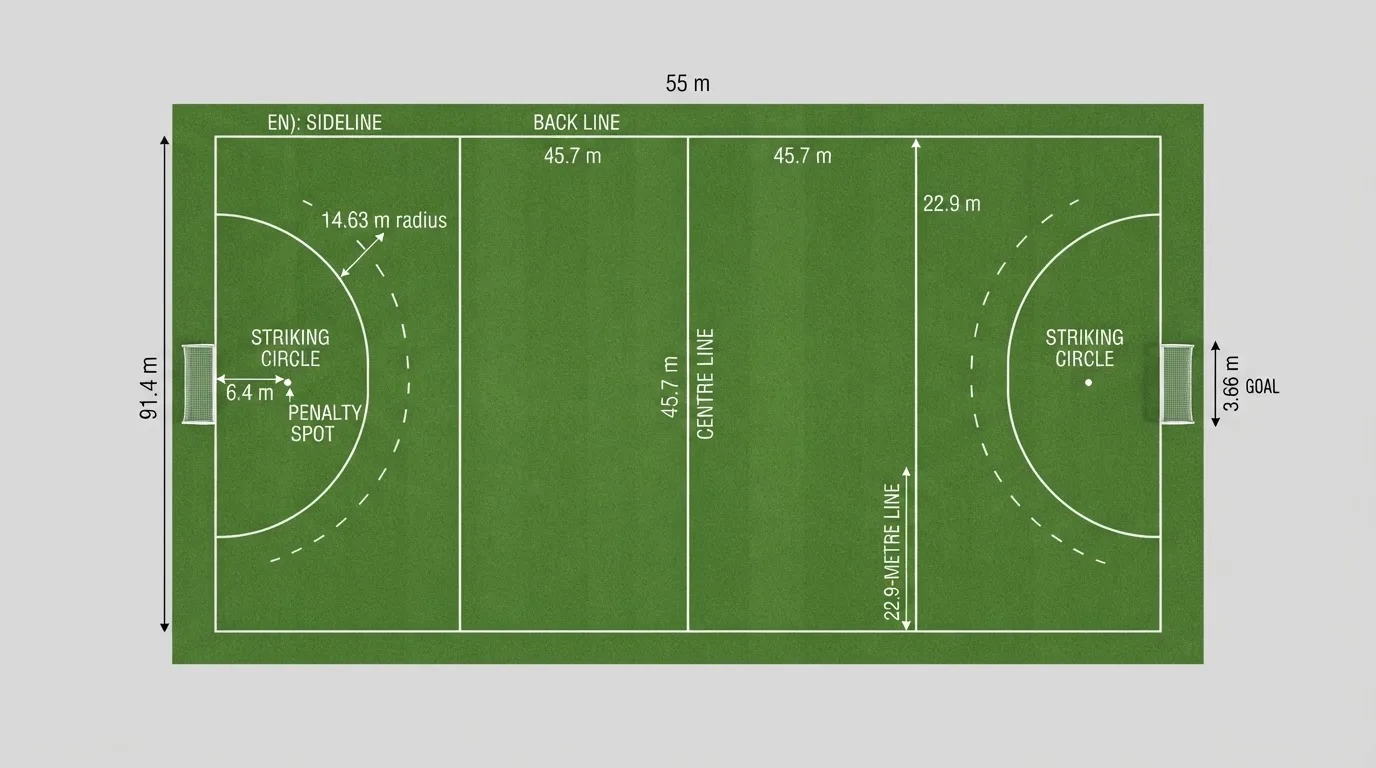
The pitch is fixed: 91.4 m × 55 m, with goals 2.14 m high and 3.66 m wide. Each side fields 10 outfield players and one goalkeeper. The match is 60 minutes of play (four 15-minute periods since 2017), with a 2-minute break after periods and a 15-minute half-time. Those numbers do not move, and they are the structural assumptions every field hockey price rests on.
The British punter’s year on field hockey is built around the Pro League (May to June), the EuroHockey Championships (August), the Hockey World Cup (every four years, next edition in 2026), the Sultan Azlan Shah Cup and the Olympics. Off-season, club leagues in the Netherlands, Germany and England carry prices, but the volume is thin and the in-play markets are often empty.
Operating behind the tip: how a tipping service works and where it falls down
A tipping service is a person or a model that publishes picks: a recommended bet, a price target, a stake size, sometimes a confidence rating. The reputable services publish a verifiable record: every tip, the price taken, the result, and a long-run yield. The yield is the measure: total profit (or loss) divided by total stakes, expressed as a percentage, and a positive yield over hundreds of bets is the only evidence that a tipster is adding value over the bookmaker’s margin.
A negative yield over hundreds of bets is the standard result for a tipster who is not pricing the margin into their picks. The headline says “10 winning tips last week”; the math says the margin ate most of those wins, and the punter’s bank is smaller than it was. A service that does not publish a verifiable record is a service the punter should not pay for, and “we can’t publish past results for legal reasons” is the sentence that ends a recognised service.
The same logic applies to social-media tipsters. A tip posted on a Monday with no price target and no record is not a tip; it is a forecast. The punter who wants to use a tip as part of their process should look for a price (the price the tipster took, not the price the market is now), a stake (in units, not pounds), a market (which book, which sport, which bet type) and a record (verified, with access to the data).
No tipping service can predict the future. Anyone who claims they can is selling certainty that does not exist, and the punter paying for it is paying for a story. The honest framing: a tip is one input into a process; the process is what produces a long-run yield, not the tips themselves.
Bankroll, staking and the discipline underneath the slip
A bankroll is the total amount the punter has set aside for betting, separate from rent money, savings and discretionary money. A unit is 1-5% of the bankroll, depending on how aggressive the strategy; a flat-stake strategy stakes one unit on every bet; a proportional strategy stakes more on higher-confidence bets and less on lower-confidence ones.
The Kelly criterion is the math behind aggressive staking: stake = (decimal odds × true probability − 1) ÷ (decimal odds − 1), expressed as a fraction of the bankroll. A 2.50 shot on a 50% true probability stakes 25% of the bankroll (2.50 × 0.50 = 1.25; 1.25 − 1 = 0.25; 0.25 ÷ 1.50 = 0.167, or 16.7% — a more conservative calculation than the headline figure suggests because Kelly assumes an accurate probability estimate). The full Kelly stakes are aggressive and most serious punters stake half-Kelly or quarter-Kelly; the math says a miscalibrated probability plus full Kelly stumbles you out of the game faster than a miscalibrated probability plus half-Kelly.
The discipline is what most punters lack. A losing streak of ten bets is statistically normal; a losing streak of thirty is unusual but possible. A punter who chases losses by raising stakes, or who skips bets when the form is poor and loads up when the form is good, is doing the opposite of what a staking plan demands. The bankroll is the test of a punter’s process: if the bankroll is shrinking over a year of recorded wagers, the process is wrong; if the bankroll is growing over the same period, the process is right (or the sample is small and the punter has been lucky).
The bookmaker’s stake limit, the customer’s stake limit, and the difference
A bookmaker sets a maximum stake on every market, and the limit varies by market, by brand and by customer. A £10,000 stake on the FIH Pro League winner market is unusual; a £500 stake on a single match winner is normal; a £5 stake is universal. A bookmaker can also restrict a winning customer, lowering the maximum stake on every market or closing the account entirely. The restriction is contractual and the punter’s only recourse is to take prices elsewhere — at other books, on the exchange, or both.
The customer’s stake limit is the punter’s own self-imposed ceiling: a single-bet cap (no more than X on one bet), a daily cap, a weekly cap, a monthly cap. The caps are the part of bankroll management that survives a bad day, a bad week and a bad month. A punter without caps is a punter who will lose the bankroll faster than the math suggests.
The sharp end: what changes a field hockey price
A price moves when new information arrives: a line-up change, a confirmed venue switch, a withdrawal, a weather update, a goalscorer announcement. The bookmaker’s algorithm absorbs the information and shifts the price; the exchange, where there is one, reacts faster because the price is set by punters, not by an algorithm. The punter who has the information first wins the edge.
A sharp bettor is one who places a bet when they have an edge the book has not priced. The edge can come from data the punter has read more carefully than the book (a long-form injury report, a tactical analysis), from information the book has not yet absorbed (a team-sheet tweet that the punter reads faster than the trader), or from a market the book has priced loosely because it does not have the volume to price it tightly. The edge is short-lived: once the price moves, the edge is gone.
The opposite of a sharp bettor is a mug bettor, and the bookmaker’s margin is calibrated to the mug. Field hockey is mug-heavy (most punters bet on football and bet on field hockey only at the Olympics), and the margin reflects that. The punter who bets on field hockey regularly, who reads the line-ups, who has a model and a record, is the exception the bookmaker prices for, and the bookmaker will eventually restrict them. That is the shape of the relationship, and it is honest.
What a British punter actually does on a field hockey Saturday
The practical sequence: check the calendar (FIH Pro League, EuroHockey, club fixtures); check the line-ups the morning of competition; compare prices across two or three books (bet365, Sky Bet, VBet for the volume markets; a specialist or an exchange for value); build the bet; place it; watch the in-play markets if the bet is on a corner or next-goal market; settle. The whole sequence runs ninety minutes on a quiet Saturday and longer on a busy one.
The traps are familiar. The accumulator that adds a fourth leg to “improve the odds” usually adds margin faster than it adds value. The price boost on a heavily favoured team is rarely a value bet because the original price was already short. The in-play market that opens after a goal is often wide enough to back the trailing side at a price that was not available pre-match. Each trap has a counter, and the counter is the same as the principle: the price has to clear margin, and most marketing does not.
Working out a return: stake, odds and the math
A £10 bet at decimal odds 3.50 returns £35 in total (£10 stake plus £25 profit). A £10 bet at fractional odds 5/2 returns £35 in total (£10 stake plus £25 profit; 5/2 = 3.50). A £10 each-way bet at 5/1 is two £10 bets (£20 total stake), one on the win and one on the place; the win leg returns £60 (£50 profit plus £10 stake) and the place leg returns a fraction of the win price depending on the place terms. A £10 accumulator on four legs at average odds of 1.8 carries combined odds of about 10.50 (1.8⁴ ≈ 10.50), so a winning acca returns £105 (£10 stake plus £95 profit) but loses £10 if any one leg fails.
The punter’s return on a winning bet is always stake × odds. The punter’s profit is stake × (odds − 1). The bookmaker’s margin sits inside the odds, not on top of them, and a punter who wants to know what the bet is worth in the long run has to back out the margin. A market priced at 1.90 / 1.90 on a two-way outcome returns 94.7% of stakes in payouts over time, so a £10 bet on this market has an expected payout of £9.47 — and the punter is paying 53p in margin on every £10 staked. That is the cost the marketing copy does not show.
The off-pitch reality: what a field hockey punter should accept
Field hockey is a sport with a thin market and a long history. The marketing writes the sport as if it were football; the reality is that the price feed is shallower, the live markets are narrower, the in-play depth is inconsistent and the bookmaker’s margin is wider than on Premier League football. The punter who treats field hockey tips like football tips is paying a margin they did not budget for, and the punter who treats field hockey like the small, structured, low-scoring sport it is will read the prices more accurately.
The bet that wins is the bet that was a value bet when it was placed, and a value bet is a price above the true probability once margin is taken out. No tipping service can predict the outcome, no staking plan can recover a losing streak without a positive edge, and no bookmaker’s welcome offer can convert a negative-edge punter into a positive-edge one. The discipline underneath the slip is what makes the difference, and the slip is the smallest part of the bet.
Frequently asked questions
What is a value bet, and why is no tip ever certain?
A value bet is a price that exceeds the true probability of the outcome by more than the bookmaker’s margin built into the market. The test is mechanical: if your estimate of the true probability is p and the decimal odds are o, the bet is a value bet when o × p > 1. No tip is certain because every price carries margin, every estimate of probability is fallible, and every match contains variables (weather, injuries, refereeing, momentum) that the model cannot price. A tip is a forecast plus a price; the price is what makes it valuable or not.
What is the bookmaker’s margin, and how can it be seen in the odds?
The margin is the commission the bookmaker keeps on every market, baked into the prices rather than added on top. On a two-way market priced at 1.90 / 1.90, the implied probabilities sum to about 105.3% (1 ÷ 1.90 + 1 ÷ 1.90), which means the book keeps roughly 5.3% of every pound staked and returns 94.7% in payouts over time. The wider the implied-probability sum above 100%, the wider the margin. Three-way markets (home / draw / away) carry a wider margin still because three prices have to sum to more than 100%.
How is the return on a bet worked out from the stake and the odds?
A winning single returns stake × decimal odds in total, of which stake is returned and the rest is profit. A £10 stake at 3.50 returns £35 (£10 stake + £25 profit). A combination bet multiplies the leg prices into one combined price: a four-fold at 1.80, 1.80, 1.80, 1.80 is a combined price of about 10.50, and a £10 stake returns £105 if all four legs win. Each-way bets are two bets of equal stake, and the place leg pays a fraction of the win price depending on the place terms.
How can it be checked that a bookmaker holds a Gambling Commission licence?
The Commission’s public register, on its own website, is searchable by business name, trading name, domain or account number, and is the whole test of whether a brand holds a licence. Search for the brand’s trading name; the record shows the licence categories, the licence holder (which may be a parent company, not the brand) and the account number. A brand whose homepage says “fully licensed in the UK” without a register entry is making a claim the register does not support, and the punter should treat that claim as marketing copy.
Which tools for controlling play does a licensed bookmaker have to offer?
GAMSTOP for self-exclusion (six months, one year, five years or five years with auto-renewal, plus a seven-year tail), deposit limits, time-outs, reality checks, product restrictions and access to help bodies (GamCare, GambleAware, the NHS gambling clinics, Gamblers Anonymous). A financial vulnerability check applies when deposits minus withdrawals exceed £150 in a rolling 30 days, in force since 28 February 2025; financial risk assessments are announced as a staged plan with no start date. The punter should use the tools proactively rather than reactively; limits set in advance survive a losing streak, limits set during one do not.
How do fractional odds such as 5/1 convert to decimal odds such as 6.00?
Divide the first number by the second and add one: 5 ÷ 1 + 1 = 6.00. “Evens” is 1/1, which becomes 2.00 in decimal. Odds shorter than evens are “odds-on” — 1/2 becomes 1.50, 4/6 becomes 1.67 — and the punter is staking more than they stand to win. The starting price (SP) on horse racing is the final price the market settles at; on a sportsbook it is the price the bet is taken at.
US & other team sports – AI Betting
Content created by the «AI Betting» team
