
Badminton betting odds in Great Britain: who carries the sport, what the price tells you, and what an offer really costs
 Available in US
The current odds below were checked on 26 October 2026 against the Gambling Commission’s public register and the operators’ own terms pages.

The price on a badminton betting slip is not the same thing as the probability of the outcome. The two move in the same direction, never by the same amount. Most of this page is about the gap between them: how a bookmaker builds it, where it sits inside the headline odds, what the rules of an offer add on top, and which operators on a British licence are worth a punter’s stake when the BWF calendar is busy. Badminton is a niche sport for British bookmakers — most carry it, few push it — and that shapes everything from the depth of the market list to the speed at which an in-play line moves.
The shortlist: ten British bookmakers and what each does with badminton
The comparison below covers ten operators whose names appear on the Gambling Commission’s public register as holders of a remote licence for Great Britain. The list is not a ranking in the sense of who is best for badminton — badminton is a small line at almost every shop — and it is not a recommendation. It is a working set: each name is here because the register shows one, and what follows is what each one does with a sport that most British bookmakers offer but few treat as a flagship.

What separates one name from another on a badminton Tuesday is rarely the headline price. The BWF World Tour runs through most of the year, the All England Open in March and the year-end World Tour Finals in December generate the deepest books, and outside those weeks the matches that draw a serious line are the Thomas Cup and Uber Cup ties, the Sudirman Cup, and the Olympic cycle. Inside that calendar, the differences that matter are which markets a bookmaker actually posts, whether in-play carries any depth at all, how the operator handles an offer that targets this sport, and how the rest of the book — the markets that draw the bigger volumes — looks alongside it. A bookmaker with a thin badminton card but a deep football book still has a place here, because most punters do not open an account for badminton alone.
The verdict at the foot of each review is the page’s own call, not the operator’s marketing. Where a brand is genuinely strong on this sport the review says so and explains why; where it carries the sport as a token line the review says that too, and points the reader at what the operator does better.
| Operator | Licence (account, holder) | What the operator’s own terms say on badminton betting odds and offers |
|---|---|---|
| Ladbrokes | Gambling Commission remote licence, account 54743, LC International Limited | Long-running British bookmaker with a deep in-play book; the badminton line tracks BWF events without a dedicated welcome package aimed at the sport |
| Bet Ahoy | Gambling Commission remote licence, account 100094, Bet Ahoy Ltd | Newer brand with a sports-led welcome; badminton sits inside the standard menu rather than as a promoted market |
| Fitzwilliam Sports | Gambling Commission remote licence, account 48760, SBKI Limited | Dublin-based bookmaker with capped membership and a high-stakes welcome; badminton coverage follows the major BWF stops rather than the weekly circuit |
| London Bet | Gambling Commission remote licence, account 66162, Thistle Bet Limited | Combines sports with a casino product from Pragmatic Play; badminton markets are basic and the in-play card is light |
| Unibet | Gambling Commission remote licence, account 45322, Platinum Gaming Limited | Operated since 1999 with a deep European book; badminton is part of a wider in-play catalogue and the welcome offer is structured around free bets |
| Smarkets | Gambling Commission remote licence, account 39173, Smarkets (Malta) Limited | A betting exchange rather than a traditional bookmaker; prices are set by punters, the operator takes a commission, and badminton markets appear when liquidity allows |
| Fafabet | Gambling Commission remote licence, account 57385, Taichi Tech Limited | A sports-focused site with best-odds-guaranteed terms on horse racing; badminton is offered without a sport-specific welcome |
| bet365 | Gambling Commission remote licence, account 55148, Hillside (UK Sports) ENC | One of the largest British books with bet builders, live streaming and a deep in-play offering across many sports; badminton is in the menu rather than a flagship |
| Hollywoodbets | Gambling Commission remote licence, account 53028, Hollywoodbets International UK Limited | South African origin with a British sportsbook; badminton coverage is modest and the welcome offer is built around accumulator insurance |
| Kalooki Sportsbook | Gambling Commission remote licence, account 57730, Kalooki Sportsbook Limited | A smaller British bookmaker; badminton is in the menu and the operator participates in GAMSTOP |
Ladbrokes
Ladbrokes runs a deep British book, and that depth shows through on badminton even though the sport is not the headline act. The line tracks the BWF World Tour events and the major team competitions, with outright markets on the All England and the World Championships when those tournaments open. The in-play book is fuller than most: games-to-lead, game-winner after the first set, total points bands and outright match winner are the kinds of markets a punter can usually find once a tournament gets past the early rounds. The welcome offer targets football rather than badminton, which is honest — there is no pretence that a £5 free bet will turn a serious punter’s year — and the cash-out option is available on most matches that carry a price in the first place.
The verdict. Ladbrokes is the kind of bookmaker a punter who already has an account uses for badminton, rather than the one a punter opens an account for. The line is there, the in-play is fuller than the niche suggests, and the brand carries the regulatory weight of a long-standing British licence.
Bet Ahoy
Bet Ahoy is a newer entry on the British market, and its welcome offer is built around a £10 free-bet package split between a sports single and a sports accumulator. The badminton line is part of the standard menu rather than a promoted sport: outright winner on major BWF stops, match winner on selected tournaments, and a handful of handicap and total-points markets when the book is busy. In-play exists but is thinner than the larger operators on this list, and the bet builder does not yet extend to badminton at the time of writing.
The verdict. Bet Ahoy is a workable secondary book for badminton at major BWF events, less useful on the weekly circuit where the line can be sparse. The welcome offer is a reasonable way to feel the platform out without commitment, and the licence is in place.
Fitzwilliam Sports
Fitzwilliam Sports is a Dublin bookmaker with capped membership and a high-stakes welcome aimed at a smaller customer base. The platform is structured around the bigger BWF events rather than the weekly World Tour, and that is reflected in both the menu and the depth of markets: when the All England or a Thomas Cup tie is on, the line is fuller than the niche would predict; outside those windows the badminton card can be thin. The welcome is gated by compliance criteria, which is worth checking before staking, and the operator links to the safer-gambling services and runs timeouts and deposit limits as standard.
The verdict. Fitzwilliam Sports suits a punter who bets bigger when the right tournament comes around and is happy to look elsewhere for the weekly card. The capped-membership structure means sign-up is selective, and the badminton offering reflects that.
London Bet
London Bet combines a sportsbook with a Pragmatic Play casino, and the centre of gravity is the casino side. Badminton markets are basic: match winner on selected events and the occasional outright tournament price. In-play is light on this sport, and the bet builder does not extend to badminton in any meaningful way. Where the operator earns its place on this list is the rest of the book — football, tennis, horse racing, greyhounds and the others — and the licence position is in order.
The verdict. London Bet is not the book a punter comes to for badminton. It is the book a punter who already uses it for football or slots might check once when a BWF major is on, and find a thin line.
Unibet
Unibet has operated since 1999 and the UK site is run by Platinum Gaming Limited, Gibraltar, under a Gambling Commission licence that has been in place for years. The badminton line is part of a wider European book, which matters: live tennis and live badminton often share the same trading team, so the in-play card on a BWF Super Series event can carry more depth than a British-only book of similar size. The welcome offer is a £40 free-bet package for a £20 qualifying sports bet at minimum odds of 2.0 (1/1), with the free bets expiring within seven days; the offer is for new customers paying by debit card or instant bank transfer. That is a tight window — seven days is short for a free bet tied to a sport with a weekly rather than daily calendar.
The verdict. Unibet is one of the stronger choices on this list for a punter who bets in-play on badminton during the bigger BWF weeks. The welcome offer is real money value but the seven-day expiry on the free bet is the kind of condition that costs a casual punter, and is worth understanding before claiming.
Smarkets
Smarkets is a betting exchange rather than a traditional bookmaker. The implication for a badminton punter is large: there is no Ladbrokes line here because there is no Ladbrokes — the price on the screen is set by other punters, and the operator takes a small commission on net winnings. When liquidity is good, an exchange tends to offer a sharper price than a traditional bookmaker because the margin is lower; when liquidity is thin, the price can move dramatically on small stakes. Badminton markets exist on Smarkets but they appear when there is enough interest to back them, and outside the major BWF events the card can be sparse. Deposits and withdrawals are fast — bank transfers are instant up to £10,000, withdrawals are processed within six hours up to £100,000 — and that is the kind of plumbing that matters to a punter who wants to move money in and out without waiting.
The verdict. Smarkets is the right tool for a punter who already understands exchange mechanics and is betting on badminton events with enough liquidity to make a price. For a casual punter who wants a single screen with a fixed price, an exchange is the wrong shape.
Fafabet
Fafabet’s headline term is best odds guaranteed on UK and Irish horse racing from 9am on race days, where the bigger of the original price and the starting price is paid. That does not extend to badminton — there is no SP on a badminton match — and the operator’s badminton offering is the standard menu: match winner on selected tournaments and outright markets on the bigger BWF events. The sports welcome offer sits alongside, and the licence position is in order.
The verdict. Fafabet earns its place on a horse racing page rather than this one. On badminton it is a workable but unremarkable book, and a punter who already uses it for racing will find a thin but functional badminton line.
bet365
bet365 is the largest bookmaker on this list and one of the largest in the world, with a UEFA Champions League partnership and an app that sits near the top of the British sports-betting charts. The bet builder — branded Bet Builder+ — extends across multiple sports and lets a punter combine markets from one event into a single bet, with versions for pre-match and in-play. Live streaming covers a long list of events, and the in-play card on badminton is one of the deeper ones on the British market, with markets such as game winner, total points and the next-game handicap available during matches on the bigger BWF stops. The welcome offer is targeted at football rather than badminton.
The verdict. bet365 is the strongest all-round choice on this list for a punter who wants a single account that does everything well, and its badminton card is among the deepest in Britain because the rest of the book pays for the trading team to be there.
Hollywoodbets
Hollywoodbets is a South African operator with a British sportsbook, and the welcome offer is built around a refund on a first losing accumulator: stake £10 or more on an acca of three legs or more at odds of 4/1 or greater, settled within seven days, with the stake returned as a free bet of up to £30 if it loses. That structure suits a punter who bets accumulators across multiple sports, and a badminton leg fits naturally inside one. The badminton card on its own is modest — match winner and selected outright markets — and the operator is strongest where its South African base pays for it: horse racing and greyhounds.
The verdict. Hollywoodbets is a useful tool for a punter who already builds accumulators across sports and wants a refund mechanic on the first one. On badminton alone the line is thin.
Kalooki Sportsbook
Kalooki Sportsbook is one of the smaller operators on this list, run by Kalooki Sportsbook Limited under account 57730. The platform is licensed by the Gambling Commission, participates in GAMSTOP, and offers a sportsbook alongside its other products. Badminton is in the menu, and the depth of markets reflects the operator’s size: match winner and outright markets on the major BWF events, with a thinner card outside those weeks.
The verdict. Kalooki Sportsbook is a legitimate British bookmaker for badminton at the bigger tournaments, and is honest about the kind of operation it is. A punter looking for a small, licensed alternative to the larger names will find a real book here.
How badminton betting works: the core of the sport and the price
Badminton is a niche sport on British bookmakers’ sites, and the way it is priced reflects that. A punter who understands how the sport is scored and how a tournament runs reads a price differently from one who does not, and that is the gap the next two sections close.
What a badminton match actually looks like
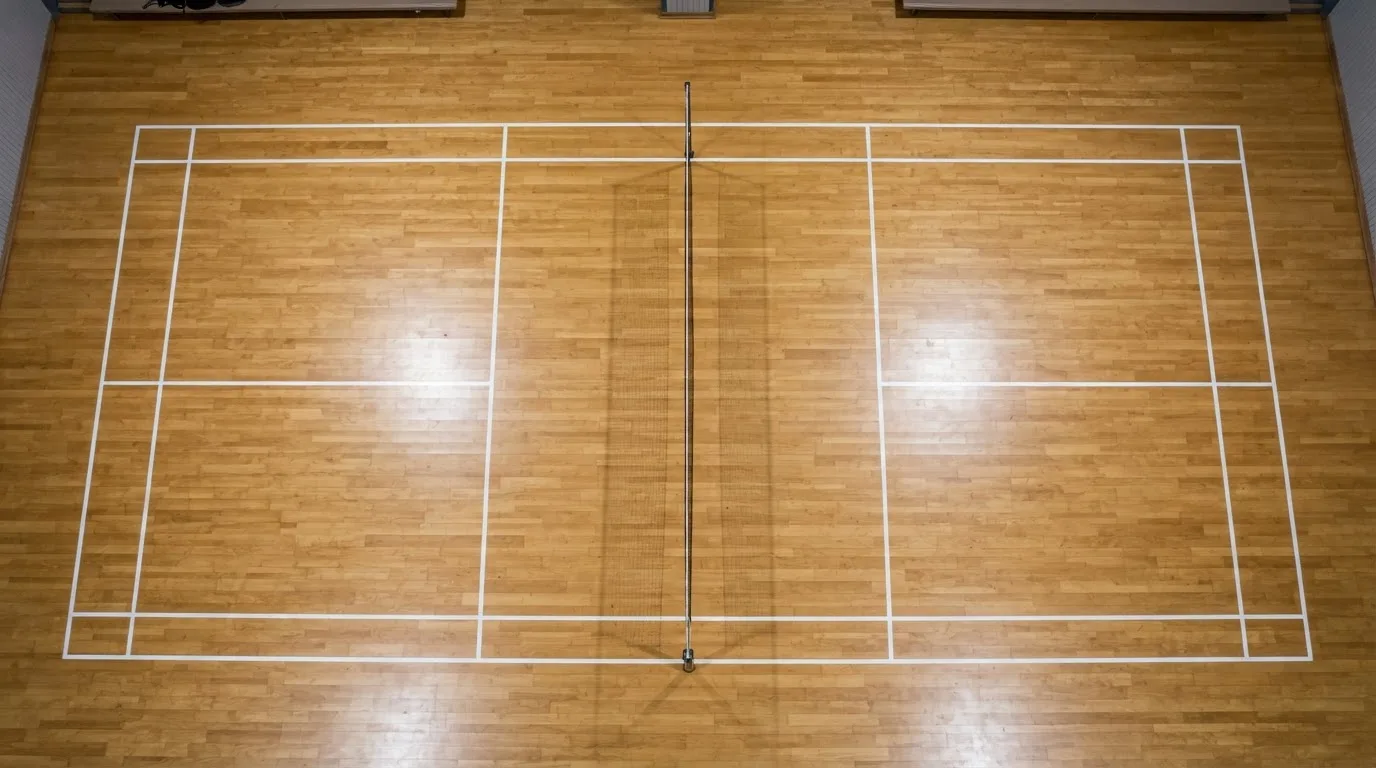
A badminton game is played to 21 points, with rally point scoring — every rally produces a point, regardless of who served — and a match is the best of three games. At 20–20, play continues until one side leads by two. At 29–29, the next point wins. The court is 13.4 m long, 6.1 m wide for doubles and 5.18 m wide for singles, with the net 1.55 m high at the edges and 1.524 m at the centre. Five disciplines are played at the international level: men’s singles, women’s singles, men’s doubles, women’s doubles and mixed doubles. The Badminton World Federation, founded in 1934 as the International Badminton Federation, governs the international game, and the sport has been on the Olympic programme since 1992, with mixed doubles added in 1996.
Why this matters at the slip: a match is short — a men’s singles match between two evenly matched players runs 40 to 60 minutes, sometimes longer — and the scoring moves in clean discrete jumps. That shape is what lets a bookmaker post markets on the next game, the next ten points, the margin of victory in a single game, and similar in-running lines, without the kind of latency that wrecks a football in-play book.
Where the British price is set
The British bookmaker’s price on a badminton match is built the same way as a price on a football match or a tennis match: each outcome carries a decimal odds figure, the implied probabilities of all outcomes add up to more than 100%, and the gap between that sum and 100% is the bookmaker’s margin. The smaller the margin, the sharper the price — the closer the implied probabilities are to the real probabilities, the less the punter pays for the privilege of betting.
What that means in practice on a two-way market priced at 1.90 / 1.90: the implied probability of each side is roughly 52.6%, the two sum to 105.3%, and the margin is 5.0%. A 5% margin on a heavily bet football market is normal; a 5% margin on a thinly bet badminton market is honest. A 10% margin on the same badminton match would still be common in the early rounds of a BWF event, and 15% or more is not unheard of when liquidity is thin.
The reason the margin is the only honest measure of price is that two bookmakers can quote the same headline decimal odds and yet charge different amounts. A line of 1.85 / 2.00 carries an implied probability sum of 54.1% plus 50%, which is 104.1% — a margin of 3.9%. A line of 1.91 / 1.91 on the same match, which looks more attractive because both sides are above evens, actually carries a margin of 4.5%. The headline number does not move with the margin; the underlying probability sum does.
For an illustrative two-way badminton match priced at decimal odds 1.90 against 1.90, the implied probability of each outcome is roughly one divided by 1.90, or about 52.6%. The two outcomes together imply around 105.3% of the event, which means the bookmaker keeps roughly 5.0% of every pound staked on the market. As a band: a real British book on a busy BWF event tends to sit between about 4% and 6% margin; on a quiet mid-week tournament the band drifts to 7–10%, and on the very thinnest cards the effective margin can rise further still.
What the law actually says in Great Britain
Badminton betting is legal in Great Britain when it is offered by a bookmaker licensed by the Gambling Commission under the Gambling Act 2005, which covers England, Scotland and Wales. Since the Gambling (Licensing and Advertising) Act 2014, an operator whose remote facilities are used in Great Britain needs a Commission licence wherever it is based, so a Curaçao, Maltese or Gibraltar licence is not a substitute. Northern Ireland sits outside the Gambling Act 2005 and has its own older framework, so a “GB licence” does not regulate Northern Ireland; the right framing is “Great Britain” or “GB-licensed”, not “UK-licensed”.
There is no statutory list of permitted sports or markets. A bookmaker licensed in the category of remote general betting standard (real events) may offer badminton under its own rules and the Licence Conditions and Codes of Practice. The Commission’s public register is the whole test of who holds a licence, and it can be searched by business name, trading name, domain or account number. Domain proves nothing: licensed operators use .com as well as .co.uk, and the register is the document that settles the question. No single brand is the only licensed one — the register lists many — and a place on a comparison is not a licence.
Betting on credit cards has been banned for gambling in Great Britain since 14 April 2020 (LCCP condition 6.1.2), including credit-card-funded payments through an e-wallet. Debit cards and bank-based payments are not covered by that ban. Minimum age is 18, and since 7 May 2019 name, address and date of birth are verified before a customer can deposit or gamble, including with a free bet or bonus. There is no state-set cap on stakes in sports betting; operators set their own maximums and may restrict customers individually. The player pays no tax on betting winnings in Great Britain; General Betting Duty is the operator’s tax on gross profits, currently 15% on most bets and a separate rate for financial spread betting, which is regulated by the Financial Conduct Authority rather than the Commission.
An offshore bookmaker that is not on the Commission’s register is not “illegal to use” in the sense of an offence aimed at a customer — the offence under section 33 of the 2005 Act is aimed at the operator — but the customer loses the British protections. Those are real and not theoretical: no GAMSTOP coverage, no Commission complaints route, no approved dispute-resolution body, no British consumer redress if funds are withheld, and no coverage by the 10x bonus cap or the £150 financial vulnerability check that applies at licensed operators.
Responsible gambling: what a licensed bookmaker is required to offer
The British framework around safer gambling is a list of operator duties, not a list of customer choices. A licensed remote bookmaker has to provide them; a self-excluded customer on GAMSTOP cannot reach them at all.
GAMSTOP is the national multi-operator online self-exclusion scheme, and participation is a mandatory licence condition for online operators since 31 March 2020. The minimum period is six months, and the available periods are six months, one year, five years, or five years with auto-renewal; after the minimum period the exclusion stays in place for a further seven years unless the customer asks GAMSTOP to remove it. GAMSTOP covers online sites and apps; betting shops use a separate self-exclusion service.
A financial vulnerability check (LCCP condition 3.4.4, in force since 30 August 2024) applies at licensed remote bookmakers when deposits minus withdrawals cross £150 in a rolling 30 days (since 28 February 2025). It is a public-record check — bankruptcy or county court judgments, for example — not an income check and not a credit reference check. Financial risk assessments, the “affordability checks” of the press, sit in a staged plan announced by the Commission in July 2026 with no start date; the right framing is “announced, staged, no start date”, not “in force”. Deposit limits under RTS 12 require operators to offer a gross deposit limit on a fixed time frame; the first changes applied on 31 October 2025, a second phase was postponed to 30 September 2026, and whether it is in operation is not established. There is no state-set deposit or loss ceiling; the limit is the customer’s own choice.
Help is available outside the operator: GamCare runs the National Gambling Helpline, GambleAware funds treatment and education, the NHS runs gambling clinics, and Gamblers Anonymous runs peer-support meetings. A licensed British bookmaker will link to those services from the safer-gambling section of the site, and an operator that does not is doing something the licence conditions do not require of it.
Bonuses and free bets on badminton: what they actually cost
The marketing word on a welcome page is rarely the price. A “free bet” is free at the point of receipt and charged at the point of clearing, because a free bet whose stake is not paid back with a win returns only the winnings, not the stake. A “risk-free” bet refunded as a free bet is not a refund in money. A “boosted price” is the same outcome as a higher headline odds figure with a tighter margin, and the difference is which side of the slip the marketing lives on. A “100% bonus” is a deposit-matching offer whose true cost sits in the wagering requirement, not in the headline number.
What that looks like across the operators on this list. Unibet’s sports welcome offer is a £40 free-bet package for a £20 qualifying sports bet at minimum odds of 2.0 (1/1), with the free bets expiring within seven days and the offer restricted to new GB customers paying by debit card or instant bank transfer. Hollywoodbets’ sports welcome is a stake-back on a first losing accumulator of three legs or more at 4/1 or greater, returned as a free bet of up to £30, settled within seven days, one free bet per customer. Bet Ahoy’s sports welcome is a £10 free-bet package split between a sports single and a sports accumulator.
What these have in common, and what every welcome offer in this market shares, is a wagering requirement or an expiry that determines whether the offer is worth what its headline number says. The promotion rules in force since 19 January 2026 cap wagering requirements on bonuses at 10x, so a £10 bonus at 50x wagering — which would have been the requirement a few years ago — now needs £100 of qualifying bets, never more. Mixed-product promotions — offers that require gambling on two or more product types such as betting, casino, bingo and lottery — are banned outright. Whether the cap applies to free bets with no wagering condition and whether there is any cap on the money value of a bonus are not established from the framework as it stands.
A free bet that expires in seven days is not a free bet for a punter whose sport of choice runs on a weekly calendar. Badminton’s BWF calendar is weekly rather than daily, and a free bet that has to be used inside a week is a free bet that has to be matched to a market the punter would have bet on anyway. The wagering rule, the expiry and the eligible-basket terms are where an offer is actually settled; the headline number is where the marketing lives.
Live betting and cash out: the in-play shape of badminton
Badminton is well-suited to in-play betting. Each game is short, the score moves in single points, and the gap between momentum and price is small. A bookmaker that takes the sport seriously offers markets on the next game, the next ten points, the margin of victory in the current game and the match outright at prices that move with the score. A bookmaker that does not take the sport seriously offers a single match-winner line that closes at the first serve and never reopens.
bet365 is the strongest all-round example on this list for in-play depth across many sports, and badminton sits inside that wider book: live streaming of events worldwide, a bet builder that works pre-match and in-play, and a long menu of in-running markets. Unibet is the natural European counterpart, with a deep in-play catalogue and a trading team that covers live tennis and live badminton from the same desk during the BWF season. Ladbrokes is the British book with a deeper-than-expected in-play card on the bigger BWF events.
Cash out is the second half of the in-play picture. Cash out is a feature that lets a punter settle a bet before the match has finished, at a figure the bookmaker sets in real time. It is useful on a sport like badminton because the score turns quickly and a punter who wants to lock in profit on a winning position can do so without waiting for the final point. It is also a feature that costs the punter in the spread the bookmaker builds into the cash-out figure, which is wider than the spread on the same selection in the regular market.
Smarkets, as a betting exchange, does not offer cash out in the traditional bookmaker sense; it allows a punter to lay a bet off at the current exchange price, which is the same mechanic and a sharper price, with the cost being the exchange commission on the net winnings.
Predictions and strategy: what a tip actually is
A badminton tip is somebody’s prediction of an outcome, priced against the bookmaker’s line. The tipster’s job is to find outcomes whose real probability is higher than the implied probability in the price; the punter’s job is to decide which tipsters are worth following and which are worth ignoring. There is no system that wins on its own: the bookmaker’s margin is real, the variance of a small sample is real, and the difference between a sharp tipster and a blunt one is a long-run edge that may be a percentage point or two.
What a punter can do, without any tipster at all, is to back markets where the margin is tight, avoid markets where the margin is wide, and read the score so that the in-play line is understood. The BWF World Tour stops, the Thomas and Uber Cups, the Sudirman Cup, the All England, the World Championships and the Olympics are the events where the line is deepest and the in-play is sharpest. Outside those events, the book can be wide enough that even a correct prediction does not pay.
A stake strategy is a separate question. Flat staking — the same stake on every selection — is the only staking plan whose mathematics are clean, and it is the right starting point for a punter who is new to the sport. Progressive staking plans do not change the underlying probabilities and they do not change the margin; what they change is the variance of the bankroll, and most of them change it in the wrong direction. The rule on staking the same way each time is not because flat staking wins; it is because flat staking is the only staking plan that does not add an extra source of error on top of the margin.
Bet types and odds: how a badminton slip is built
A badminton betting slip is built out of the same building blocks as a football or tennis slip, and the names are the same.
A single is one selection. A double is two. A treble is three. An accumulator — shortened to acca in British usage — is four or more. The odds of an accumulator multiply into one price, so a treble at 1.50 / 1.80 / 2.00 is a single price of 5.40, and a winning £10 treble returns £54.40 — the £50 profit on top of the £10 stake. The more legs, the bigger the headline price, and the more the margin of each leg compounds into the final price; that compounding is why a 10-leg acca at average odds of 2.00 carries a margin that is roughly twice the margin of a single at 2.00.
An each-way bet is two equal-stake bets: one on the win, one on the place. The place terms vary by sport, by operator and by the field of the event. Each-way is mostly a horse racing term, but it shows up in some outright badminton markets and it doubles the stake.
A bet builder, sometimes called a same-game multi, is a single bet that combines markets from one event. bet365 brands it Bet Builder+ and offers it pre-match and in-play. The bet builder is the natural shape for a badminton match because the markets that move together — the match winner, the total games, the handicap — sit inside one event and one trading team.
Cash out is the inverse of placing a bet: it settles the bet before the outcome is known, at a price the bookmaker sets. Trixie, Patent, Yankee, Lucky 15, Super Yankee, Heinz and Goliath are full-cover bets on a small number of selections; the unit stake multiplies by the number of bets in the structure, so a Lucky 15 at £1 a bet costs £15.
Fractional and decimal odds are the two ways the same price is written. Five-to-one (5/1) is a fractional price that returns five units of profit for every one unit staked; in decimal form that is 6.00, because the return includes the stake. Eleven-to-four (11/4) is 3.75 in decimal. Evens (1/1) is 2.00. Odds-on — shorter than evens — means the stake is larger than the profit; 4/5 is 1.80 in decimal. The conversion is the decimal odds minus one, which equals the fractional numerator divided by the fractional denominator: 5 ÷ 1 = 5, plus 1 = 6.00.
Sports and tournaments: the badminton calendar
Badminton is governed internationally by the Badminton World Federation. The calendar that matters for British bookmakers runs through most of the year. The BWF World Tour is the annual circuit of Super Series and Super 1000 events, with stops across Asia, Europe and the rest of the world. The All England Open, first held in 1900, is one of the oldest and most prestigious tournaments on the calendar; it runs in March and is treated by British bookmakers as a flagship event. The BWF World Championships have been held since 1977.
The team competitions shape the second half of the calendar. The Thomas Cup is the men’s team event, the Uber Cup is the women’s team event, and both are held every two years. The Sudirman Cup, the mixed team event begun in 1989, is also held every two years. Outside the team events and the World Tour, the individual disciplines — men’s singles, women’s singles, men’s doubles, women’s doubles and mixed doubles — each carry their own BWF rankings and their own betting markets at the bigger stops.
Badminton has been on the Olympic programme since 1992, with mixed doubles added in 1996, and the Olympic cycle shapes the calendar between Games the way the World Championships do. The five Olympic disciplines generate the deepest betting books at any BWF event, and the men’s and women’s singles are the most heavily priced.
The shape of the badminton calendar for a British punter is this: the All England in March, the European Championships in the spring of odd-numbered years, the Sudirman Cup in the spring of even-numbered years, the Thomas and Uber Cups in the same cycle, the BWF World Tour through most of the year, the World Championships in the summer of odd-numbered years, and the Olympics in the summer of each leap year. Between those events, the weekly BWF International Challenge and International Series stops carry a thinner book, and a punter who wants to bet on badminton every week will find some matches priced at most British books but not the deepest books.
Where the in-play card on badminton actually deepens
What a punter has noticed: the in-play card on a BWF World Tour Super 500 or above is a different product from the in-play card on a BWF International Challenge. The difference is not the sport — it is the data feed, the number of punters betting, and the trading team’s confidence in moving the line quickly.
The bigger events generate enough liquidity that the bookmaker’s trading desk has multiple data points for every rally: serve speed, rally length, shot type from the player-tracking system, and the score as it moves. The smaller events do not, and the line moves more slowly as a result. A punter who wants a sharp in-play price bets on the bigger events. A punter who wants to bet on badminton at 10pm on a Tuesday because a match is on finds what is available at that price.
The rule of thumb: an in-play card on badminton is sharpest at the All England, the World Championships and the Thomas, Uber and Sudirman Cups; less sharp at the BWF Super Series; and least sharp at the weekly BWF International Series, where the line is often a single match-winner price that closes at the first serve.
What a punter does before placing the first bet
A punter who is new to badminton betting does four things before staking the first pound. First, the punter checks that the bookmaker holds a Gambling Commission licence by searching the public register — by business name, trading name, domain or account number. Second, the punter reads the welcome offer carefully, looking for the wagering requirement, the minimum odds on a qualifying bet, the expiry on the free bet and any sport restriction. Third, the punter checks the deposit method — debit card or bank transfer, since credit cards are banned for gambling — and the verification flow, which is mandatory before the first deposit at a licensed site. Fourth, the punter sets a deposit limit and registers with GAMSTOP if self-exclusion is part of the plan.
The point of these four steps is not to make betting slower. It is to make sure the punter is betting with a licensed operator under terms the punter has read, with a stake the punter has set, on a sport the punter understands. The bookmaker’s margin is real; the verification flow is real; the GAMSTOP coverage is real. A punter who skips any of them is paying for the skip in ways the slip does not show.
What a punter does not get from an offshore bookmaker
A punter who bets on an unlicensed offshore bookmaker does not get a British licence, the British safer-gambling framework or the British complaints route. The customer does not commit an offence under section 33 of the Gambling Act 2005 — that offence is aimed at the operator — but the customer loses the protections a licensed site provides. There is no GAMSTOP coverage at an unlicensed site, so a self-excluded customer who has registered with GAMSTOP can still reach an unlicensed site, which is one of the reasons the scheme is structured around licensed operators. There is no Commission complaints route, no approved alternative dispute resolution body, and no British consumer redress if funds are withheld. The 10x bonus cap that applies at licensed sites does not bind an unlicensed operator. The £150 financial vulnerability check does not apply. The credit card ban does not apply.
The honest framing is that a licensed bookmaker offers the British checks, limits, GAMSTOP coverage and bonus cap, but also the verification-before-the-first-bet flow that some customers find intrusive; an unlicensed bookmaker offers none of those protections and the risk of lost funds.
Frequently asked questions
How does a punter bet on badminton?
A punter bets on badminton by opening an account with a Gambling Commission-licensed bookmaker, completing the identity verification that the licence makes mandatory, depositing by debit card or bank transfer (credit cards are banned for gambling in Great Britain), and selecting a match or tournament from the badminton menu. The slip carries the stake, the selection and the odds; placing the bet confirms the price at the moment of placement, not at the moment the match begins, which is the reason an in-play price moves the way it does.
How is it checked that a bookmaker holds a Gambling Commission licence?
The Commission’s public register is searched by business name, trading name, domain or account number. Every operator on this page is listed on that register, and the account number beside each review is the reference the register uses. The register is the whole test; a domain ending in .co.uk or .com proves nothing because licensed operators use both.
How is the return on a bet worked out from the stake and the odds?
For a single bet, return equals stake multiplied by decimal odds; net profit equals stake multiplied by decimal odds minus one. A £10 single at 2.50 returns £25, of which £15 is profit. For a combination bet the odds of each leg multiply into one price, so a treble at 1.50, 1.80 and 2.00 carries a combined price of 5.40; a £10 treble returns £54, of which £44 is profit.
What is the bookmaker’s margin and how can it be seen in the odds?
The margin is what the bookmaker keeps of every pound staked on a market, calculated by converting each outcome’s decimal odds into an implied probability, summing them and subtracting the sum from 100%. For a two-way market priced at 1.90 against 1.90, the implied probability of each side is about 52.6%, the sum is 105.3%, and the margin is 5.0%. A smaller margin means a sharper price for the punter, because the implied probabilities sit closer to the real probabilities and less of the stake is absorbed by the bookmaker.
How do fractional odds such as 5/1 convert to decimal odds such as 6.00?
The decimal odds equal the fractional numerator divided by the fractional denominator, plus one: 5 divided by 1 plus 1 equals 6.00. Eleven-to-four (11/4) is 11 divided by 4 plus 1, which is 3.75. Evens (1/1) is 2.00. The decimal form is the return including the stake; the fractional form is the profit excluding the stake, which is why the conversion adds one to the ratio.
Which tools for controlling play does a licensed bookmaker have to offer?
A licensed remote bookmaker has to offer GAMSTOP self-exclusion (six months, one year, five years, or five years with auto-renewal), a financial vulnerability check at £150 of net deposits in a rolling 30 days, timeouts and reality checks under the LCCP, and a gross deposit limit under RTS 12 (the first changes applied on 31 October 2025; a second phase was postponed to 30 September 2026). Outside-gambling help is available through GamCare, the National Gambling Helpline, GambleAware, the NHS gambling clinics and Gamblers Anonymous, and a licensed operator links to those services from the safer-gambling section of its site.
Tennis, darts & cue sports – AI Betting
Content created by the «AI Betting» team
