
The real price of an acca: ten licensed bookmakers ranked by what they charge you
 Available in US
26 October 2026 — checked against the Gambling Commission’s public register.
An accumulator — an acca, a parlay, a multi, a combo bet — is one bet that links two or more selections into a single ticket. Every leg must win, or the whole stake is lost. The odds of each leg multiply together, which is what makes a small stake capable of returning a large sum, and what makes the same margin cost the bettor more than it would on a single. This page is built for the bettor who wants to know what that arrangement actually costs in Great Britain today, and which licensed bookmakers make a fair job of it. Ten Gambling Commission-licensed operators are reviewed below; each one runs under a Commission account listed on the public register, and each one settles accas on its own published rules. The same arithmetic that powers a four-fold also powers a Heinz or a Lucky 15, so a reader who understands one understands the whole family of full-cover bets this market sells under the heading of acca.
How an accumulator actually pays
The mechanics of an acca are simple enough to state in three sentences, and each one carries a cost the marketing usually omits. The stake is placed once, on a ticket that names several selections. Each selection’s odds are multiplied together to give one combined price, and the return is the stake multiplied by that combined price. A losing leg means the entire stake is forfeit; a tie — a void, a push — drops that leg out of the calculation and the combined price is recalculated on what remains.

That, in full, is how an acca pays. The arithmetic underneath is the same arithmetic that prices every multiple bet the British market offers, from a four-fold on the Premier League to a Goliath on the horses. The decimal form of the odds suits this kind of bet because the multiplication is direct. A £10 stake at decimal odds of 1.50, 2.00 and 2.50 returns £10 × 1.50 × 2.00 × 2.50, which is £75 — a profit of £65 over the £10 risked. The same three selections priced fractionally at 1/2, evens and 6/4 give the same combined price (6.00) and the same return. A £2 unit stake across a Trixie’s four bets on the same three selections totals £8 risked, and produces a return wherever any of the four bets lands; on a full-cover bet the stake is multiplied by the number of lines the cover contains, not by the number of selections.
The cost the marketing omits is the margin. Each leg carries its own overround, and those overrounds compound: a market with a 5% margin on each leg does not produce a 5% margin on the acca, it produces something closer to a 14% margin on the combined ticket, which is why a four-fold rarely offers true value even when every leg looks individually fair. The page turns to margin in plain numbers later, and the difference between an acca that prices 6.00 and one that prices 5.40 is the same difference the rest of this page returns to: what the bookmaker keeps of every pound the reader wagers.
Ties, voids and Rule 4
A tie in any one leg is not a disaster on most British books. The convention — set by the operator’s own rules, not by statute — is to remove that leg from the acca and re-price the ticket across what remains. A four-fold with one void becomes a treble at the combined odds of the three surviving legs; the stake is unchanged. Where the operator’s terms allow it, an each-way acca splits into two bets of equal stake: one on the win portion and one on the place portion, and each is settled separately. A Rule 4 deduction, applied when a horse withdraws from a race after the betting market has formed, takes a percentage off the gross return rather than voiding the leg; the rate is set by the rulebook the operator publishes.

Full-cover bets on the same selections
The selections of an acca also power the full-cover bets the market sells under separate names, and they share the same combined-odds arithmetic with extra lines on top. A Trixie covers three selections in four bets (three doubles and a treble); a Yankee covers four selections in eleven bets; a Lucky 15 covers four selections in fifteen bets and pays a bonus on four winners; a Heinz covers six selections in fifty-seven bets; a Super Heinz covers seven in one hundred and twenty; a Goliath covers eight in two hundred and forty-seven. The total stake on each is the unit stake multiplied by the number of lines: a 50p Trixie costs £2, a 10p Lucky 15 costs £1.50, a £1 Heinz costs £57, a £1 Super Heinz costs £120. These are not accumulator bets in the strict sense — they cover combinations — but they share the same pricing engine, and a reader who learns one has learned the rest.
What the combined odds really mean
The combined price on a multi is what the bettor reads when judging whether the bet is worth taking, and it is what the operator has priced to leave itself a margin across the whole ticket. A fair four-fold on four independent events would price just above the product of the four true probabilities; the operator’s price sits a little below. That gap, multiplied by the stake across many bets, is what pays for the lights on the trading floor and the marketing on the side of a Premier League shirt. It is not a hidden charge. It is what the published odds show, provided the reader is willing to convert them into probabilities and compare them to what they think the true probabilities are. The page returns to this in the section on margin.
The ten licensed bookmakers, ranked by what an acca costs you
Each operator below holds a Gambling Commission remote licence for general betting on real events, and each settles accumulators under its own published rules. The ranking is built on what the acca costs the bettor in margin and restrictions, not on the marketing line each one leads with.
| Brand | Licence | Terms |
|---|---|---|
| bet365 | 055148 Hillside (UK Sports) ENC | Bet Builder+, Super Boosts, Winnings Boosts |
| Geoff Banks | 054095 GB Sports Advisors Limited | Live in-play, ante-post markets |
| Kwiff | 044448 Eaton Gate Gaming Limited | Supercharge feature on singles and multis |
| Fitzwilliam Sports | 048760 SBKI Limited | Prices to Oddschecker average |
| Dabble | 065677 Dabble Sports UK Ltd | £10 free bet welcome offer |
| Swifty Sports | 058957 Swifty Global (UK) Ltd | BOG, Cash Out, live streaming |
| Octobet | 062545 Octopus Game Limited | BOG on racing (£150 cap) |
| BetGoodwin | 002927 Goodwin Racing Limited | £15 free bet welcome offer |
| Betfred | 039544 Petfre (Gibraltar) Limited | Bet Builder, Sub Switch, Extra Places |
| BetUK | 039198 LeoVegas Gaming PLC | Free bets exclude virtual/esports |
bet365 — the largest catalogue, the most acca features
Bet365 holds Commission account 55148 under Hillside (UK Sports) ENC and runs the broadest sportsbook in the British market. The acca offering is built on three pieces: Bet Builder+, which combines markets from a single event into one bet (a same-game multi, available pre-match and in-play); Super Boosts on selected prices; and Winnings Boosts on Bet Builders and selected singles, which lift the payout on a winning bet without lengthening the ticket. Daily Bet Boosts run alongside. The acca builder on the slip is straightforward, the voiding convention follows the British norm, and the price feed is dense enough that a four-fold rarely forces a bettor into a stale line. The cost is the standard Commission-mandated identity check at sign-up and the source-of-funds questions that follow once deposits exceed £150 across a rolling 30 days. For a bettor who wants every Premier League market priced, Bet Builder+ on the same fixture and a Winnings Boost on top, bet365 is the default.
Geoff Banks — the ante-post specialist with a small app
Geoff Banks’ app is published by GB Sports Advisors Limited under Commission account 54095. The product is built around live in-play prices and ante-post markets on future events — the long-priced outrights on tournaments, leagues and seasonal specials. An acca built from ante-post markets pays the same way any other acca does, but each leg is on a price the book has held open for weeks or months, so the margin is wider than on a Saturday match-day card. For a bettor who wants to string together several ante-post views into one ticket, Geoff Banks is a useful counterweight to the match-day-heavy operators. For a bettor who lives on in-play, the app is thinner than the leaders.
Kwiff — Supercharged odds on singles and multis
Kwiff runs under Commission account 44448, with Eaton Gate Gaming Limited as the licence-holder and Spryme Ltd the named trademark operator. The feature that sets the product apart is Supercharge: a stake can return boosted odds on a single bet or on any multi, with the boost applied at random to winning bets and to a level the operator publishes — the example the app itself uses is a 2/1 price boosted to 20/1. There is no manual opt-in and no separate acca product; the multi is the standard British model. The Supercharge mechanism is what changes the calculation, because the boosted odds are not always available on the same fixture on a competitor, and on a four-fold they compound in the bettor’s favour. The cost is the same Commission identity check every licensed operator runs, and a tighter catalogue than the leaders in some second-tier sports.
Fitzwilliam Sports — priced to Oddschecker’s average
Fitzwilliam Sports operates under Commission account 48760, with SBKI Limited as the licence-holder. The book prices each selection to the average price Oddschecker reports across the British market at the moment of pricing, which is a structural commitment to a thin margin on the published price. For a bettor who prices accas carefully and reads the odds comparison sites, Fitzwilliam is a useful anchor. The product is otherwise plain: a sportsbook with Apple and Android apps and a settled acca that follows the British norm. There is no Bet Builder in the same match-day sense as the leaders, and no live-streaming tie-up. For a bettor whose edge is price, Fitzwilliam is the place to take it.
Dabble — a free-bet welcome with a short acca line
Dabble runs under Commission account 65677 with Dabble Sports UK Ltd as the licence-holder. The welcome offer is a £10 stake returning £10 in free bets on the first settled bet, with a seven-day free-bet expiry and the stake not returned with a win. Minimum odds apply on the qualifying bet. The acca product itself is built along the British norm, with the slip showing the combined price as the legs go on and the standard voiding convention applying. For a bettor who wants a small cash-back to start, and a bookmaker that prices a clean four-fold, Dabble fits. The cost is the seven-day expiry and the not-returned stake, both of which the marketing does not lead with.
Swifty Sports — Best Odds Guaranteed and live streaming
Swifty Sports runs under Commission account 58957 with Swifty Global (UK) Ltd as the licence-holder. The product carries Best Odds Guaranteed on UK and Irish horse racing (the price the horse starts at is paid if it is higher than the price taken), Cash Out on markets that include horse racing and football, daily price boosts, live streaming and in-play betting. Bet Builder is listed as coming soon, which means an acca built from markets on the same match is not yet supported. For a racing-led bettor who wants BOG, streaming and a settled accumulator across the day’s card, Swifty delivers.
Octobet — BOG on the racing with a £150-per-race cap
Octobet operates under Commission account 62545 with Octopus Game Limited as the licence-holder. Best Odds Guaranteed is offered on UK and Irish horse racing, with a £150-per-customer-per-race cap that the bettor should know about before staking — anything above £150 settles at SP rather than the higher price. The acca product is the British norm, with the slip building the combined price and the standard void convention applying. For a racing bettor staking under £150 a race, Octobet’s BOG is genuine. Above it, the cap shows.
BetGoodwin — three free bets at sign-up, one of them an acca
BetGoodwin runs under Commission account 2927 with Goodwin Racing Limited as the licence-holder. The sports welcome offer returns £15 in free bets for a £10 qualifying stake, split into three £5 tokens — one on the standard sports market, one on an acca, one on a Sub-Cover bet. The acca token is paid as a free bet whose stake is not returned, and the qualifying bet carries a minimum-odds requirement that the bettor checks on the offer terms. For a bettor who wants to test the acca product on the house, the £5 acca token fits the bill. The cost is the not-returned stake on the free bet, the minimum-odds rule on the qualifier, and the seven-day expiry that operators typically apply.
Betfred — Bet Builder, Sub Switch and the racing tie-up
Betfred runs under Commission account 39544 with Petfre (Gibraltar) Limited as the licence-holder. The app carries Bet Builder, Sub Switch (the option to substitute a reserve selection into an existing acca when a non-runner is declared), Racing Post data inside the product, Extra Places on selected races, and a live casino and bingo alongside. For a bettor who wants to build a same-game multi, who races against non-runners and who wants to substitute the reserve selection without rebuilding the ticket, Betfred’s Sub Switch is a genuine edge. The acca itself settles on the British norm. For a racing-led bettor who wants Extra Places and a clean acca, Betfred is a serious choice.
BetUK — a clean acca product with restricted free-bet use
BetUK operates under Commission account 39198 with LeoVegas Gaming PLC as the licence-holder. The sportsbook is built along the British norm, with the acca product settling the standard way and the voiding convention applying. The free-bet offering excludes virtual sports, esports and non-UK or non-Irish horse racing, with minimum odds applying on the qualifying stake. For a bettor who wants a settled acca product and who accepts the free-bet exclusions, BetUK fits. For a bettor whose acca is built across virtual markets or non-UK racing, BetUK is not the place.
What the operator’s licence actually buys
Every brand in the ranking holds a Gambling Commission remote licence for general betting on real events, and every one of them is on the Commission’s public register, which a bettor can search by business name, trading name, domain or Commission account number. The register is the whole test of who holds a licence in Great Britain; no other list is authoritative. Several brands can run under one licence-holder — Ladbrokes and Coral under one, Paddy Power and Betfair under another — and a registered trade with no Commission licence is not, in the legal sense, a British bookmaker at all.
The licence as it sits on the register
The Commission’s register records, for each operator, the licence number, the categories the licence covers, the legal entity that holds the licence, and any trading names that operate under it. For an acca product the relevant category is remote general betting standard (real events); a separate category covers virtual events. A separate licence type covers pool betting, and a third covers the betting intermediary model that exchanges run on. Each is a different licence with different conditions. A bookmaker that lists acca and Bet Builder has the general betting licence; a brand that lists only exchange or only pool products has a different one. A bettor who wants to verify a brand finds it on the register by name and reads the categories from there.
What the licence changes for the bettor
A licensed operator is bound by the Licence Conditions and Codes of Practice and by the Commission’s social responsibility code. The bettor’s protection is in name, not in statute: GAMSTOP enrolment, the financial vulnerability check at £150 of net deposits across a rolling 30 days, a deposit-limit tool the operator must offer, identity verification before the first deposit, source-of-funds questions at higher spend, the 10x cap on bonus wagering, the ban on credit cards for betting. None of those are the bettor’s choice. They are the price of a British licence. An unlicensed site offers none of them, and a bettor who uses one has no Commission complaints route, no approved dispute-resolution body, no British consumer redress if funds are withheld, and no GAMSTOP coverage. The choice is not between safe and unsafe. It is between regulated and unregulated.
How the margin hides inside the odds
The margin is what the bookmaker keeps of every pound wagered, expressed as a percentage of the total amount staked across all outcomes of a single market. It is the same number, viewed from the other side, as the payout share: a market with a 95% payout share has a 5% margin. It is not a fee charged on top of the stake. It is built into the odds.
What the arithmetic looks like
Take a tennis match with two players and decimal prices of 1.91 on each. The implied probabilities are 1 ÷ 1.91 = 0.5236 on each side, and they sum to 1.0472, which is 104.72%. The payout share is 1 ÷ 1.0472 = 0.9549, or 95.49%; the margin is 1 − 0.9549, or 4.51%. That is a typical margin on a major-event two-outcome market. On a three-way football market (home, draw, away), the same arithmetic runs across three prices and the margin is higher — typically 5% to 8% — because the bookmaker carries more risk on the third outcome. On an acca, the margin compounds: a market with a 5% margin on each leg does not produce a 5% margin on the four-fold; it produces a margin closer to 19% on the combined ticket, which is why the headline price on a multi is rarely what the bettor thinks it is.
Where the bettor sees it
The bettor sees the margin by converting each price to an implied probability, summing the probabilities across all outcomes of one market, and subtracting 100. Anything above 100 is the overround; the reciprocal of the overround is the payout share. A 106% overround means a 94.34% payout share and a 5.66% margin. The bettor who takes the trouble runs the calculation once or twice and remembers the number for the kind of market they bet on. The bettor who does not is the one whose acca prices 5.40 instead of 6.00, and who cannot tell why.
Bonuses and free bets at the acca bookmakers
A bonus at a British bookmaker is a fixed sum paid on top of a qualifying action — a first deposit, a settled bet — and a free bet is a token whose stake is not returned with a win. The Commission caps the wagering requirement on a bonus at 10x, which the marketing rarely leads with. The cap took effect on 19 January 2026 and applies to every bonus the operator offers.
What a 10x cap actually allows
A £10 bonus at 10x wagering requires £100 of qualifying stakes to clear; the same bonus at 50x would require £500, and the cap stops the operator asking for more. Mixed-product promotions — an offer that requires gambling on two or more product types such as betting, casino, bingo and lottery, for example a “bet on football to get free spins” — are banned under the same rule. The cap is a ceiling, not a floor: an operator may set wagering at 1x or 5x or none, and a £10 bonus with no wagering converts to £10 of withdrawable cash on settlement.
The free-bet arithmetic
A £10 free bet at decimal odds of 3.00 returns £30 of winnings (the stake is not paid back), of which the book keeps a margin on the underlying market. The expected value of the free bet is the free-bet amount multiplied by the price minus one, divided by the price, then multiplied by the payout share of the market. On a market with a 95% payout share and a 3.00 price, the expected value of a £10 free bet is £10 × (3.00 − 1) ÷ 3.00 × 0.95, which is £6.33. That is the average the bettor clears across many such free bets, not the amount of any one of them. The stake is not returned with a win, which is the marketing’s omission: a £10 free bet that returns £30 is a £20 profit on the token, not a £30 one. The bettor who reads the small print does not misread the headline.
Acca insurance and the price boost
Acca insurance refunds a stake as a free bet when one leg of a multi lets the ticket down; the refund is paid as a free bet whose stake is not returned, not as cash. A price boost lifts the published odds on a selection or a multi for a limited window, and the boost is paid on the same terms as the underlying bet. Both products sit inside the 10x cap where they carry a wagering condition; both sit outside it where they do not. The bettor who reads the offer terms sees the difference. The bettor who reads the marketing does not.
The legal frame for an acca in Great Britain
The Gambling Act 2005 covers Great Britain — England, Scotland and Wales. Northern Ireland is outside the Act and runs under its own older law. The Gambling Commission, a non-departmental public body sponsored by the Department for Culture, Media and Sport, licenses the whole commercial market under the Act. There is no state monopoly and no cap on the number of licences; an operator whose remote facilities are used in Great Britain needs a Commission licence wherever it is based, since the Gambling (Licensing and Advertising) Act 2014 amended sections 33 and 36 of the 2005 Act to that effect.
What may be bet on
There is no statutory list of permitted bets or markets in Great Britain. An operator holds a licence for a category and offers markets under its own rules and the Licence Conditions and Codes of Practice. In-play betting is offered by GB bookmakers and is controlled by the operator’s licence conditions and its customer-protection duties; the legal position is not that in-play is “unrestricted” as a conclusion of law. Esports are treated like any other event; virtual events sit on a separate licence category. Bets on politics, novelty markets and television contests are offered by GB bookmakers and no statutory prohibition has been published.
Identity, age and the deposit limit
The minimum age is 18, and identity — name, address and date of birth — is verified before a customer can deposit or gamble, including with a free bet or bonus. The rule has applied since 7 May 2019. Credit cards are banned for gambling in Great Britain since 14 April 2020 (LCCP condition 6.1.2), including credit-card-funded payments through an e-wallet; debit cards and bank-based payments are not covered by the ban. A gross deposit limit on a fixed time frame is a requirement on operators (RTS 12); the first changes have applied since 31 October 2025, a second phase was postponed to 30 September 2026, and whether it is live is not established in this material. There is no state-set ceiling on stakes in sports betting: the operator sets its own maximum stakes and may restrict a customer.
The financial vulnerability check
A financial vulnerability check (LCCP condition 3.4.4, in force since 30 August 2024) applies to licensed remote betting when a customer’s deposits minus withdrawals exceed £150 in a rolling 30 days (since 28 February 2025). It is a public-record check — for example, bankruptcy or county court judgments — and not an income check or a credit reference check. A heavier financial risk assessment, the “affordability check” of the press, has been announced by the Commission in a staged plan published on 7 July 2026, with no start date set. The current position is that the £150 vulnerability check is in force and the wider affordability assessment is announced and staged but not in force.
Tax
The player pays no tax on betting winnings in Great Britain. General Betting Duty is the operator’s tax on gross profits, currently 15%; from 1 April 2027 a new remote betting rate of 25% applies within it, while remote bets on UK horse racing, bets on self-service betting terminals in licensed premises, pool betting and in-person betting stay at 15% (HM Government policy paper of 26 November 2025). Until 1 April 2027 the remote rate stays at 15%; whether operators pass the duty on through the odds is not established in this material, and the bettor is not charged duty by the operator. The Commission’s statutory levy is a separate charge.
Offshore and the loss of protection
A GB licence is compulsory at the point of consumption. Providing gambling facilities in Great Britain without the licence the Act requires is an offence under section 33 of the Gambling Act 2005 — up to 51 weeks’ imprisonment, a fine up to level 5, or both on summary conviction (six months in Scotland) — aimed at the operator. The customer who bets on an unlicensed site commits no offence under the Act that this material establishes. What the customer loses is the protection: no GAMSTOP coverage, no Commission complaints route, no approved dispute-resolution body, no British consumer redress if funds are withheld, no 10x bonus cap, no £150 vulnerability check. The framing the page takes is not “safe” or “unsafe”. It is regulated or unregulated, and a regulated site is one that checks, limits, enrolls in GAMSTOP and caps bonuses. An unregulated site is none of those.
Responsible gambling at the acca bookmakers
Responsible gambling is what the operator does because the licence requires it, and what the bettor does because they have decided to. The Commission’s social responsibility code, the LCCP and the Remote Technical Standards set the operator’s obligations; the bettor’s choices are GAMSTOP, the operator’s deposit limit, and the help services listed at the foot of every British sportsbook.
GAMSTOP
GAMSTOP is the national multi-operator online self-exclusion scheme and a mandatory licence condition for online operators since 31 March 2020. Periods are six months, one year, five years, or five years with auto-renewal; after the minimum period, the exclusion stays in place for a further seven years unless the customer asks GAMSTOP to remove it. GAMSTOP covers online sites and apps; the betting shops run a separate scheme. Every operator in this ranking is a GAMSTOP member.
Deposit limits and the customer’s tools
Operators must offer a gross deposit limit on a fixed time frame. The bettor sets the limit themselves; the operator cannot lower it on the bettor’s behalf without the bettor’s instruction, and the operator cannot raise it without a cooling-off period that the LCCP prescribes. Where the bettor’s deposits minus withdrawals exceed £150 across a rolling 30 days, a financial vulnerability check runs on public-record data, and the operator may apply further checks. Where the bettor’s pattern of play trips the operator’s own safer-gambling triggers, the operator intervenes.
Help services
GamCare runs the National Gambling Helpline; GambleAware funds treatment and research; the NHS runs gambling clinics; Gamblers Anonymous runs peer-led meetings. The numbers and the addresses sit at the foot of every licensed sportsbook, and the bettor who needs them uses them. There is no charge for calling the Helpline, no requirement to give a name, and no record kept beyond what the Helpline itself needs to operate.
Predictions, tips and what they actually mean
A prediction of an outcome is not a published view. The page makes the distinction for the bettor who has read enough tipster pages to know how thin the line is. A prediction is a guess about a future event; a tip is the same guess packaged for someone to act on; a system is a guess about a class of future events, often with a staking plan attached. None of them changes the arithmetic that prices an accumulator. A prediction that one leg wins does not change the margin on the leg, does not change the voiding convention on the ticket, and does not change the stake-not-returned rule on a free bet. The bettor who reads a tipster page and the bettor who reads the betting slip are reading two different documents, and the page does not pretend otherwise.
What an acca tipster actually sells
A tipster on social media publishes a four-fold every Saturday and prices it at 12/1. The price is the combined price of four selections, each taken from one bookmaker or several. The bettor who follows the tip lays a stake on the same combination, takes the same combined price, and either wins or loses on the same legs. The tipster’s edge, where one exists, is the margin at which they took each leg against the true probability. The bettor who copies the tip without checking the legs has bought the tipster’s view at the tipster’s margin. Where the tipster is paid by the bookmaker, the bettor has also bought the marketing. The page does not say which tipsters are paid and which are not, because the inputs do not. The page says what the structure costs the bettor who does not check.
Bankroll and staking
A bankroll is the stake money the bettor has set aside for betting, distinct from rent money and bill money. The convention is to stake a fixed percentage — 1% to 5% — of the bankroll on each bet, and to keep the percentage constant as the bankroll rises or falls. The acca, which carries a higher variance than a single, calls for a smaller percentage than the single does. The bettor who stakes 5% of the bankroll on a four-fold has, on average, four losing weeks before one winning week returns the stake and a profit. The bettor who stakes 25% has, on average, one losing week that ends the bankroll. The arithmetic is its own argument.
Worked example: what a four-fold returns
Take three illustrative selections at fractional odds of 1/2 (decimal 1.50), evens (decimal 2.00) and 6/4 (decimal 2.50). A £10 stake on a straight accumulator of the three returns £10 × 1.50 × 2.00 × 2.50, which is £75. The profit is £65 over the £10 risked. The same three selections on a Trixie — three doubles and a treble — at a £2 unit stake costs £8 in total (four bets of £2) and pays out on whichever combination lands; where all three win, the Trixie returns £2 × 1.50 × 2.00 (the first double) plus £2 × 2.00 × 2.50 (the second double) plus £2 × 1.50 × 2.50 (the third double) plus £2 × 1.50 × 2.00 × 2.50 (the treble), which totals £39 of return on an £8 stake.
Where one leg ties, the ticket is re-priced across what remains. The first double becomes a single at 1.50 (return £3 on a £2 unit stake), the second double becomes a single at 2.50 (return £5 on a £2 unit stake), the third double becomes a single at 2.00 (return £4 on a £2 unit stake), and the treble becomes a single at 1.50 × 2.00 × 2.50, which is 7.50 (return £15 on a £2 unit stake). The Trixie total in that scenario is £27 of return on an £8 stake.
What the band means
The figure on the slip is a single number, and the page does not pretend otherwise: a £10 accumulator of three selections at 1.50, 2.00 and 2.50 returns £75 if all three win. The band the page refers to is the range the bettor should expect across the family of full-cover bets built from the same three selections: a straight accumulator returns £75 on a £10 stake when all three win; a Trixie at a £2 unit stake returns £39 on an £8 stake when all three win; a Patent at a £2 unit stake costs £14 across seven bets and pays the singles, doubles and treble on whatever combination lands. The band sits between the £75 the straight accumulator returns and the £39 the Trixie returns on the same three selections; a Lucky 15 on four selections would carry a different range again. The point is that the same three selections produce different returns under different covers, and the bettor who knows which cover they are buying does not misread the slip.
The price the reader pays for an acca
Every price on a British sportsbook carries a margin. The margin is the same number as the difference between the sum of implied probabilities and 100, and it is the same number as the difference between 100% and the payout share. A market with a 95% payout share keeps 5% of every pound staked across all outcomes. The acca compounds the margin because the book carries it on every leg.
A concrete reading
A four-fold priced at 12/1 carries a combined implied probability of 1 ÷ 13.00, which is 7.69%. Four independent fair odds of 2.00 each would compound to 16.00, with an implied probability of 6.25%. The 12/1 ticket is short of fair by a margin of around 19% across the combined bet — the gap between the fair 6.25% and the offered 7.69%. That gap is what the bookmaker keeps across the bet, on average, on every £100 wagered on this kind of ticket. The bettor who stakes £10 on the four-fold at 12/1 has, on average, paid £1.90 to the bookmaker as part of the price, before the bet is even settled.
What it looks like against the alternative
The same stake on four singles at 2.00 each carries a margin of 5% on each leg, which is roughly 5% on the total stake across the four singles. The acca at the same selections prices 12/1 instead of the fair 16/1, and the gap between them is the cost of combining them on one ticket. The bettor who splits the stake across four singles pays a smaller margin and accepts the lower variance of four independent bets. The bettor who combines them on one ticket pays a larger margin for the chance of a larger return. Both choices are legitimate; neither is hidden. The page sets them out because the bettor who knows the difference picks the one they actually want.
A bettor’s checklist before placing an acca
A short list of questions a bettor asks before placing an accumulator, and the answer to each.
The bettor checks the licence. The Commission account number sits in the operator’s terms and on the Commission’s register, and a five-second check confirms the licence covers the kind of bet the bettor is placing. The bettor checks the voiding convention. The convention is in the operator’s rules, and a tie on the first selection does not void the whole ticket. The bettor checks the minimum odds on a free-bet qualifying bet. The minimum is in the offer terms, and a stake below it does not qualify. The bettor checks the expiry on a free bet. The expiry is in the offer terms, and a free bet unused at the end of the expiry is forfeit. The bettor checks the maximum stake on a price-boosted selection. The cap is in the offer terms, and the bettor stakes under the cap or loses the boost. The bettor checks the deposit limit on the account. The limit is in the safer-gambling settings, and the bettor sets it before staking. The bettor checks GAMSTOP. The bettor who has self-excluded does not open a new account; the operator who allows it has breached the licence condition.
What to do if a settlement is wrong
A bettor who disputes a settlement asks the operator first, in writing, with the bet reference and the selection details. The operator’s response runs on the operator’s own complaints procedure, which the terms set out. Where the operator’s response is unsatisfactory and the bettor has been unable to resolve the dispute, the bettor may take the dispute to an approved alternative dispute resolution (ADR) body; the operator’s terms name the ADR body. A licensed operator is bound by the ADR’s decision in the contractual sense; an unlicensed one is not. A bettor who has bet on an unlicensed site has no ADR route, no Commission complaints route and no British consumer redress.
The full-cover family in plain English
The full-cover bets the British market sells under separate names are combinations of an accumulator and its doubles (and sometimes singles) on a fixed number of selections. They share the same combined-odds arithmetic with extra lines on top.
Trixie, Patent and Yankee
A Trixie covers three selections in four bets: three doubles and a treble. A Patent covers three selections in seven bets: three singles, three doubles and a treble. A Yankee covers four selections in eleven bets: six doubles, four trebles and a four-fold. The total stake on each is calculated as the unit stake times the number of lines.
Lucky 15, Lucky 31 and Lucky 63
A Lucky 15 covers four selections in fifteen bets: four singles, six doubles, four trebles and a four-fold; many operators pay a bonus on the four-fold or on all four winners. A Lucky 31 covers five selections in thirty-one bets. A Lucky 63 covers six selections in sixty-three bets. The total stake equals the unit stake times the number of lines, and the bonus (where paid) is a percentage of the return or of the profit on the named combination.
Heinz, Super Heinz and Goliath
A Heinz covers six selections in fifty-seven bets. A Super Heinz covers seven selections in one hundred and twenty bets. A Goliath covers eight selections in two hundred and forty-seven bets. None of them pays a bonus on the all-winners combination. The total stake is determined by multiplying the unit stake by the number of lines: a £1 Heinz is £57; a £1 Super Heinz is £120; a £1 Goliath is £247. None of them is a casual stake.
The price feed a careful bettor watches
The British market has more than one bookmaker offering prices on the same events, and the price feed a careful bettor watches is the feed that shows the same event at the same time across the books. The careful bettor lays the same acca on each bookmaker and keeps the one that returns the highest combined price; the discipline is called line-shopping, and it is the cheapest edge available to the recreational bettor.
Best Odds Guaranteed
Best Odds Guaranteed is the racing-specific concession where the operator guarantees to pay the higher of the price taken and the starting price (SP) — the price the horse starts the race at. BOG applies on UK and Irish horse racing at the operators that offer it; the cap varies (Swifty, Octobet at £150 per customer per race, others at different levels). The acca built from racing selections benefits from BOG leg by leg, because each leg’s settled price is the higher of the two. A racing four-fold on a BOG operator returns more than the same four-fold on a non-BOG operator, and the difference is paid by the operator, not by the margin.
Live in-play and Cash Out
In-play betting is offered by every operator in this ranking, with prices updating through the event. Cash Out lets a bettor settle a ticket before the final leg is decided, at a price the operator publishes; the price is the operator’s mid on the position, less the operator’s margin, and the bettor who cashes out takes a smaller expected value than the bettor who lets the ticket run. Cash Out on a settled acca is the operator’s offer to buy the ticket back at a discount, and the bettor who reads it as a “feature” reads it as the marketing intends. The bettor who reads it as a haircut to expected value reads it as it is.
What the page leaves out
The page does not name a tipster, does not publish a tip, and does not tell the reader which team will win on Saturday. The page does not know which team will win on Saturday, and a tipster who says otherwise is selling a guess at a margin. The page does not name a “best” bookmaker in the sense the marketing uses the word; the ranking above is built on what the acca costs the bettor, not on which operator would suit which reader. The page does not name a “free” offer guaranteed to clear; the arithmetic in the worked example shows what an offer is worth on average across many such offers, and no single offer is guaranteed to clear. The page does not name an “exclusive” deal; the British market has no exclusive deals, and a deal the marketing calls exclusive is a deal the operator has cut with an affiliate.
The page also does not tell the reader to open an account. A reader who wants to open one does so at their own decision, with their own money, on the operator’s own terms. The page describes the operators because the bettor comparing them needs the description; it does not advertise them because the bettor does not need the advertisement.
A short note on currency and the bettor’s stake
The page uses pounds sterling, because Great Britain uses pounds sterling, and the licence the operators hold is a Great Britain licence. A stake of £10 at decimal odds of 6.00 returns £60; a stake of £100 at the same odds returns £600; the stake is the bettor’s choice and the odds are the operator’s. The numbers on the page are illustrative, drawn from the inputs, and the bettor who acts on them does so with their own money.
The page uses the British convention on odds: fractional and decimal form. A price of 5/1 returns five pounds for every pound risked, plus the stake; the decimal form is 6.00. A price of 11/4 returns eleven pounds for every four risked, plus the stake; the decimal form is 3.75. A price of evens returns one pound for every pound risked, plus the stake; the decimal form is 2.00. The conversion from fractional to decimal is a/b to (a ÷ b) + 1. The conversion is exact; the rounding the operator publishes is the operator’s, not the bettor’s.
The image of the betting slip
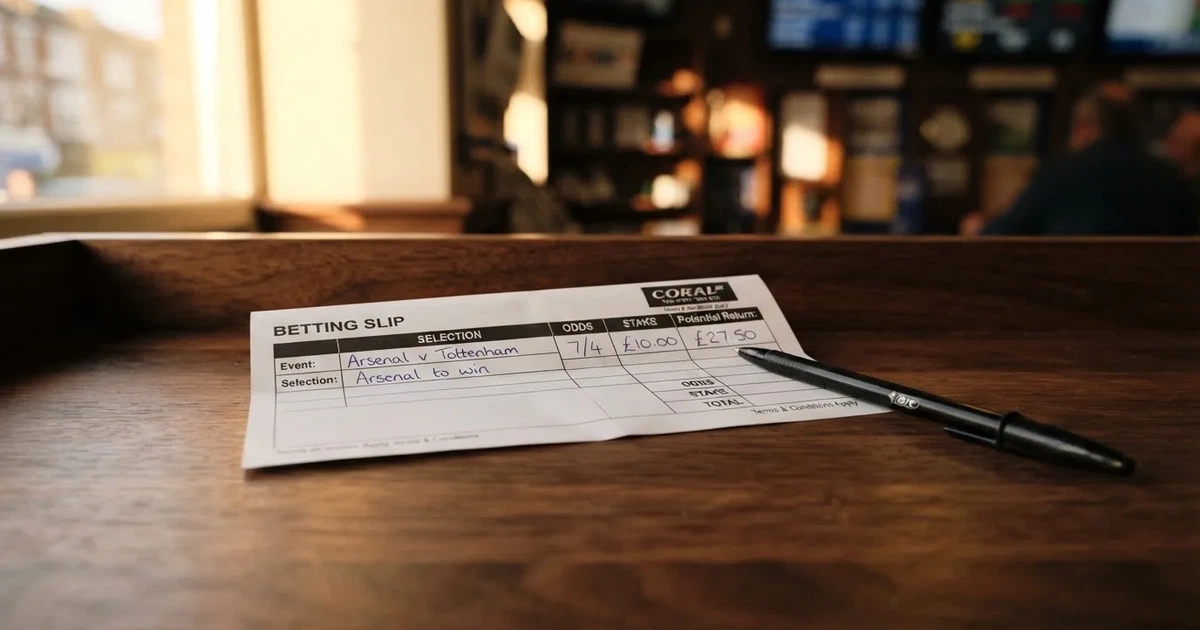
The slip on a wooden counter beside a pen is what a Saturday accumulator looks like before it is placed — a blank piece of paper with the selections pencilled in, the stake in pounds and the combined price in the margin. The price on the slip is the price the operator offers at the moment of writing; the price at the moment of placing may be lower. The slip is a snapshot of the bettor’s view of the day, and the day is what it is.
The image of the empty stadium at dusk
The floodlight masts of an empty stadium at dusk are the image of an ante-post accumulator, where every leg is a future event and every leg carries a price the bookmaker has held open since the market formed. The margin on an ante-post market is wider than the margin on a match-day market; the bettor who knows this does not stake the same percentage of bankroll on the ante-post multi as on the match-day single.
The image of the empty courtroom in morning light
The courtroom is the place where disputes over a settled acca are settled, when the operator’s complaints procedure has run and the alternative dispute-resolution route has run and the bettor has not been paid. The line of a courtroom in morning light is the line the licensed operator carries behind every settled bet: a Commission licence, a Commission register, a Commission complaints route, an ADR body. The unlicensed site carries none of those, and the bettor who uses one has no line at all.
A brief reading on what the licence costs the bettor
The licence costs the bettor identity verification before the first deposit, a deposit limit they cannot raise without a cooling-off period, a GAMSTOP check that runs against their name, a financial vulnerability check at £150 of net deposits across a rolling 30 days, and a source-of-funds question at higher spend. None of these are negotiable; they are the licence conditions every Commission-licensed operator carries. The bettor who wants a Commission-regulated account accepts them; the bettor who does not chooses an unlicensed site and loses the protections that come with the licence.
The licence also costs the operator the marketing constraint: no credit cards for gambling, no marketing aimed at under-18s, no use of under-25s in advertisements (with a narrow exception for in-shop marketing), no mixed-product promotions, a 10x cap on bonus wagering, and the social responsibility code that runs underneath the marketing. The bettor who reads the marketing reads what the licence allows the marketing to say; the bettor who reads the small print reads what the licence allows the offer to do.
How the page handles the inputs it does not have
The page does not name a brand’s acca margin, identity-check turnaround, or source-of-funds threshold because the inputs do not provide them. Where a value is missing, the page says so in the language of the offer: a free bet is modest or heavy; a requirement is ordinary or steep against the market; a term is the kind a bettor should read before claiming. The qualitative sentence is the sentence the inputs support; the precise figure is the figure the inputs do not carry. A reader who wants the precise figure checks the operator’s terms.
The page also does not name a “best” brand in any sense the marketing uses. The ranking is built on what the acca costs the bettor in margin and restrictions, and the bettor whose priorities are different — a price-for-price leader, a free-bet-for-free-bet leader — would pick differently. The ranking is one ranking of ten; it is not the ranking.
A note on what to read next
A reader who wants to read further on acca betting reads the operator’s own terms on accas and free bets, the Commission’s social responsibility code and the LCCP, and the Commission’s own register of licensed operators. A reader who wants to read further on price reads the betting odds comparison sites, where the same event is priced across the British market at the same minute. A reader who wants to read further on the help services reads the GamCare site and the National Gambling Helpline. The page points to none of them by address, because the inputs do not; the page points to them by name, because the name is what the reader uses.
A final word on what this page is for
The page is for the bettor who wants to know what an acca costs in Great Britain today, and which licensed bookmakers make a fair job of it. It does not invent a fact, does not name a tipster, does not publish a code, does not call a brand the only licensed one, does not write that an unlicensed site is “safe”, and does not tell the reader to open an account. It sets out what the acca is, what the operator does with it, what the licence costs and what it buys, and what the bettor should check before staking. The rest is the bettor’s decision.
Frequently asked questions about accumulator betting in Great Britain
What is an accumulator bet?
An accumulator — also called an acca, a parlay, a multi or a combo bet — is a single bet that links two or more selections into one ticket. The odds of each leg multiply together to give one combined price, and the return is the stake multiplied by that combined price. Every leg must win, or the whole stake is forfeit; a tied leg is removed and the ticket is re-priced across the rest. A £10 stake at combined odds of 6.00 returns £60.
How do accumulator bets work in practice?
The bettor adds selections to the betting slip; the slip shows the combined decimal price as each leg goes on; the bettor sets a stake and confirms. The bookmaker prices the ticket to leave itself a margin across the combined bet, settles each leg after the event, and either pays the return (where every leg wins) or keeps the stake (where any leg loses). A tied leg drops out and the ticket is re-priced; a Rule 4 deduction takes a percentage off the return rather than voiding the leg.
Can you use acca freeze on a free bet?
Acca freeze, where the operator offers it, lets a bettor lock in the current price on a selection while building a multi on other markets. Whether acca freeze applies on a free bet is set by the offer terms and the operator’s rules; the bettor checks the offer page for the wording before staking. A free bet whose stake is not returned cannot be converted to cash, and any acca feature it carries runs on the same stake-not-returned basis.
How can a bettor check that a bookmaker holds a Gambling Commission licence?
The Commission’s public register can be searched by business name, trading name, domain or Commission account number. The account number sits in the operator’s terms and at the foot of the responsible-gambling page. The register is the whole test of who holds a licence in Great Britain; no other list is authoritative. A registered brand whose domain is not on the register is not licensed in the legal sense; a licensed brand whose domain is on the register is licensed for the categories the register names.
How is the return on a bet worked out from the stake and the odds?
For a single bet, the return is the stake multiplied by the decimal odds; the profit is the stake multiplied by the decimal odds minus one. For an accumulator, the combined decimal odds are the product of each leg’s decimal odds, and the return is the stake multiplied by that combined price. For a full-cover bet — a Trixie, a Yankee, a Heinz — the return is the sum of the returns on each line that wins, where each line is a separate bet at the unit stake.
What is the bookmaker’s margin and how can it be seen in the odds?
The margin is what the bookmaker keeps of every pound staked across all outcomes of a single market. It is built into the odds, not charged on top of the stake. The bettor sees it by converting each price to an implied probability (1 ÷ decimal odds), summing the implied probabilities across all outcomes, and subtracting 100. The result is the overround; the reciprocal of the overround is the payout share; the margin is 100 minus the payout share. A market with a 95% payout share has a 5% margin. On an accumulator, the margin compounds across every selection.
Bet types & in-play – AI Betting
Content created by the «AI Betting» team
