
Chess betting tips 2026: value, margin and a ten-bookmaker shortlist
 Available in US
Current as of 26 October 2026 against the Gambling Commission’s public register of remote operating licences for Great Britain.

Chess is a niche betting market, and that is precisely why the words “tips” and “predictions” do more work here than in football or horse racing. The events are sparse, the line-ups of two are public, and a result is one of three outcomes — White win, draw, Black win — with the draw so frequent that it is rarely offered on a par with the other two. A tipster who claims to know who will win the next game is selling certainty the game does not allow. What a useful page on chess betting can do is set out the price a reader is being asked to take, what the bookmaker keeps of every pound staked, and which bookmakers serve UK customers under a Gambling Commission licence. The rest of the work — studying form, openings, time controls, head-to-head records, tournament situation — is the reader’s, and no guide on the open web can do it for them.
This page covers the building blocks: how odds are written in Britain, what margin does to a price, what a value bet is and why no tip is ever certain, the bet types that chess markets actually use, the licence test every UK-facing bookmaker has to pass, and a ten-bookmaker shortlist drawn from the Commission’s register. Concrete picks, predicted results and named winners are not given and never are, because nobody can know them.
The ten reviewed bookmakers for chess betting in 2026
The shortlist below is a count of ten, not a ranking. Every brand on it holds a remote operating licence from the Gambling Commission for Great Britain, verified against the Commission’s public register. Several brands on the list — Ladbrokes and William Hill among them — have run sportsbooks for decades; others are newer names built for the app era. What separates them for chess bettors is rarely the chess market itself, which most treat as a small corner of the sportsbook, but the surrounding mechanics: how the welcome offer behaves when it expires, whether Best Odds Guaranteed applies, how quickly the cash-out button appears on a fast-moving in-play game, whether a free bet pays back its stake. The table below sets the licence line beside each operator’s own headline mechanics, and the write-ups that follow read those mechanics against a chess bettor’s actual decision.
| Brand | Gambling Commission licence | Headline mechanics from the operator’s own terms |
|---|---|---|
| Betboro | 044181-R-324363-007 (account 44181), remote general betting standard (real events), held by Webmedia Development N.V. | In-play markets, cash-out on football, racing and tennis, boosted odds on selected singles from £10 stakes, deposit limits, reality checks, self-exclusion |
| Hollywoodbets | 053028-R-330019-013 (account 53028), remote general betting standard (real events), held by Hollywoodbets International UK Limited | Sports welcome offer: deposit £10+ by card, stake returned as a free bet up to £30 on a first qualifying losing accumulator (3+ legs, odds 4/1 or greater, settled within 7 days); one free bet per customer |
| 888sport | 039028-R-319297-014 (account 39028), remote general betting standard (real events), held by 888 UK Limited | Pre-match and in-play betting, Cash Out, Bet Builder, racing streams, BetFinder form tools, live bet feed, daily boosted odds |
| Sky Bet | 067370-R-341330-005 (account 67370), remote general betting standard (real events), held by SBG Sports Limited | Welcome offer: £30 in free bets as three £10 tokens after a £5+ deposit and a first single or each-way bet of at least 5p at odds 1/1 or greater |
| Swifty Sports | 058957-R-334734-006 (account 58957), remote general betting standard (real events), held by Swifty Global (UK) Ltd | Best Odds Guaranteed, Cash Out on horse racing and football, daily price boosts, live streaming, in-play betting; Bet Builder listed as coming soon |
| Ladbrokes | 054743-R-330863-014 (account 54743), remote general betting standard (real events) and remote betting intermediary, held by LC International Limited | Odds boosts on horse and greyhound bets, Best Odds Guaranteed on UK and Irish racing, in-play betting, Acca Boosts |
| DAZN Bet | 048756-R-327274-019 (account 48756), remote general betting standard (real events), held by DZBT Limited | Deposits from £5 by debit card, Apple Pay, Paysafecard, Trustly and Skrill; £20 minimum by PayPal; no processing fees |
| Betfair | 039439-R-319330-013 (account 39439), remote general betting standard (real events), held by PPB Counterparty Services Limited | In-play betting, Bet Builder, free live streaming of UK and Irish racing and football inside the app, 90 Minute Payout market |
| QuinnBet | 061011-R-335683-004 (account 61011), remote general betting standard (real events), held by QuinnBet (Gibraltar) Limited | Free bets valid 7 days from credit, used on any market at odds of 1/2 (1.5) or greater, maximum odds 50/1; straight accumulators allowed; Trixies, Patents and Yankees excluded |
| William Hill | 039225-R-319373-015 (account 39225), remote general betting standard (real events), held by WHG (International) Limited | Best Odds Guaranteed on UK and Irish horse racing from 8 AM on race day, on single and multiple bets; does not apply to ante-post, tote or pari-mutuel bets |
The licence line is the test every UK-facing bookmaker must pass, and it is the only line on the table that is independent of the operator’s own marketing. The mechanics column is reported from each operator’s published terms, not from a current promotion; offers change, and a reader should re-check them on the day.
Betboro
Webmedia Development N.V. holds account 44181 with the Commission for remote general betting on real events. The brand’s own terms describe in-play markets and cash-out on football, racing and tennis, boosted odds on selected singles from £10 stakes, and the safer-gambling tools the LCCP requires of every licensee — deposit limits, reality checks, self-exclusion. Chess is not a market the operator advertises on its home page, so a reader who wants chess prices here needs to use the search box or the sport list inside the sportsbook; the licence, not the homepage, is what clears the brand for UK customers. For a bettor who already keeps an account for football and wants a one-off chess bet during a Candidates tournament, that is a working setup. For a bettor who wants a deep chess menu on the home page, look elsewhere.

Hollywoodbets
Hollywoodbets International UK Limited runs the UK site under account 53028. The sports welcome offer returns a stake of £10 or more, on a first qualifying losing accumulator with three or more legs at minimum odds of 4/1, as a free bet of up to £30 — one per customer, settled within seven days of the first bet. That is a plain cash-back-as-free-bet mechanic, and the standard chess caveat applies: a free bet’s stake is usually not returned with a win, so the value of a successful £30 free bet at 5/1 is the profit only, not £180. One free bet per customer means the offer cannot be repeated, and the seven-day settlement window means a long multi-week tournament gives the customer time but no second chance. The licence line is sound; the welcome offer is best read as a one-shot top-up rather than a source of profit.
888sport
888 UK Limited holds account 39028 for the sportsbook. Pre-match and in-play betting, Cash Out, Bet Builder, racing streams, BetFinder form tools, a live bet feed and daily boosted odds are the mechanics the brand lists. Chess-specific markets are not named on the App Store description and the bettor who wants chess here is fishing in the wider sportsbook menu rather than a dedicated section. The wider mechanics are strong for a bettor who treats chess as one of several sports, weak for a bettor who wants chess outright on the top navigation. For a one-off match bet during the World Chess Championship, the licence and the cash-out button are enough.
Sky Bet
SBG Sports Limited holds account 67370 for Sky Bet. The welcome offer is £30 in free bets, paid as three £10 tokens after a £5 deposit and a first single or each-way bet of at least 5p at odds of 1/1 (2.00 decimal) or greater. Three tokens means three separate bets, each token typically not paid back with a win, so the value of a £10 token at odds of 3/1 is the profit only, not £40. The 5p minimum qualifying bet is the kind of detail that makes a welcome offer widely usable — the qualifying bet can be almost nominal, leaving the deposit and the free bet tokens to do the real work. Chess markets are part of Sky Bet’s wider sportsbook and appear during major tournaments.
Swifty Sports
Swifty Global (UK) Ltd holds account 58957. Best Odds Guaranteed, Cash Out on horse racing and football, daily price boosts, live streaming and in-play betting are listed; Bet Builder is shown as coming soon. Best Odds Guaranteed matters most for horse racing, where a late odds drift pays out at the higher price, and has no direct application to chess. The cash-out line confirms that the platform settles open bets during an event, and on a long chess game that lasts several hours that mechanism — settling an open position before the game ends — is the practical equivalent of what cash-out does on a football match. Chess markets sit inside the wider sportsbook. A bettor who treats Swifty as a racing-first book with a chess side door is reading it correctly.
Ladbrokes
LC International Limited holds account 54743 for both remote general betting on real events and a remote betting intermediary licence, the latter category used by exchanges; Ladbrokes is not itself an exchange, but the licence grouping covers the corporate group. Odds boosts on horse and greyhound bets, Best Odds Guaranteed on UK and Irish racing, in-play betting and Acca Boosts are listed. Chess is part of the wider sportsbook and tends to appear when a tournament hits the news. For a chess bettor the practical question is whether the brand’s BOG and boosts matter to chess at all, and the honest answer is that they are designed for racing; the value to a chess customer is the liquidity of the platform and the familiarity of the app.
DAZN Bet
DZBT Limited holds account 48756 for remote general betting. The deposit mechanics — £5 minimum by debit card, Apple Pay, Paysafecard, Trustly and Skrill, £20 by PayPal, with no processing fees — are the practical headline for a bettor who wants to fund an account quickly and cheaply. None of these payment methods applies specifically to chess; they are the rail the bettor uses to get to the sportsbook. A £5 minimum is the lowest on this list and matters to a bettor with a small budget. The chess menu is part of the wider sportsbook and is not advertised on the home page.
Betfair
PPB Counterparty Services Limited holds account 39439 for remote general betting. In-play betting, Bet Builder, free live streaming of UK and Irish racing and football inside the app, and a 90 Minute Payout market are listed. The 90 Minute Payout market is a football product and is not directly applicable to chess; the cash-out and in-play lines are. Betfair’s exchange arm sits under a different brand from the sportsbook, but the parent group shares a Commission account structure. For a chess bettor the practical picture is a sportsbook with strong in-play mechanics and a separate exchange; the exchange has its own back-and-lay model that is a different topic from sportsbook betting.
QuinnBet
QuinnBet (Gibraltar) Limited holds account 61111 — 061011 in full — for remote general betting. The free-bet rule is the line that matters most: free bets valid seven days from credit, used on any market at odds of 1/2 (1.5 decimal) or greater, maximum odds 50/1, straight accumulators allowed, Trixies, Patents and Yankees excluded. Seven days is a short window for a chess tournament that runs over weeks; a customer with three free bet tokens and a long event cannot stockpile them. The minimum odds of 1.5 rule disqualifies very short prices; a chess bettor backing a heavy favourite at 1/10 (1.10 decimal) cannot place the free bet there. The exclusion of Trixies, Patents and Yankees means the free bet works on simpler bet types — single, double, treble, straight accumulator — and that is the kind of rule a reader should check before claiming.
William Hill
WHG (International) Limited holds account 39225 for remote general betting. Best Odds Guaranteed applies to UK and Irish horse racing from 8 AM on race day, on both single and multiple bets, and does not apply to ante-post, tote or pari-mutuel bets. As with Ladbrokes and Swifty, BOG is a racing product and has no direct application to chess. The chess market sits inside the wider sportsbook, and William Hill’s strength for a chess customer is brand familiarity and the depth of its app rather than a chess-specific feature. For a one-off bet during a high-profile tournament, the licence and the app are enough.
What chess betting actually is
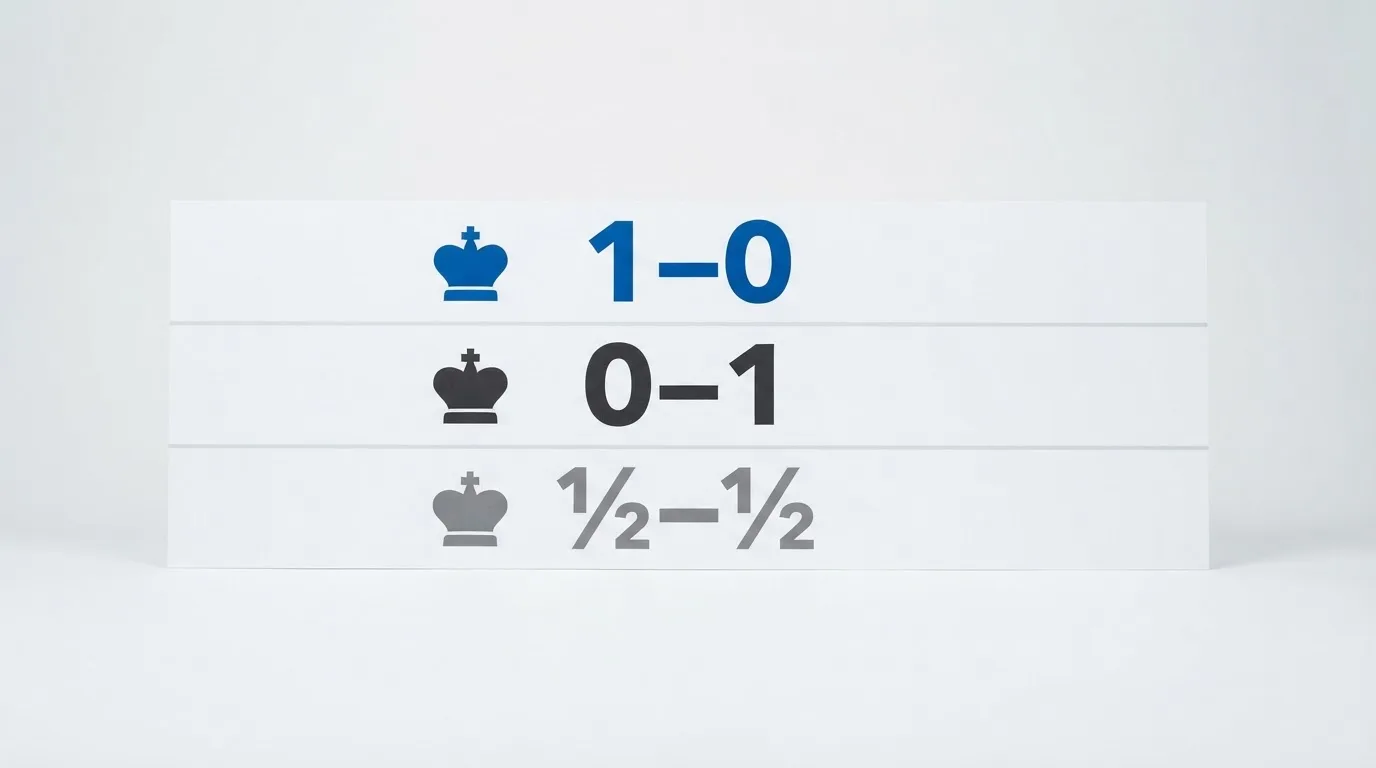
Chess is a two-player board game played on an 8×8 board of 64 squares, with each player controlling 16 pieces. The International Chess Federation, universally known as FIDE, is the world governing body and publishes the Laws of Chess in its Handbook. Games are recorded as 1–0 for a White win, 0–1 for a Black win and ½–½ for a draw — the same notation that bookmakers use to settle match odds. The draw is so common at elite level that it is the third outcome a bookmaker must price, and pricing the draw correctly is what separates a serious chess market from a token one.
The sport has had an official world championship since 1886, when Wilhelm Steinitz claimed the title. The current holder is Gukesh Dommaraju, who won in 2024 at the age of eighteen. Between championships the Candidates Tournament determines the next challenger. The match format — classical games, tiebreaks, sometimes rapid and blitz — means a single World Chess Championship match can run for three weeks, with one or two games per round and a rest day between each. For a bettor, that length is a feature: long events mean in-play markets that move over hours rather than minutes, and a slow game on move 30 is not the same proposition as a fast game on move 12.
Why chess is a niche market for bookmakers
Most major sportsbooks carry chess on their feed, but few treat it as a featured sport. The reason is straightforward: liquidity is thin. A Premier League match pulls millions of pounds in handle across dozens of bookmakers; a Candidates game pulls a few thousand. Thin liquidity has two consequences for a bettor. First, prices move more slowly and with less competition, so the margin on a chess market is typically wider than on a football market at the same operator. Second, in-play markets on chess are rarer and shallower than on football or tennis, because the bookmaker’s risk team watches a smaller number of events at once. A bettor who is used to betting on football has to recalibrate expectations: the chess menu is smaller, the prices are wider, and the cash-out button may not appear until the tournament is well underway.
Why “tips” do not exist in the way the word implies
A tip is a prediction of an outcome. In a chess match between Gukesh and a top challenger, no published source can predict the result with certainty; if any could, the prediction would already be priced into the odds. The job of a tip, properly understood, is to compare the bettor’s own estimate of the probability of each outcome to the bookmaker’s implied probability and to bet only when the bettor’s estimate is higher. That comparison is what a value bet is. Anything else — a named winner, a “sure” pick, a system that wins — is either marketing or a misunderstanding of the game.
How odds are written in Britain
British bookmakers write prices in fractional form: 5/1, 11/4, evens. A £10 stake at 5/1 returns £60 — £50 profit plus the £10 stake back. Odds-on prices — shorter than evens — are written as 4/6, 1/2, 1/5. The same prices can also be written in decimal form: 5/1 is 6.00 decimal, 4/6 is 1.67 decimal, evens is 2.00. The conversion is decimal = a ÷ b + 1 for a fraction a/b. Bookmakers and most price-comparison sites display both forms beside each other.
Two British shorthands matter for chess. SP, or starting price, is the industry-wide price set at the start of an event — common in horse racing, rarer in chess. BOG, or Best Odds Guaranteed, is a bookmaker’s promise to pay out at the higher of the price taken and the starting price; for chess, where SP is rarely quoted, BOG is effectively inert and the price taken is the price settled.
Reading a three-way chess market
A bookmaker’s match odds on a single chess game are three prices: White to win, draw, Black to win. Because the draw is so common at elite level, the prices are typically structured around it. A heavy favourite White might be priced at 8/11 (1.73 decimal) for the win, 5/2 (3.50) for the draw, 5/1 (6.00) for Black. An even match might be evens (2.00) White, 5/2 (3.50) draw, 2/1 (3.00) Black. The draw’s price reflects its probability — and a bookmaker who prices the draw at 6/4 (2.50) in a classical match between two elite players is reading the form correctly, because the historical draw rate in classical chess at the top level is high.
What “each-way” means in chess
Each-way betting is a horse-racing term that some chess bettors borrow for tournament winner markets. In horse racing an each-way bet is two equal-stake bets — one on the win, one on the place. In a chess tournament winner market the place terms are set by the bookmaker: typically a quarter of the win odds for a top-three finish, or a third of the win odds for a top-two finish, depending on the size of the field. A £10 each-way bet at 10/1 is therefore £20 total stake: £10 on the win, £10 on the place. The place payout is calculated against the place fraction, not the full odds, so the maths is mechanical and the place terms are the part to check.
What the bookmaker’s margin does to the prices
Every market a bookmaker offers carries a margin — the share of every pound staked that the bookmaker keeps on average, whatever the result. The margin is built into the prices: the implied probabilities of all outcomes sum to more than 100%, and the excess is the margin. For a two-way market at 1.90 / 1.90 (fractional 9/10), the implied probability of each side is 1 ÷ 1.90 = 52.63%, summed across both outcomes 105.26%, and the margin is 5.0%. A wider-margin market — say 1.80 / 1.80 — implies 55.56% per side, summed 111.11%, and the margin is 10.0%. The margin is the single number that tells a bettor how generous the bookmaker is being: a football match market with a 2–5% margin is competitive, a niche chess market with a 7–10% margin is normal for the sport.
A worked illustration of margin
Take an illustrative two-way chess market priced at decimal odds of 1.90 on each side. The implied probability of each side is 1 ÷ 1.90 = 52.63%; summed across both outcomes, 105.26%; the margin is the excess over 100%, or 5.0%. As a band, this sits at the tighter end of what a chess market realistically offers — competitive but not the best a bettor will see. A market at 1.80 on each side would carry a margin of about 10%, the kind of spread a chess bettor should expect on a thin event. Where the bookmaker’s own page shows three prices rather than two, the same calculation applies across all three outcomes, with the margin spread across White, draw and Black together.
What a value bet is, and why no tip is ever certain
A value bet is a price that is higher than the bettor’s own estimate of the true probability implies. If the bettor believes Black has a 40% chance of winning, and the bookmaker offers Black at decimal odds of 3.00 (implied probability 33.33%), the bet is value: the bettor’s estimate is 6.67 percentage points higher than the price implies. Over many such bets the bettor should come out ahead, before the bookmaker’s margin is taken into account. Over a single bet the result is whatever the chess game decides.
That is the second half of the rule. A value bet is a long-run expectation, not a guarantee for any single game. The chess match between two elite players is decided on the board, and the draw rate at the top level means even a strong favourite loses often enough that a small sample of bets will mislead. Bankroll discipline — staking a fixed small percentage of the betting bank on each bet, rather than chasing losses — is the part of “value betting” that the marketing pages do not talk about, and it is the part that decides whether a value-bet approach survives a losing run.
Staking and bankroll
A common rule is to stake no more than 1–3% of the betting bank on a single bet. The exact number is a matter of taste, but the principle is fixed: a stake that risks more than the bankroll can absorb across a losing run will eventually empty the bank. A bettor with a £500 bank staking £25 per bet — 5% — will be wiped out by a modest losing streak; the same bank with a £10 stake survives much longer. Staking plans like level stakes, percentage stakes, and the Kelly criterion are ways of formalising this; none of them turn a value bet into a sure thing.
The role of form, statistics and time controls
The inputs that go into a bettor’s probability estimate are the ones that decide whether the bet is value: recent results in classical, rapid and blitz; head-to-head history at the chosen time control; the colour sequence in a match; tournament situation (must-win versus playing for a draw); the venue; rest days; and the named tiebreak format. None of these guarantees a result, and a bettor who weights any single factor too heavily will overestimate or underestimate the favourite. The arithmetic in the section above is mechanical; the judgement that drives the bet is the bettor’s, and the job of a guide is to keep the bettor honest about what the inputs can and cannot tell them.
The bet types chess markets use
Chess bookmakers offer a narrower range of bet types than football bookmakers, and the menu depends on whether the event is a single game or a tournament.
Match odds
The three-way market on a single game — White win, draw, Black win — is the standard chess bet. Settlement is by FIDE result: 1–0, 0–1, ½–½. Tournament organisers occasionally rule games forfeit or award wins for late arrival or other administrative breaches; the bookmaker’s terms will specify which rulings count for settlement.
Tournament winner
A outright market on the winner of a tournament. For the Candidates, an each-way bet typically pays a quarter of the win odds for a top-four finish or thereabouts; for the World Chess Championship, an each-way bet is meaningless because there is only one winner, and bookmakers offer win-only. Settlement is by the official final result.
Series winner
In a multi-game match, an overall winner market that pays out as soon as one player has mathematically secured more points than the other can catch. Settlement is by the official match result, including any tiebreaks; an unplayed tiebreak day still counts as long as the match result is recorded.
Handicap
A virtual start applied to one player: a Black +0.5 handicap means Black needs only a draw to win the bet. This is the simplest way to back the underdog on a single game.
Total moves over/under
A market on the number of moves in a game, with a line set by the bookmaker. Chess is unique among sports in that the game has a defined length in moves but no fixed time; an over/under on 40.5 moves pays out according to the official game record.
In-play betting on chess
A bet placed after the game has started. Because chess moves are public and broadcast move-by-move for high-level games, in-play prices adjust as the position develops. The bookmaker’s in-play feed is slower than football’s — there is no equivalent of a goal flash — and a bettor who wants to bet on move 20 needs to be watching. The cash-out button on an in-play chess bet works the same way as on a football match: the bookmaker offers a price to settle the bet before the game ends, the bettor accepts or rejects.
Where chess fits in the British sportsbook
Chess sits inside the wider sportsbook at every major UK-facing bookmaker, alongside sports with much larger handles. The mechanics of welcome offers, free bets, boosted odds and cash-out apply to chess the same way they apply to football — except where an offer is restricted by sport, which most are not. The practical consequences for a chess bettor are:
- Welcome offers apply. A new customer who deposits and places a qualifying bet can claim a free bet or a stake-back, regardless of the sport of the qualifying bet. Some bookmakers restrict the free bet to certain sports; the terms say so.
- Best Odds Guaranteed applies to horse racing by default, not chess. A chess bettor does not benefit from BOG.
- Cash-out works on chess markets during an event. The cash-out price the bookmaker offers reflects the live state of the game and the bookmaker’s own risk model.
- Accumulator insurance is a horse-racing and football product and rarely covers chess.
The wider sportsbook context matters for the welcome offer rather than the chess market itself. A bettor who opens an account to claim a free bet is wise to size the qualifying bet to the minimum the terms allow — 5p at Sky Bet, £10 at Hollywoodbets — so the free bet carries the real stake.
The legal frame for chess betting in Great Britain
Betting on chess in Great Britain is regulated by the Gambling Commission under the Gambling Act 2005, with remote betting covered by the Gambling (Licensing and Advertising) Act 2014. The Commission’s public register is the whole test of whether a brand holds a licence: every operator in this guide is on it, with the licence number and licence holder named on each card.
The Act covers Great Britain — England, Scotland and Wales. Northern Ireland is outside the Act and has its own older law, so a GB licence does not regulate Northern Ireland. An operator whose remote facilities are used in Great Britain needs a Commission licence wherever it is based; a Curaçao, Maltese or Gibraltar licence is not a substitute. Several of the brands on this list are operated by companies domiciled outside the UK — Platinum Gaming in Gibraltar runs Unibet’s UK site, QuinnBet (Gibraltar) Limited runs QuinnBet — and each is named on the Commission’s register as a Commission licence holder for the relevant remote activity.
The minimum age is 18, and name, address and date of birth are verified before a customer can deposit or gamble at any licensed site. That has been the rule since 7 May 2019, and it applies to free bets and bonuses as well as cash stakes. The verification step is the reason no licensed site offers anonymous play; the customer protection regime the Commission requires depends on knowing who the customer is.
A licensed operator’s general betting duty is currently 15% of gross profits on general betting, with a new remote betting rate of 25% in force from 1 April 2027 for remote bets outside the carve-outs; the remote rate stays at 15% until then. Betting winnings are not taxed on the player in Great Britain. General information only, not tax advice; a professional gambler should ask HMRC or an adviser.
What a Commission licence means for a chess bettor
A licence is not a quality mark. It is a permission to operate, conditional on the operator meeting the LCCP and the Commission’s social responsibility code. The conditions that matter to a chess bettor are the safer-gambling tools: deposit limits, reality checks, time-outs, self-exclusion, and GAMSTOP, the national multi-operator online self-exclusion scheme that every licensed online operator takes part in. GAMSTOP is mandatory for online operators since 31 March 2020, with exclusion periods of six months, one year, five years, or five years with auto-renewal, and a further seven-year hold after the minimum period unless the customer asks GAMSTOP to remove it. A financial vulnerability check has applied to licensed remote betting since 30 August 2024 when a customer’s deposits minus withdrawals exceed £150 in a rolling 30 days (since 28 February 2025); it is a public-record check, not an income check. Financial risk assessments — the “affordability checks” of the press — are announced in a staged plan as of 7 July 2026, with no start date. A bettor who wants a complaint about a licensed operator to be heard by an alternative dispute resolution body has that route; a bettor who uses an unlicensed site does not.
What an unlicensed site means for a chess bettor
A site without a Commission licence is operating outside the British regulatory frame. No GAMSTOP coverage, no Commission complaints route, no approved dispute-resolution body, no British consumer redress if funds are withheld, not bound by the 10x bonus cap or the £150 vulnerability check. Whether using such a site is “legal” is a different question from whether it is sensible; the customer is not committing an offence, but is losing the protections the licence regime exists to provide. There is no ISP blocking in operation as a matter of policy; the Commission’s enforcement is disruption — cease-and-desist notices, work with registrars, hosts and payment providers — rather than blanket blocking. The honest framing is that a licensed site carries checks, limits and dispute resolution; an unlicensed site carries none of those and exposes the customer to the loss of funds.
The credit-card ban
Credit cards are banned for gambling in Great Britain, in force since 14 April 2020 (LCCP condition 6.1.2). The ban covers credit-card-funded payments through an e-wallet: a deposit via Skrill funded from a credit card is not allowed. Debit cards and bank-based payments are not covered by the ban. For a chess bettor, the practical consequence is that funding an account requires a debit card, a bank transfer, an e-wallet loaded from a debit source, or a prepaid voucher; a credit card will be refused at the deposit screen.
Safer gambling and player protection
The Commission’s safer-gambling regime applies to every brand on this list. The tools are the customer’s choice to set, and the licensed operator is required to offer them. The headline tools are:
- Deposit limits: a gross deposit limit on a fixed time frame, settable by the customer. The Commission’s RTS 12 has applied in phases since 31 October 2025, with a second phase postponed to 30 September 2026; whether the second phase is live is not established.
- Reality checks: a pop-up reminder during a session, typically after a set period of play, showing time spent and net position.
- Time-outs: a short break from play, typically 24 hours to six weeks.
- Self-exclusion: a longer break, typically six months to five years, taking the customer off the operator’s marketing list for the period.
- GAMSTOP: the national multi-operator online self-exclusion scheme. Self-excluding with GAMSTOP excludes the customer from every licensed online operator in Great Britain for the chosen period.
- Product restrictions: at Unibet, the Player Profile test and product restrictions are listed alongside deposit limits and self-exclusion.
- Help: GamCare (with the National Gambling Helpline), GambleAware, NHS gambling clinics, Gamblers Anonymous. These are listed on every licensed operator’s safer-gambling page and link from the app.
The 10x wagering cap on bonuses has been in force since 19 January 2026: a £10 bonus at 50x wagering would require £500 of qualifying bets; under the cap, no more than £100. Mixed-product promotions — an offer that requires gambling on two or more product types — are banned. The cap applies to bonuses with a wagering condition; whether it applies to free bets with no wagering condition is not established, and any cap on the money value of a bonus is not established either.
What a chess bettor should do before opening an account
The safer-gambling tools are the customer’s to set. A bettor who wants to deposit a fixed monthly amount sets a deposit limit at that amount before the first deposit; a bettor who wants to be told how long they have been playing sets a reality check at 30 or 60 minutes. GAMSTOP self-exclusion is for the bettor who has decided the safest option is to stop entirely. None of these is a substitute for self-knowledge, but together they put the customer in control of the conditions under which they bet.
Mobile apps and the chess betting experience
Most UK-facing bookmakers run a mobile app and a mobile browser site. The app is typically faster on in-play markets because it caches the price feed and can push notifications; the browser site is more flexible on a tablet or a desktop. For chess, where the in-play feed moves slowly and the bettor has time to log in, the practical difference between app and browser is small. The exception is the cash-out button on a fast-moving market: the app’s push notification means the bettor sees the offer before the price has moved away.
Most of the brands on this list publish an iOS app on the UK storefront: 888, Hollywoodbets, Betfair, QuinnBet, William Hill, Ladbrokes and others. The 17+ or 18+ age rating on the App Store is the storefront’s own check; the Commission’s minimum-age rule is enforced inside the app at sign-up. Bet Builder is a same-game multi product offered by 888 and Betfair; Swifty lists it as coming soon. The mechanics matter for a bettor who wants to combine chess markets on a single slip; the chess menu at most operators is small enough that a bet builder is rare.
Live betting and cash-out on chess markets
In-play betting on chess works on the same principle as in-play betting on any sport: the bookmaker takes bets during the event and adjusts the price as the position develops. The mechanics are slower than football because a chess game moves by moves, not by goals. A bet placed on move 12 may not have a meaningful cash-out price until move 25, when the position has clarified.
Cash-out is the bookmaker’s offer to settle an open bet before the event ends, at a price the bookmaker sets. For a single chess game, a cash-out offer on a match-odds bet on White will reflect the live position: White ahead in material trades ahead in the price; White losing material sees the cash-out price fall. A bettor who wants to lock in a profit when White converts an early advantage into a winning endgame accepts the cash-out; a bettor who wants to wait for the full payout rejects it. The decision is the bettor’s, and the bookmaker’s offer is not a guarantee — the cash-out price can be withdrawn at any time, particularly when the game reaches a critical moment.
Ladbrokes, 888, Betfair, Swifty and Sky Bet all list cash-out in their terms; QuinnBet and William Hill list it through the wider sportsbook. The cash-out price is set by the bookmaker and is not the same as the live price on the bettor’s original selection; it is the price at which the bookmaker is willing to close out the bet, with the bookmaker’s margin already taken out.
Predictions, strategy and the limits of tips
The word “prediction” in chess betting means the same thing it does in any other market: an estimate of the probability of each outcome, derived from the inputs available. The inputs are recent results, head-to-head history, colour sequence, time control, tournament situation, form over the last twelve months, and the named tiebreak format. None of these guarantees a result, and the bettor’s job is to weight them honestly and to compare the resulting probability estimate to the bookmaker’s implied probability.
What a tipster actually provides
A tipster who publishes a “tip” is publishing a bet. The bet is a selection at a price, and the price determines whether the bet is value. A tipster who charges for tips is selling the same product, with the additional cost of the subscription; the tip’s value is the tipster’s hit rate at the prices given, minus the subscription. Most published tipster track records do not survive a margin check: a tipster hitting 60% of bets at prices of 1.80 is breaking even before the subscription; the same hit rate at prices of 2.20 is profitable. The arithmetic is mechanical, and the tipster’s value is the quality of the price selection rather than the ability to pick winners.
Why no tip is ever certain
A chess game between two elite players has three outcomes, and the draw is frequent enough that no published source can predict the result with certainty. Even the players themselves do not know the result before the game starts. The bookmaker’s margin is the only certainty, and even that is an average over many bets rather than a guaranteed profit on a single event. A bettor who treats a tip as a certainty will lose, because the certainty does not exist.
Staking as the practical part of strategy
The arithmetic in the section above shows the long-run value of a value bet; the staking plan is what determines whether the bettor survives the losing runs along the way. A level-stake plan — the same stake on every bet — is simple and survives modest losing runs; a percentage-stake plan — staking a fixed percentage of the current bank — reduces stakes as the bank falls and protects the bettor from a wipeout. The Kelly criterion is a mathematical staking plan that maximises the long-run growth rate of the bank, but is volatile in practice and is typically used at a fraction (half-Kelly, quarter-Kelly) for that reason.
Chess betting on the UK market in 2026
Chess is on the feed at every brand on this list, with the depth of the menu depending on whether a tournament is in play. The World Chess Championship and the Candidates Tournament are the two events that consistently pull a full three-way market with in-play pricing; the Grand Chess Tour, the FIDE Grand Prix, the Tata Steel Masters, the Norway Chess and other elite events pull a thinner match-odds market for the headline games only. Outside the elite events, chess markets are rare and may be limited to outright tournament winner.
The British bettor’s practical setup is the same as for any niche sport: a sportsbook account at a licensed operator, a deposit limit set before the first deposit, and a staking plan that survives a losing run. The welcome offers at the operators on this list are described above; the offer a reader claims is the offer whose terms they read. A welcome offer is a one-shot top-up, not a source of profit, and the value of a free bet whose stake is not returned with a win is the profit only.
Frequently asked questions about chess betting
Where can I bet on chess in the UK?
At any operator holding a Gambling Commission remote licence. The ten on this list are confirmed against the Commission’s public register, and every UK-facing online operator must hold one. Markets are typically match odds on a single game, tournament winner and series winner, with in-play pricing during the headline events.
Is betting on chess legal in Great Britain?
Yes, at a licensed operator. The Gambling Act 2005 covers Great Britain, and the Gambling (Licensing and Advertising) Act 2014 requires an operator whose remote facilities are used in Great Britain to hold a Commission licence wherever it is based. Northern Ireland has its own older law. Minimum age 18, with identity verified before the first deposit.
How do I bet on chess?
Open an account at a licensed operator, deposit by debit card or another accepted method, navigate to the chess section of the sportsbook, and select the market. Single-game markets settle on the FIDE result: 1–0 White, 0–1 Black, ½–½ draw. Tournament winner markets settle on the official final result.
What is a value bet, and why is no tip ever certain?
A value bet is a price that is higher than the bettor’s own estimate of the true probability implies. It is a long-run expectation: over many such bets the bettor should come out ahead, before margin. A single bet’s result is whatever the game decides, and no tip is ever certain because the chess game is decided on the board, not by a prediction.
What is the bookmaker’s margin and how does it show in the odds?
The margin is the share of every pound staked that the bookmaker keeps on average. It is built into the prices: for a two-way market at 1.90 on each side, the implied probability of each side is 52.63%, summed 105.26%, margin 5.26%. A wider-margin market — 1.80 on each side — implies 55.56% per side, summed 111.11%, margin 11.11%. The margin is the spread between the prices.
How is the return on a bet worked out from the stake and the odds?
For decimal odds, return = stake × odds, net profit = stake × (odds − 1). A £10 stake at decimal odds of 3.00 returns £30 (£20 net profit). For fractional odds a/b, decimal = a ÷ b + 1, and the same formulas apply. For a combination bet the odds of the legs multiply into one price, and the return is the stake times that combined price.
Tennis, darts & cue sports – AI Betting
Content created by the «AI Betting» team
