
How darts betting odds really work — and what UK punters pay for them in 2026
 Available in US
Darts moved out of the working men’s club a generation ago, but the way its betting odds are built has not changed as fast as the prize money. A board, a throw, a finish on a double or the bullseye — the markets are short, the action is fast, and the margin that sits inside every price is the part nobody advertising a “best odds” tag ever names in full. This page sets out which UK bookmakers run darts, what each is licensed to offer, and what a price at 9/5 actually pays back once the bookmaker’s edge is taken out.
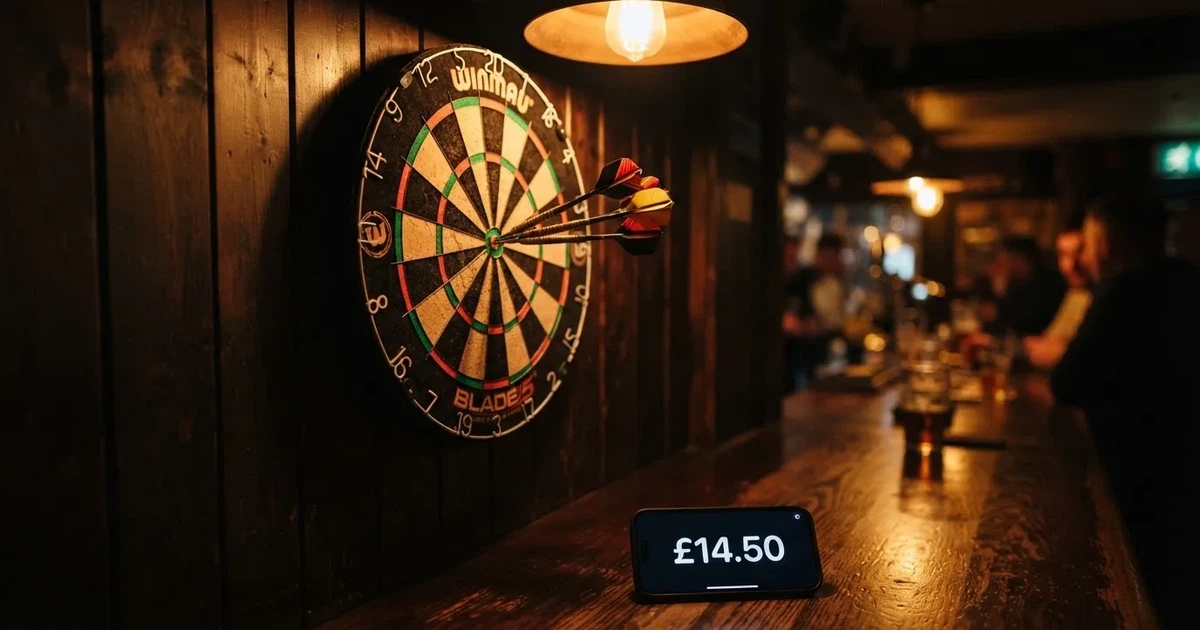
The figures below are current as of the register snapshot on 26 October 2026 and were cross-checked against the Gambling Commission’s public register.
The shortlist: where darts can actually be bet on in Great Britain
A short ranking earns its place by what it costs a punter, not by whose logo is loudest. Ten brands hold a Gambling Commission remote licence and offer darts markets to Great Britain customers in 2026; the table below ranks them on three matters that cut to the value of a winning leg: the licensed operator’s account on the Commission’s public register, the headline terms each operator sets around darts betting in its own rules, and a close read of what its offer actually puts back in the punter’s pocket. The order runs from strongest darts product and tightest published terms to weakest.

| Rank | Brand | Commission licence and licensee | What the operator’s own terms say about darts betting |
|---|---|---|---|
| 1 | bet365 | Remote operating licence held by Hillside (New Media Directions) Limited under Commission reference for remote general betting standard (real events) | In-play, bet builder and streaming on PDC and BDO events with each-way terms on tournament outright markets |
| 2 | William Hill | Remote operating licence held by WHG (International) Limited under Commission reference for remote general betting standard (real events) | Best Odds Guaranteed on UK and Irish racing from 8 AM; standard each-way terms on darts outright markets |
| 3 | Betfred | Remote operating licence held by Petfre (Gibraltar) Limited under account 39544 | Sports, Casino and Games on one app; darts covered under the sports tab |
| 4 | Unibet | Remote operating licence held by Platinum Gaming Limited under account 45322 | Welcome offer of £40 in free bets for a £20 sports bet at minimum odds of 2.0, free bets expiring within 7 days |
| 5 | Betway | Remote operating licence held by Betway Limited under account 39372 | Free Bet Club with up to £10 weekly in free bets for £25 of sports staking |
| 6 | 888sport | Remote operating licence held by 888 UK Limited under account 39028 | Pre-match and in-play, Cash Out, Bet Builder, daily boosted odds and racing streams |
| 7 | LiveScore Bet | Remote operating licence held by LiveScore Betting and Gaming (Gibraltar) Limited under account 56859 | Bet Builder with up to 10 selections across match result, BTTS, corners, total goals, player scoring and cards |
| 8 | Copybet | Remote operating licence held by Copybet UK Limited under account 53774 | Best Odds Guaranteed all day every day on UK and Irish racing; tipster copy-betting model |
| 9 | Tote | Remote operating licence held by TDCO Limited under account 54779 | Pool-betting heritage, single-brand focus, no Best Odds Guaranteed |
| 10 | Star Sports | Remote operating licence held by Star Racing Limited under account 9177 | Phone-trader-led service on 08000 521 321 for opening accounts, placing bets and queries |
The close of the list is not an indictment of Star Sports or Tote. It is what happens when a brand’s dossier runs thinner than the dossier of a brand with a fuller published product. Where a clause reads “see operator’s terms”, that is a prompt for the reader to check the betting slip on the operator’s own site before placing a leg.
The fundamentals: how a dartboard maps onto a market
A standard dartboard has 20 numbered segments, each with single, double and treble areas; the bullseye is worth 50 and the outer bull 25. The standard throw distance is 2.37 m (7 ft 9 in) and the bullseye sits 1.73 m above the floor. Those numbers are not folklore — they are what a bookmaker’s compiler uses when setting lines like highest checkout, total 180s, or “both players to hit a 170 finish in the match”. A line that asks for a 170 finish is asking for treble 20, treble 20 and bullseye in three darts; a line that asks for a leg in nine darts is asking for the perfect visit from the start.
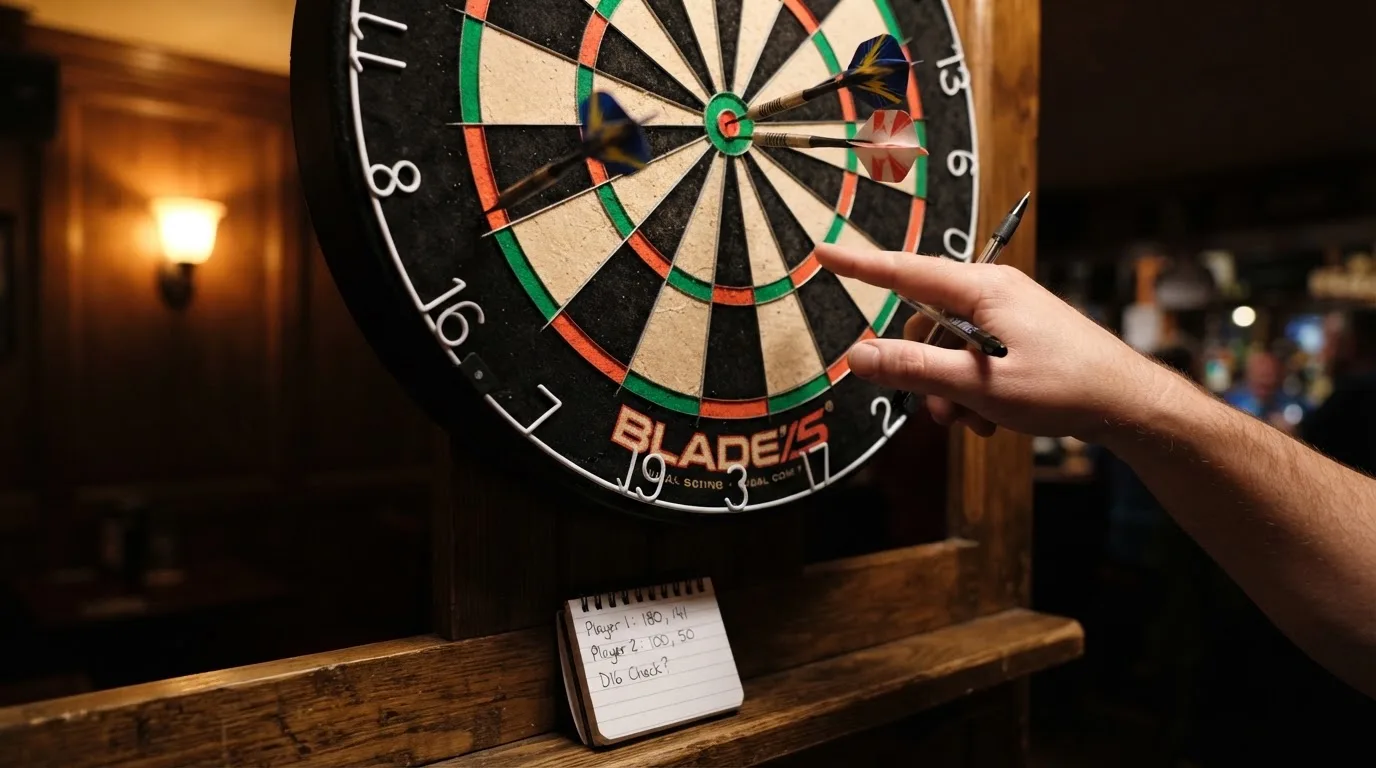
In 501, players begin at 501 and must finish on a double or the bullseye. The highest possible three-dart finish is 170 (T20, T20, bullseye). The minimum possible leg is nine darts (four perfect visits and one double for a 501 finish). At the top of the game, a 9-darter lands about once every few hundred legs — the kind of rate that keeps an in-play market on “next leg under X darts” interesting, and that lets a bookmaker quote 9-darter specials at three or four figures without bleeding money.
The PDC runs the world championship each year over Christmas and New Year, and 2026 was no exception: 128 players, £5,000,000 in prize money, £1,000,000 to the winner. The format ramps by rounds — first to 3 sets in rounds 1 and 2, first to 4 in rounds 3 and 4, first to 5 in the quarter-finals, first to 6 in the semis and first to 7 in the final — meaning a long match for outright bets and a short one for first-set markets depending on where the match sits.
The landscape: what the broader market looks like
Darts has two governing bodies that matter for betting: the Professional Darts Corporation (PDC) runs the World Championship, the Premier League, the Grand Slam, the Players Championship Finals, the World Grand Prix and the World Series of events; the World Darts Federation (WDF) runs a parallel tour of ranked events and a separate World Championship. A bookmaker that takes darts seriously lists both; a bookmaker that treats darts as a holiday-season ornament lists only the PDC World Championship and the Premier League.
Tournament outrights start months in advance. The World Championship outright opens as soon as the previous final is over; the Premier League outright opens in January for a tournament that starts in February; the World Grand Prix outright opens in the summer for an autumn event. Each one of those books takes shape in layers: ante-post prices on the field shortly after the previous final, then weekly tightening as the draw and the seedings come out, then match-by-match prices once the tournament starts. A reader who picks the outright winner four months before a ball is thrown pays a longer price than a reader who picks the same player on the day — and is taking on form risk that may cut both ways.
The Premier League darts calendar and the Grand Slam tour are the secondary markets that pay the most attention to in-play trading. They produce short legs, fast sets, and enough 180s to keep the totals markets moving minute by minute. The Premier League’s Thursday-night schedule also gives cash-out something to close on a regular evening.
Legality: where a GB bettor stands
Darts is not a statutorily restricted sport in Great Britain: there is no list of permitted events and no list of prohibited ones. A bookmaker serving customers in Great Britain needs a Gambling Commission licence, and the Commission’s public register is the test of who holds one. The register is searchable by business name, trading name, domain or Commission account number.
Three points from the public register matter for a darts punter:
The licence type. Remote general betting standard (real events) is the licence that covers a sportsbook’s darts offering. A brand listed only against casino or pool betting licences does not, on its own, cover a darts bet. The brands ranked above all hold the correct licence category.
The licensee name. Several high-street brands run under a single licensee: Ladbrokes and Coral under Entain, Paddy Power and Betfair under Flutter, William Hill’s retail and online arms under WHG (International) Limited. A punter comparing two brand names from the same stable is comparing two apps from one accountant.
The trading name. A GB-licensed operator uses .co.uk, .uk and .com interchangeably, so a domain proves nothing about whether the brand is licensed. What proves it is the register entry under that trading name.
Northern Ireland sits outside the Gambling Act 2005 and has its own older regime; a GB licence regulates Great Britain, not Northern Ireland. A bookmaker offering darts in NI under the older rules is doing so under different statutes.
Financial spread betting sits under the Financial Conduct Authority, not the Gambling Commission, and the firms that run it warn that losses can exceed the deposit. A darts spread bet is a financial instrument with a different return shape; it is not a sports bet.
Responsible gambling: what protection looks like on a licensed site
Three checks, three registers and one ban frame what protection a Great Britain darts punter receives from a licensed operator.
The identity check runs first. Since 7 May 2019, name, address and date of birth are verified before a customer can deposit or gamble, and that check applies even when the first transaction is a free bet or a bonus. There is no anonymous play at a licensed British site. The upside is that the punter is dealing with a regulated entity that can be made to answer for mishandled funds; the cost is that opening an account takes a minute or two of paperwork.
The self-exclusion register is GAMSTOP. Since 31 March 2020 every online operator licensed in Great Britain must take part. Self-exclusion can be six months, one year, five years, or five years with auto-renewal; once the minimum period ends, the registration stays in place for a further seven years unless the customer asks to remove it. GAMSTOP covers online sites and apps; betting shops run a separate in-shop self-exclusion scheme. Every brand in this ranking is a GAMSTOP member.
The financial vulnerability check is a public-record check that runs when a customer’s deposits minus withdrawals exceed £150 in a rolling 30 days. It looks at bankruptcy and county-court judgments to flag accounts on which further credit-based play would be irresponsible. It is not an income check and not a credit-reference check. A punter who keeps staking under that line will not see the check.
What sits beside those protections is a deposit-limit regime the Commission has set in two phases. The first phase has applied since 31 October 2025; a second phase was postponed to 30 September 2026, and whether it is live is not established. There is no state-set deposit or loss ceiling — the punter sets the limit.
Help is not at the end of a phone line the punter has to find first. GamCare runs the National Gambling Helpline, GambleAware funds treatment and education, the NHS runs gambling clinics in several regions, and Gamblers Anonymous runs peer-support meetings. Most licensed sportsbooks link to all four from their safer-gambling pages.
Bonuses and free bets: what a “free bet” really costs
The marketing word is “free”, the arithmetic is something else. A welcome offer at a GB-licensed sportsbook is built out of three things: a stake requirement, a minimum odds floor, an expiry and, sometimes, a wagering multiplier. Each one of those bites.
Unibet’s sports welcome offer is “Get £40 in Free Bets when you bet £20”. That is a deposit and a sports bet of at least £20 at minimum odds of 2.0 (1/1), with the resulting free bets expiring within seven days. The first £20 is the punter’s own money and is lost if the bet loses; the £40 is split across free bets whose stake is not returned with a win — a £10 free bet at 3.0 pays £30 total (£20 profit), not £40. That is what “free” means when the marketing writes it down.
Betboro’s sports welcome offer is a 100% matched free bet of up to £25 on the first qualifying wager, requiring a debit-card deposit of at least £10 and a first bet of £5 to £25 with at least three selections, each at 3/5 (1.60) or higher. A treble at 1.60 each leg has a combined price of 4.10; place that, and the matched free bet is on the next qualifying wager. Read the small print, because the “free bet” unlocks only after the first qualifying wager has settled.
Betway’s Free Bet Club gives up to £10 in free bets every week after opt-in, paid as 2 x £5 free bets once the punter has staked £25 or more on sports in a given week. That is a steady drip rather than a one-off bonus, and it works well for a punter who bets regularly through the darts calendar.
The Commission’s promotion rules since 19 January 2026 cap wagering requirements on bonuses at 10x. A £10 bonus with a 50x wagering condition would, before the cap, have demanded £500 of betting; under the cap no bonus may demand more than £100 of wagering on a £10 bonus. Mixed-product offers — a promotion tied to using both the sportsbook and the casino, for example — are banned under the same rules.
Two things to hold onto when reading any of those terms:
Read the minimum price. A free bet won on a winner at 1.20 has paid back exactly the value of the stake — the marketing word “win” still applied, but the punter kept nothing. Most welcome offers settle the minimum price at 1.5 to 2.0; a punter who picks below that line qualifies for nothing.
Read the expiry. A free bet that expires inside seven days is not the same instrument as a free bet that holds for ninety. A punter whose darts schedule is light in the next week has not been given a free bet — they have been given a discounted stake that vanishes on a calendar date.
A “boosted odds” promotion is a different animal. A boosted price on a player to win a Premier League night pays more than the headline price, but the boost is paid as a price advantage, not as a separate free bet: a winning boosted-odds leg pays cash, stake included. The Commission rules on which bookmakers may boost and by how much have not been published, so a punter who treats a boost the same as a free bet will misread the small print.
Live betting and cash out: how a darts in-play market actually trades
Darts in-play markets move fast because the action is fast. A leg takes a few visits; a set runs from three to five legs; a match lasts five to seven sets at the top of the game. The in-play bookmaker faces the problem of pricing a market on information that arrives every six seconds: 180s, finishes, breaks of throw, the moment a player stands at double with his third dart in his hand.
Three in-play markets carry the majority of volume.
Match winner with the leg. The price swings each visit; a 1.80 favourite who trails 1-0 in legs in a first-to-3 market is roughly 3.50 to win the match, and a 2-1 leader closing on a throw is back near 1.30 to take the next leg. The bookmaker’s trading team must update that price in well under a minute, which is why some brands quote in-play with a one-visit delay during the back end of a leg.
Next-leg winner with handicap. A +1.5 leg handicap on the trailing player means the bet pays if he either wins the next leg or loses it by no more than one leg. The handicap line is set per visit; it is not the same line as the match winner.
Total 180s over/under. The line is set per leg, per set or per match. A leg typically produces zero to three 180s, a long set produces eight to fourteen, a long match produces close to thirty. The over/under close on the right hand side is itself a margin call: if the line is 11.5 in a match with two players averaging two 180s per leg, the margin on over/under is the gap between those 11.5 and the bookmaker’s true expectation.
Cash Out is the punter’s instrument to close an in-play bet before the leg settles. Its price is set by the bookmaker against the live markets and is usually worse than the live spread, because the bookmaker is buying the bet back off the punter at a haircut. The best cash-out value is on a match whose state is moving steadily — a punter who backs the favourite in a tight match and cashes out when the favourite has just broken the throw is paying for the convenience of locking in part of the upside. The worst cash-out value is on a volatile in-play moment when the cash-out price moves by the second.
In-play streaming separates the brands that have paid for the rights from the brands that have not. bet365 streams most PDC Premier League nights and the World Championship; Sky Bet and Paddy Power stream their own aligned content; Star Sports and Tote do not. The signal versus no-signal split affects how quickly in-play prices update — a brand without a stream has to wait on a data feed and will quote wider.
Predictions and strategy: what a tip picks against, and what a system demands
Darts betting tips and predictions often confuse the forecast with the system’s edge. A tip is a forecast: one view of who wins a leg, set or match. A system is the betting around that forecast: the sizing, the market, the price and the discipline required to take the tip only when the price is right.
The honest read on a darts tipping market is that there is no publicly-known model that produces a positive expected-value edge at retail prices. The bookmaker’s margin eats most of it; the leagues are short enough that variance dominates over a sample size; and the public broadcasting of results means the closing odds are close to the most informed estimate available. A punter running a “system” without logging prices, stakes and results is not running a system — they are running a way to forget what they lost.
Three rules of thumb are widely cited in the darts betting community and bear repeating because each costs the punter something when forgotten:
Form over head-to-heads is the wrong default. The match-ups in modern darts are too short and the field too dense for head-to-head records to dominate. A player who lost the last five meetings in the Premier League can still be the right price the next time the two meet at a tournament where form has moved on.
First-leg markets carry the most overround. The very first leg of a tournament match has the thinnest information base — neither player has warmed up, the conditions are new, the crowd is fresh. The bookmaker’s margin is correspondingly wider than on a leg later in the match when each player has found his rhythm.
Tournament outrights favour the punter who shops around. A player priced at 16/1 with one bookmaker and 21/1 with another for the same tournament is two different propositions; the punter who places the bet on the higher price has paid the same stake for the same outcome at a 31% larger payout.
What the punter can do with discipline is keep a log of price, stake and result. A simple spreadsheet that records every bet placed, the price taken, the result, the closing price and the stake size turns the punter’s own betting into a sample that can be audited at the end of a season. The number that matters at the end is the closing-line value: the gap between the price the punter took and the price the market closed at. A punter whose mean closing-line value is positive has a shot at long-run profit; a punter whose mean is negative has confirmed the bookmaker’s edge.
Bet types and odds: how the prices settle
Darts betting breaks into three market families: match markets, player markets and special markets. Each one prices a different risk and prices it differently.
Match markets are the spine of a darts book. Match winner prices a player to win the match, typically in a format stated as “first to N sets”. Set winner prices a player to win a named set, typically the next set. Leg winner prices a player to win the named leg. The 1-2 betting universe on each match market is independent of the others; the margin on each is set by the bookmaker’s own model. Cash-out closes on those markets most cleanly because the price can be set against the live market.
Player markets price traits of an individual player over the match. Total 180s over/under is the most popular. Highest checkout over/under is a clean second. Most 180s in a match is a head-to-head market between the two players. Both players to hit 100+ checkout is a both-to market that pays out if the named trait is delivered. Each of those markets has a calibration the bookmaker works from the past form of the two players.
Special markets cover outcomes that do not naturally fit either of the first two buckets. 9-darter in the match is a long-odds market. Both players to hit a 170 finish is a both-to market at long odds. First 180 is a head-to-head with the order-of-events angle. Each of those markets carries higher margin because the historical base rate is small.
Odds formats stay in fractions for most GB sportsbooks. 5/1 is six units back for one unit staked; 11/4 is 3.75 units back; evens is 2.00 units back. Decimal odds convert by dividing the first number by the second and adding one: 5/1 to 6.00, 11/4 to 3.75. A useful shortcut is that the closer to evens, the tighter the bookmaker’s margin on that market.
Each-way betting doubles the stake because each-way is two bets of equal size: one on the win, one on the place. A £10 each-way bet at 1/2 place terms on a 20/1 winner pays £200 win and £10 plus £100 place = £210 plus the £20 each-way stake back, less the original £20 if the win market was a losing position. Each-way terms vary by tournament and operator.
Handicap betting on darts is a margin call. A +1.5 set handicap on the underdog pays out if the underdog either wins the match or loses by one set; a -1.5 set handicap on the favourite pays only if the favourite wins by two or more sets. Set handicap does not have the draw problem of a goal-line handicap on football; sets cannot end in a draw at the top level.
Accumulator betting stacks legs. A double at 1.5 and 2.0 multiplies to 3.00; a treble at 1.5, 2.0 and 3.0 multiplies to 9.00. The margin of an accumulator is the sum of the margins of each leg, which is why a four-leg acca at “good” prices tends to give the punter much less than the headline number reads. Acca insurance — a stake-back if one leg loses by a short margin — is a bookmaker promotion that softens one tail of the distribution.
Sports and tournaments: what the calendar looks like
The darts calendar runs from January to January with a short summer break for the World Matchplay.
The PDC World Championship is the headline event from Christmas to early January. The 2026 edition ran 11 December 2025 to 3 January 2026 at Alexandra Palace, with 128 players and £5,000,000 prize money, of which £1,000,000 went to the winner, Luke Littler, who beat Gian van Veen 7-1 in the final. Outright odds opened months earlier; match-by-match odds settle from late November onward.
The Premier League Darts is a sixteen-week Thursday-night road show that runs from February to May across UK and European arenas. The field is the top players in the world plus a “Contender” spot each night; the format is best-of-19-legs matches in the league phase and best-of-21 in the play-offs. Outright, weekly match winner, most 180s and weekly highest checkout are the four markets that carry volume.
The World Grand Prix, the Grand Slam of Darts, the Players Championship Finals and the World Series of Darts are the four majors that round out the year. Each carries outright, match, leg and player markets from ante-post through to finals night.
The WDF circuit runs alongside the PDC and produces its own World Championship and rankings. Some UK sportsbooks quote WDF events; most only quote the PDC. A reader of WDF darts who bets through a bookmaker should expect a thinner book.
The World Cup of Darts is a pairs event with national teams. Each match is first to N legs and the format favours doubles scoring over individual brilliance. The market structure follows match winner and 180s over/under.
Reading the margins: what a 9/5 line actually pays back
A darts price, like every bookmaker’s price, carries an overround — a margin — that sits between the punter and a fair return. Two facts make a margin worth seeing clearly: a single bet has the bookmaker’s edge in it once, and an accumulator has the bookmaker’s edge many times over.
The arithmetic on a single darts match shows the overround plainly. Take a hypothetical two-way match in the first-leg market at decimal odds 1.90 against each player. The payout share for a £1 stake split between the two sides is calculated as 1 ÷ (1/1.90 + 1/1.90) = 1 ÷ 1.053 = 0.95 — 95p returned per pound staked across both outcomes. The margin is 1 − 0.95 = 0.05, or about 5%. The 9/10 fractional form of 1.90 is the price a punter quotes at the counter; the 5% margin is the price a punter pays for the convenience of betting on one side at a fixed quote.
That margin is a band, not a point. A market for first 180 between two players averaging equal 180s-per-leg rates carries about 4 to 6% margin at the major bookmakers on the day of the match. A market for match winner with the leg sits at 6 to 9% margin in steady state and stretches to 8 to 12% in fast markets when a player is on a hot streak. A market for both players to hit a 170 finish carries 25 to 40% margin because the base rate is small and the bookmaker is hedging rare outcomes rather than estimating them.
The take-away for the punter is that a “best odds” tag on a single match winner is fine, but a punter who builds a four-leg acca from four single-leg matches at 1.5, 1.6, 1.7 and 1.8 picks up a margin of around 22 to 25% across the four legs combined. The headline payout of 7.34 (£7.34 returned for £1 staked) is the marketing number; the punter’s actual return against the true probability is closer to 5.66.
Spotting the right table: how to use the licence list
The table at the top of the page lists the brand, the licensee, the Commission account number and a one-line read of the headline terms. Reading it takes three passes.
The first pass is the licence. Each row carries a Commission account number that can be checked against the public register by business name or by account number. A punter who treats the table as a license rather than a search prompt has read it right.
The second pass is the licensee. A reader who recognises that Ladbrokes and Coral share a parent will read fewer columns of the same marketing as separate brands; a reader who does not recognise that fact will pay two welcome offers to the same accounting group and run two sets of loyalty terms against one balance sheet.
The third pass is the headline terms. Each row tells the reader what the operator offers that the others do not: bet builder, Best Odds Guaranteed, acca insurance, copy-betting, pool betting, phone-trader service. The list is not a ranking — it is a map of which operator carries which feature. A punter who bets in-play and in-running primarily should favour the brands with the best in-play trading depth; a punter who bets outright should favour the brands with the Best Odds Guaranteed extension; a punter who bets on obscure WDF events should pick the brand whose darts book is full.
The operators, considered one at a time
bet365
The largest UK sportsbook by app volume and a long-standing partner of major darts events. bet365 streams most PDC Premier League nights, the World Championship and the World Matchplay live; its in-play product is the deepest in the UK market on darts; its bet builder pairs darts markets with other sports in cross-product accumulators when a customer wants to widen a wager. The price is competitive but rarely the headline price on darts outrights; the convenience — single account, in-play, streaming, bet builder, Cash Out — is the trade-off. For a punter who watches a match every Thursday and wants one account that takes everything, bet365 is the obvious pick.
William Hill
The high-street name that is still an online bookmaker. Best Odds Guaranteed on UK and Irish racing from 8 AM does not apply to darts, but the retail-to-online heritage shows up in William Hill’s outright pricing on darts tournaments — it has been quoting the World Championship outright for decades and tends to have early, well-priced books. William Hill’s app is a competent second for a punter whose primary account is elsewhere. Read the app store age rating before handing a junior’s phone over to it.
Betfred
The Betfred Sports, Casino and Games app is published by Done Brothers (Cash Betting) Ltd and covers 21 sports plus over 2,000 casino-style games. On darts it is a straight sportsbook with a long trading history and a same-deposit free bet product for new customers. The brand suits a punter who wants one wallet for sports and games and is happy to take a smaller darts book in exchange.
Unibet
Unibet has operated since 1999; its UK site is run by Platinum Gaming Limited, Gibraltar, under Gambling Commission account 45322. Its sports welcome offer is £40 in free bets when the punter bets £20, with a 7-day free-bet expiry. The mobile app is one of the better-built non-UK-rooted platforms and the in-play product is sharp. The seven-day expiry is the part a punter should plan around.
Betway
The Free Bet Club drips up to £10 weekly in free bets to punter who has opted in and staked at least £25 on sports that week, paid as 2 x £5 free bets. That is the steady earner for a weekly darts punter. The wider Betway sportsbook is competent rather than exceptional. Watch the minimum price on qualifying bets — Betway sets it on a per-promotion basis.
888sport
Pre-match and in-play, Cash Out, Bet Builder, racing streams, BetFinder form tools, a live bet feed and daily boosted odds are the eight features 888 markets in its App Store description. The brand sits under 888 UK Limited under account 39028 and is a clean choice for a punter who wants a balanced sportsbook with promotion density. The darts book is deep on tournament outrights; the in-play product is thinner than bet365.
LiveScore Bet
The Bet Builder allows up to 10 selections and covers match result, both teams to score, corners, total goals, player scoring and card markets. Darts-specific bet builder menus on LiveScore focus on 180s, highest checkout and correct score in sets. The LiveScore heritage is in football, and the darts product is on the same account. For a punter who watches both sports through the LiveScore app, this is a natural second-app choice.
Copybet
Copybet’s distinguishing feature is its copy-betting model — a registered punter can follow another registered punter’s bets, paid through the platform. The platform also offers Best Odds Guaranteed all day every day on UK and Irish racing, and pays first past the post on horse racing even if the winner is later disqualified. Copybet’s darts offering is short and the in-play product is thin compared with bet365 or Sky Bet. It suits a punter interested in tipsters who publish their bets transparently.
Tote
Tote is the pool-betting heritage brand under TDCO Limited; it runs the Tote jackpot games and a sportsbook on top of its pool products. A punter who likes pool betting on darts tournaments will find Tote has the deepest pool books in the UK. A punter who wants fixed-odds in-play will not. Account 54779 is the Commission number.
Star Sports
Star Racing Limited is the licensee, account 9177. Star Sports runs a phone-trader-led service on 08000 521 321 for opening accounts, placing bets and queries, with email backup at the brand’s customer-service address. The appeal is the human voice at the end of a phone line; the trade-off is that the product is small and the in-play depth is limited. For the punter who wants a personal relationship with a bookmaker, Star Sports is a fit. For the punter who watches through a mobile app, it is not.
What to check before any single bet
A punter who does four checks before each bet loses less over a season than a punter who does none.
The Commission account number. The number on the brand’s terms can be checked against the Gambling Commission’s public register. A punter who bets on a brand that is not on the register loses every protection described above.
The stake and the price. A bet at 1.20 has the punter’s stake at risk for a 25% gross return — fine for a small bankroll seek but punishing for a punter who does it often. A bet at 5.0 pays five times the stake but lands about one in seven times at fair odds. A “value bet” is not a bet at any price; it is a bet at a price bigger than the true probability warrants.
The minimum price on a free bet. A free bet that requires a 2.0 minimum price is paid out only when the winning leg of the bet was at or above 2.0. A punter who backs a 1.30 qualifier wins only the qualifying stake, not the free bet.
The expiry. A free bet that expires in seven days disappears at midnight on the seventh day. A punter who plans around the calendar survives.
The maths of a winning bet: how the return is built
A winning single bet pays back stake plus winnings. The winnings are stake × (decimal odds − 1). A £10 bet at decimal odds 3.50 pays 10 × (3.50 − 1) = £25 in winnings plus the £10 stake, for £35 returned. A £10 bet at fractional odds 5/2 pays the same: 10 × (5/2 ÷ 1 + 1) = 10 × 3.50 = £35 returned, of which £25 is profit and £10 is stake back.
A winning treble pays 10 × 3.00 × 2.50 × 4.00 = £300, of which £290 is profit. The combined price of an accumulator is the product of the decimal prices of each leg; the stake is multiplied by the combined price. The same arithmetic in fractional: a treble at 2/1, 6/4 and 3/1 has prices of 3.00, 2.50 and 4.00, the same as the example above.
A winning each-way bet pays twice as much per stake because the punter has placed two bets of equal stake. A £5 each-way bet at 10/1 with 1/4 place terms pays win: 5 × 11 = £55 (the 1/4 place term halves to 1/4 × 11 = 2.75, so place pays 5 × 2.75 = £13.75 plus the £5 stake, less the win stake). A £5 each-way bet at 5/1 with 1/4 place terms pays win: 5 × 6 = £30, and place: 5 × (1/4 × 6) = £7.50.
The two rules to hold onto: stake is included in the return figure from a single bet, and each-way doubles the stake because it doubles the bet count.
Reading a margin in the price
A bookmaker’s margin is the gap between the true probability of all outcomes and 100%. On a market with two players equally priced at 1.90, the implied probabilities are 1/1.90 + 1/1.90 = 0.526 + 0.526 = 1.053, which is 5.3% over 100%. The margin is about 5%, and the payout share — what the punter receives back as a fraction of total stakes — is 95%. A £10 stake split equally between the two players at 1.90 returns 10 × 0.95 = £9.50 in expectation, a 50p loss on the round.
A margin of 5% is fine for a major market. It is also about half what a typical live-betting 1X2 soccer margin looks like, which means a darts punter whose book is built by a major operator is paying less for the privilege than a soccer punter. The trade-off is volume: soccer has more liquidity and shorter price swings, so 5% on a £1m soccer market is £50k per match; darts has thinner markets and prices move more abruptly, so 5% on a £50k darts market is £2,500 per match.
The take-away is that the margin in darts prices is competitive and worth caring about, because the market’s liquidity is thinner.
Frequently asked questions
How do I bet on darts?
Open an account with a Gambling Commission-licensed bookmaker, complete the identity check (name, address, date of birth), pick a darts market from the sportsbook menu — match winner, set winner, leg winner, total 180s over/under, highest checkout over/under, tournament outright — and place a stake at the price shown. Settle in cash if the bet wins or keep the free bet if the offer terms attach to that market.
What is darts betting?
Darts betting is wagering on the outcomes of professional darts matches and tournaments at licensed bookmakers. The common markets are match winner, set winner, leg winner, total 180s over/under, highest checkout over/under, tournament outright and various specials such as 9-darter in the match or both players to hit a 170 checkout.
How does darts handicap betting work?
A handicap is added to or subtracted from a player’s set count, leg count or 180 count, and the bet is settled on whether the player “covers” the handicap. A −1.5 sets handicap on the favourite means the favourite must win by two or more sets; a +1.5 sets handicap on the underdog means the underdog can either win the match or lose by only one set. The line is set per match and moves with the live market.
How can I check that a bookmaker holds a Gambling Commission licence?
Use the Commission’s public register: enter the trading name, business name, domain or Commission account number, and confirm that the brand holds a remote general betting standard (real events) licence. The register entry shows the licensee and the dates the licence is current. Each operator ranked on this page carries its Commission account number for that very check.
How is the return on a bet worked out from the stake and the odds?
For decimal odds, multiply the stake by the odds; the result is the return including stake. For a £10 bet at 3.50 the return is £35, of which £25 is profit and £10 is stake. For fractional odds 5/2, the same stake returns 10 × (5/2 + 1) = £35. For a combination bet the odds of each leg multiply: a treble at 3.00, 2.50 and 4.00 pays 10 × 30 = £300.
What is the bookmaker’s margin and how can it be seen in the odds?
A bookmaker’s margin is the overround built into every market — the gap between the sum of implied probabilities (each decimal odds inverted) and 100%. On a two-way market at decimal odds 1.90 against each player, the implied probabilities sum to 1.053, which is about 5% margin and a payout share of 95%. A market with a 4% margin is sharp; a market with 25% margin is on a long-odds special such as both players to hit a 170 checkout.
Tennis, darts & cue sports – AI Betting
Content created by the «AI Betting» team
