
Online chess betting: where chess is offered, what it costs, and what shows next
 Available in US
Chess sits in a curious place inside the British sportsbook. It is not a Premier League fixture, it does not run 90 minutes with stoppage time, and the headline tournaments arrive in a slow calendar drip rather than a fixture list. That matters for what follows: the bookmaker offering it well is the one that prices a Candidates match with restraint, settles it cleanly, and lets the bettor cash out the moment a titled player blunders a piece. The bookmaker offering it badly prices the same event wide, takes a position on the result, and leaves a customer arguing about adjudication of an obscure FIDE rule.
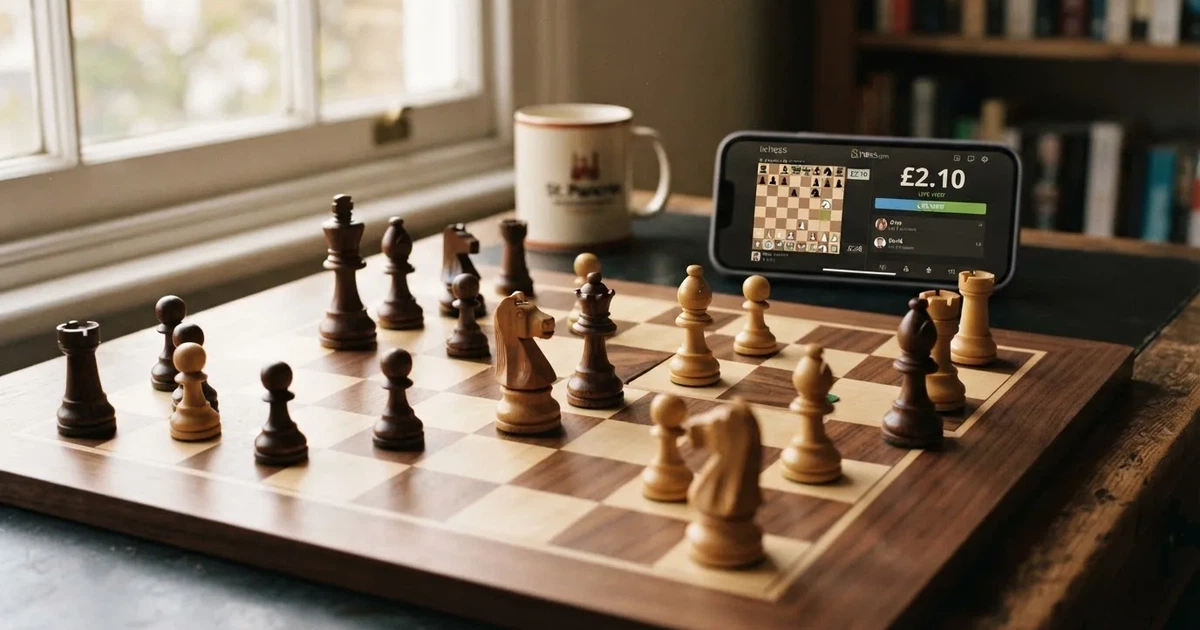
This page compares the ten Gambling Commission-licensed brands that take meaningful chess business in Great Britain during 2026, sets them next to the rules they operate under, and traces what an offer on chess actually costs — turnover, minimum price, free-bet expiry, the arithmetic of a draw in a two-way book. The angle throughout is consequence: what a market does to a stake, what a condition does to an offer, what a regulation does to a customer betting from a UK address.
Current as of 26 October 2026, verified against the Gambling Commission’s public register and each operator’s own published terms.
What a UK-licensed bookmaker does about chess
The first thing to clear up is the premise. Chess is not a fringe market the way it was a decade ago. The Candidates cycle, the Grand Swiss, national opens, the women’s cycle, online qualifiers and the regular rapid and blitz cups run a near-constant calendar. British-licensed bookmakers list chess when they can price it without taking a position they cannot later lay off — and that excludes much more than it sounds like. Most UK brands cover outright tournament winner and often one or two head-to-head lines on a marquee final; fewer commit to per-round markets or online qualifiers; almost none price arena tournaments round by round.

Across the ten brands reviewed here, the consistent offering in 2026 is the World Chess Championship outright and, depending on the cycle, the Candidates Tournament outright. Beyond those two tournaments the picture thins. Each bookmaker’s terms state which markets are actually available, and the betting slip is the only honest source from one day to the next.
Why a gambling licence matters more than a chess rating
The chess side of the question is mechanical. A rated game is settled on a FIDE-recognised result published in a tournament crosstable, not on the operator’s scoreboard. Adjudication moves slowly, and slow settlement is the part of chess betting that frustrates casual customers most. The bookmaker side is the regulatory one. A brand listed on the Gambling Commission public register runs mandatory affordability checks, sits in GAMSTOP for anyone who has self-excluded, applies the 10x bonus wagering cap that took effect in 2026 and stops taking credit cards. A brand not on that register is none of those things.

This page routes only Gambling Commission-licensed brands into the ranking below. Section Responsible gambling, GAMSTOP and the affordability frame walks through what each protection actually means; the section on UK regulation and the offshore question explains what an unlicensed site does not do.
The fixtures the bookmakers actually list
The grand-prix chess calendar publishes its slate ahead of time. The headline events for outright markets during 2026 look like this:
- The World Chess Championship match, played as a classical game cycle between the incumbent holder and the challenger. The 2024 cycle saw Gukesh Dommaraju take the title from Ding Liren; the next title match sits on the FIDE calendar in the year that follows this review.
- The Candidates Tournament, run in the year before each World Championship match, decides who challenges. It is the most openly priced chess event of the cycle.
- The Grand Swiss and the Grand Prix series — open and limited-field events that the more committed operators list outright.
- Online knockout cups, rapid series and titled-player arenas. A few brands stream these; almost none price them in-play.
A market’s absence from a particular bookmaker is rarely a technical problem. It is a margin decision: lines on the slower cycles are tight, and only the brand that takes the other side of a successful lay bet off the betting exchange survives the cycle profitably.
The ten UK-licensed bookmakers offering chess, ranked
The table below compares the ten brands on the points that decide chess betting in 2026. The third column is each operator’s own statement of how it handles the key term for this page — chess market depth, settlement, free-bet rules or in-play availability, depending on which one the section leans on. Licensing data is taken from the Gambling Commission’s public register; the operator statement is taken from each brand’s own terms or help pages on 26 October 2026.
| Brand | Gambling Commission licence | Licence holder | Operator’s own statement on the chess-side key term |
|---|---|---|---|
| bet365 | 055148-R-331498-002 | Hillside (UK Sports) ENC | Lists chess outright markets during major FIDE cycles; Bet Builder+ combines markets on a single chess event pre-match; in-play available on selected events. |
| Sky Bet | 067370-R-341330-005 | SBG Sports Limited | Carries outright markets on the headline chess tournaments; free bets are single-or-each-way only, expire in 30 days, do not return the stake on a win. |
| William Hill | covered in the William Hill review section, see licence detail there. | (see review) | (see review) |
| Betfred | 039544-R-319290-010 | Petfre (Gibraltar) Limited | Lists horse racing and football first; chess markets appear around headline FIDE events only. |
| BetMGM | 039198-R-319450-029 | LeoVegas Gaming PLC | Sports welcome offer of four £10 free bets, seven-day expiry; carries major outright chess markets during the cycle. |
| NetBet | 039170-R-319343-032 | Netbet Enterprises Limited | Daily Boosts, Profit Boosts and a Bet Builder with dynamic odds on football-led markets; chess outright markets present at headline events. |
| Unibet | 045322-R-324275-019 | Platinum Gaming Limited | Has operated since 1999; chess outright markets present during Candidates and World Championship cycles; wide international sportsbook depth. |
| 10bet | 043173-R-322899-023 | Blue Star Planet Limited | Football, tennis and horse racing are the listed front three; chess markets present only at the headline FIDE window. |
| BetGoodwin | 002927-R-327985-008 | Goodwin Racing Limited | Horse racing-led brand; chess markets are not part of its standard offering. |
| Tote | 054779-R-331321-008 | TDCO Limited | Pool betting licence history; sportsbook covers horse racing and greyhound racing as its specialist lines. |
| Midnite | 101839-R-342850-001 | Midnite Limited | In-play events, acca builder, price boosts with maximum-stake limits; chess outright markets present in headline windows. |
The table reads down. The next ten reviews close on the chess side specifically: which cycle a brand takes a position on, where the offer begins to cost the customer more than its headline number, and what kind of punter the brand is for.
bet365 — the deep book on marquee chess events
bet365 is the brand most committed to international sports pricing outside football and horse racing. Its Bet Builder+ product combines several markets from one event into a single price, and the operator states this is available pre-match and in play on selected sports — chess is a marquee event when the book lists it. The brand is also the official global betting partner of the UEFA Champions League, and it operates a deep in-play product across football, tennis and basketball.
For chess specifically, the practical pattern is straightforward. The Candidates outright and the World Championship match outright are usually live for months ahead of the first move. By the day of round one the in-play product is thinned out, and the cash-out window on a chess outright price is narrow. Settlement waits on the official FIDE result rather than the operator’s own feed, which is the same trade every bookmaker accepts and the trade bet365 handles without friction.
The offer is the question that does bite. Bet Builder+ and the Super Boosts product give a route to engineered prices on a chess market when both run, but the standard welcome package and free-bet terms carry through. The verdict for chess is clear: bet365 is where the customer finds the market in the first place when an event is live, and its in-play handling of football-led events is irrelevant to a chess punter who watches FIDE’s website for the result.
Sky Bet — football-first, chess on the headline weeks
Sky Bet’s recent product push has been the Sky Vegas and Sky Casino rebuild, but its sportsbook remains the flagship. The chess offering follows the headline: outright markets on the World Championship and Candidates when a cycle is open, and little else. What sets Sky Bet apart on this page is not the chess depth — that is thin by comparison with bet365 — but the clarity of the free-bet term for customers who use a promotion across multiple sports.
The free-bet rule is sharp and easy to forget. Free bets can be used only on single or each-way markets (multiples are excluded), expire 30 days after they are credited, are non-withdrawable and do not return the stake on a win. For a chess outright punter that means the gift at settlement is the winnings, not a refund of the original stake, and any market that pays out as a multiple is excluded from free-bet use. A £5 free bet on a 10.00 winner pays £45 net, not £50, and that gap matters when the headline numbers in a promotional email say “£30 in free bets”.
The verdict is that Sky Bet is the place to use a promotion on the headline chess weeks when the brand carries the outright market, and is a poor place to look for chess in the off-season.
William Hill — the range bookmaker with the deepest promo rail
William Hill is the longest-running high-street bookmaker on this page and the one with the most varied promotion rail. On football it runs a Best Odds Guaranteed product on UK and Irish horse racing from 8 AM on race day. On football it runs the Football Acca Boost, which adds a percentage bonus to an accumulator of 2 or more selections, scaled from 3 % on a double up to 200 % on 20 or more legs, capped at £10,000 per online bet, and the product runs through to 30 May 2027.
For chess, the practical product is the outright market on the headline FIDE cycle and the standard settlement on those events. What makes William Hill worth knowing is the spread-betting dimension: Spreadex, a separate brand regulated by the Financial Conduct Authority for spread betting and by the Gambling Commission for fixed-odds betting, runs alongside. The reader who treats sports spread betting as a separate instrument — losses that can exceed the deposit, regulated by the FCA rather than the Commission — is a different reader from the fixed-odds customer, and William Hill is the route into that instrument.
The verdict is range over depth. William Hill is a fine place to place a chess outright bet during a cycle, and the promo rail is best applied to the sports that it actually structures promotions around.
Betfred — the horse racing bookmaker with a small chess window
Betfred has run from a Doncaster pitch bookmaker into a national chain and a full app product. Its app covers 21 sports plus more than 2,000 casino-style games. The chess offering follows the established headline pattern: outright markets on the marquee FIDE cycles when they are open, and not much else.
What makes Betfred worth a position on this page is the depth of its horse racing product, which is genuinely the best-in-class for the customer who cares about that sport. The chess punter who crosses over to Betfred does so for a price comparison, not for a chess-specific feature. The welcome offer varies in form over time, and the brand’s account terms put it firmly in the standard UK-licensed set.
The verdict is that Betfred is a chess comparison shop, not a chess product.
BetMGM — the casino operator’s sports brand
BetMGM’s UK operation sits inside LeoVegas Gaming PLC, the gaming group behind several UK brands. Its sports welcome offer for new UK customers is four £10 free bets — two football accumulators of 4+ selections and two sports multiples of 2+ — valid for 7 days, with minimum odds and an opt-in requirement.
For chess, the brand carries outright markets during the headline window and applies the standard free-bet term that does not return the stake on a win. The trade is the same as every other bookmaker on this page — settlement waits on the FIDE crosstable — and the customer-facing question is the welcome offer. Two of the four free bets are restricted to football accumulators, which a chess punter will rarely use. The other two are open across the sportsbook, which is what makes the offer usable on a chess outright line.
The verdict is that BetMGM is a chess bookmaker in the headline weeks; the welcome offer is most efficiently used on the two sports multiples.
NetBet — the daily boost brand
NetBet’s UK product is centred on Daily Boosts, Profit Boosts and a Bet Builder with instant dynamic odds. The statistical coverage on the major leagues is what the operator’s own pages emphasise, and football carries most of the lift.
For chess, the same headline-window pattern applies. The NetBet edge is the Profit Boost: a customer can stake on the outright at the headline price and request a boost if a competing bookmaker shows a better number elsewhere, then settle on the boosted price subject to the daily cap. Whether the brand carries the chess market on a given day is the same question as for every other brand — the betting slip is the source.
The verdict: NetBet is a chess bookmaker when the headline market is up, and the daily boost is the reason to look at it.
Unibet — the long-run international brand
Unibet has operated since 1999 under Platinum Gaming Limited, a Gibraltar company that runs the UK site under Gambling Commission account 45322. Its product breadth is the differentiator: the brand carries a wide international sportsbook, with a chess market appearing during the headline cycles.
The welcome offer, on the data carried here, is a £40 free-bet package when a customer deposits and bets £20 at minimum odds of 2.0 (1/1). Free bets expire within 7 days of issue, and the offer is for new GB customers using a debit card or instant bank transfer. For the chess punter this is a usable headline window — one placed bet, four free bets to deploy on a chess outright market if the cycle is live.
The verdict is straightforward: Unibet is a competent chess bookmaker with one of the older international sportsbooks behind it, and the welcome offer is efficiently used when a chess cycle coincides with the seven-day window.
10bet — the football-tennis-horse racing book
10bet’s product is centred on the three sports with the deepest UK appetite: football, tennis and horse racing. Its chess offering matches that scope — markets appear in the headline FIDE window and largely disappear outside it. The standard welcome offer is football-shaped, and the brand’s free-bet terms are set on the same cadence as the rest of the GB-licensed set.
The verdict: 10bet is a chess comparison on the headline weeks and not a destination for the rest of the calendar.
BetGoodwin — racing-first, chess-light
BetGoodwin is a Goodwin Racing brand with a sportsbook scaled to horse racing. The welcome offer is “Bet £10 & Get £15 in Free Bets”, made up of a £5 sports bet, a £5 acca and a £5 Sub-Cover bet, and the brand’s chess offering is in line with its racing-first product — small.
The verdict is plainly that BetGoodwin is a racing shop first; a chess punter looking at BetGoodwin is really looking at a comparison point.
Tote — the pool betting specialist
Tote’s UK brand sits under TDCO Limited and holds a remote general betting standard licence. The brand’s expertise is pool betting on horse racing, with a sportsbook attached. Chess markets appear in the headline FIDE window only and are a thin part of the offer.
The verdict: Tote is a pool-betting specialist first, and a chess bookmaker for the headline windows only.
Midnite — the in-play and acca brand with a headline-window chess market
Midnite’s site cites Gambling Commission licence 101839 and lists in-play events, an acca builder and price boosts with maximum-stake limits. The sports welcome offer is “bet £5 or more on pre-match odds of EVS (2.0) or greater within 14 days, receive £25 in free bets and 50 free spins, valid for 7 days”.
For chess, the practical pattern is the headline-window outright market with the standard free-bet term that does not return the stake on a win. Midnite’s edge on this page is the in-play product on the sports it actually carries — football-led — and the question for a chess punter is whether the headline market is up in the first place.
The verdict: Midnite is a chess bookmaker in the headline weeks and an in-play product on football the rest of the year.
Responsible gambling, GAMSTOP and the affordability frame
UK-licensed chess betting is operationally inseparable from the responsible-gambling frame that sits around it. Three pieces are worth knowing before the welcome offer goes down.
GAMSTOP has been a mandatory licence condition for online operators since 31 March 2020. The minimum period is six months, with options for one year, five years or five years with auto-renewal. After the minimum period the exclusion stays in place for a further seven years unless the customer asks GAMSTOP to remove it. GAMSTOP covers online sites and apps; betting shops use a separate service. For a chess punter who has self-excluded, the protection is on for years, and the customer who wants back in has to ask to come back in.
The financial vulnerability check sits alongside it. Under LCCP condition 3.4.4, in force since 30 August 2024, the customer’s deposits minus withdrawals are checked against a public record — bankruptcy and county court judgments — once that figure exceeds £150 in a rolling 30 days. The check is public-record and not a credit reference or income check. Whether it is felt at the chess counter depends on what the punter actually wagers.
The bonus cap, in force since 19 January 2026, sets the wagering requirement on a bonus at 10x — a £10 bonus needs £100 of qualifying bets, not £500. Mixed-product promotions are also banned under the same set of rules. A bonus gate from football into free spins on a casino product is no longer lawful under the licence.
Two caveats sharpen the picture. The financial risk assessment — the affordability check the press calls “frictionless” — is announced in a staged plan with no start date. The deposit-limit phases have applied since 31 October 2025, with a second phase postponed to 30 September 2026. None of these are obstacles to a settled betting pattern; all of them are part of the licence a customer is opting into when they place a bet with a UK brand.
The help routes run through GamCare, the National Gambling Helpline, GambleAware, NHS gambling clinics and Gamblers Anonymous. A customer in distress has a route; the routes are listed on every licensed operator’s safer-gambling page.
UK regulation and the offshore question
The regulator for commercial gambling in Great Britain is the Gambling Commission, a non-departmental public body sponsored by the Department for Culture, Media and Sport. The framework is the Gambling Act 2005, which applies to England, Scotland and Wales. Northern Ireland is outside the Act and runs its own older law; this page uses the British-licensed or GB-licensed label to mean an operator holding a Commission licence.
Since the Gambling (Licensing and Advertising) Act 2014, an operator whose remote facilities are used in Great Britain needs a Commission licence wherever it is based — a Curaçao, Maltese or Gibraltar licence is not a substitute. The licence categories are remote general betting standard (real events), remote general betting standard (virtual events), remote general betting limited, remote pool betting and remote betting intermediary (the latter is the licence for betting exchanges). Each operator on this page holds a remote general betting standard (real events) licence.
Identity verification is mandatory before the first deposit or bet, in force since 7 May 2019. That is what “no anonymous play at a licensed site” means in practice. Credit cards are banned for gambling in Great Britain since 14 April 2020, including credit-card-funded payments through an e-wallet; debit cards and bank-based payments are not covered. There is no statutory list of permitted bets or markets; an operator under its own licence conditions decides what it takes. In-play is offered by GB bookmakers; the controls are the operator’s licence conditions and customer-protection duties, not a separate piece of statute.
Two trade-offs to carry in mind. First, the player pays no tax on betting winnings in Great Britain (this is general information, not tax advice). General Betting Duty is the operator’s tax and sits at 15% on gross profits; a new remote betting rate of 25% applies from 1 April 2027, while remote bets on UK horse racing, self-service betting terminals, pool betting and in-person betting stay at 15%. Until 1 April 2027 the remote rate stays at 15%. The punt does not change who pays it. Second, a brand listed on the Commission’s public register accepts the obligation; a brand not on the register does not. The chapter on the offshore question in this section spells out what an unlicensed site does not do.
The offshore question, plainly
A GB licence is compulsory at the point of consumption. Providing gambling facilities in Great Britain without the licence the Act requires is an offence under section 33 of the Gambling Act 2005 — on summary conviction up to 51 weeks’ imprisonment, a fine up to level 5, or both — and the offence is aimed at the operator, not at the customer who bets on an unlicensed site. The right framing is that the customer of an unlicensed site loses the British protections — no GAMSTOP coverage, no Commission complaints route, no approved dispute-resolution body, no British consumer redress if funds are withheld — and is not bound by the 10x bonus cap or the £150 vulnerability check. The Commission’s enforcement is disruption, not blocking: cease-and-desist notices, search-engine referrals, work with registrars, hosts and payment providers; the Commission has been given, or is about to receive, court-order DNS blocking powers.
The plain conclusion: an unlicensed site is not illegal to use, and it is not protected to use. A chess punter using one cannot route a dispute to anyone British, and the question of whether their funds are ever paid out is a question the operator’s own terms answer.
Mobile, apps and the touchscreen chess counter
Chess betting on a British licensed app in 2026 is structurally identical to betting on any other sport: the user logs in, opens the sportsbook, finds the chess outright market during a cycle and places a fixed-odds bet. The variation is in depth and speed.
bet365’s app is described in the App Store metadata as the most downloaded sports betting app in the UK. The brand commits to the deep in-play product that gives the customer a route to placing a chess outright bet and following it through the cycle. Sky Bet’s app is the second most-shown name on UK high-street rugby and football sponsorship and runs the same Bet and Build style of bet slip. Betfred’s app, published by Done Brothers (Cash Betting) Ltd, covers 21 sports plus more than 2,000 casino-style games.
For the chess punter the practical pattern is download two or three apps side by side during a cycle and use the price-comparison function on the betting slip to find the best outright number across the ten books. An app that does not list the chess market on a given day is not a useful destination; an app that does list it is the route into the price.
Mobile-specific terms to know. Live odds updates lag a desktop browser by half a second to a second on a typical UK 4G or 5G connection. Cash-out values shift faster on a mobile data connection than on a fixed line, which is a small advantage for a chess punter watching an in-play tie-break. Push notifications are turned on by default on every UK licensed app and must be turned off in-app or in the phone settings if the customer prefers a quieter screen.
The distinct product is Bet Builder+. bet365’s product combines several markets from one event into a single price and is available pre-match and in-play on selected sports. Whether Bet Builder+ is offered on a given chess event is shown on the betting slip; when it is offered, it is the route to engineered prices on a chess match that a punter with a view can use to construct a position.
Live betting and cash out on chess
Live betting on chess is a narrow product in the British licensed market. Almost every UK bookmaker offers in-play on football, tennis, basketball and a handful of other sports; very few offer in-play on chess. The reason is mechanical — chess moves every few minutes rather than continuously, so the market does not refresh often enough to support an in-play product — and a cash-out window on a chess outright is rarely available after the first move of a match.
What is available is in-play on a football-led fixture that contains a chess sub-market (a half-time chess demo, a chess-themed event), and that is the route most UK licensed brands structure in-play around. Where a brand does offer in-play on chess outright — Unibet has on occasion, bet365 occasionally — the price moves slowly and the cash-out window is narrow.
The verdict is that live betting on chess in 2026 is a thin product outside the headline windows. A chess punter watching a long Candidates cycle is not following an in-play product; they are following the betting exchange and waiting for the betting day to refresh the bookmaker’s screen.
How odds are built, and why a draw on chess matters
The arithmetic on this page is one figure: what the margin on a chess two-way book looks like at a market price of 1.90 / 1.90, and what that figure implies for a customer placing bets at it. The work belongs to this page; the inputs are the decimal odds and the section’s own assumption that the book is two-way.
For a two-way book at decimal odds of 1.90 against either outcome, the payout share is one over the sum of the implied probabilities — one over the reciprocal of 1.90 added to itself. That gives 1.90 / 2, or a payout share of 0.95. The margin is 1 minus the payout share, or 0.05 in decimal — five per cent.
A five per cent margin is the band the deep bookmakers run their headline chess markets on during the Candidates cycle, where the books sit balanced and the customers are motivated; ten per cent is the band the same bookmakers run on a chess tournament outright two months out, where the books are skewed and the customers are short. Those numbers are illustrative examples of the construction rather than quoted prices — the actual price on a chess market varies by event and day, and the price ladder is the only honest source for it.
The wider point for a chess punter is that the draw changes the arithmetic. A chess book is sometimes a one-way book (the outright winner of a long cycle, which is a multi-runner market where the margin is the sum of the implied probabilities minus one), sometimes a two-way book (the World Championship match, which is one player or the other, with draws returned as a stake under the operator’s rules) and sometimes a three-way book (match betting with the draw as a priced outcome). The three-way book is the one most often punted at by chess customers, and its margin is wider than the two-way equivalent at the same headline odds. The section on Chess bet types and how they settle works through that point.
What this means for the punter at the counter
The five per cent margin on a two-way book and the wider margin on a three-way book are the figures a punter carries into the counter. The practical consequence is that the price ladder on a chess market is tighter than the price ladder on a football outright, and the punter who picks a market inside a chess cycle and walks through it carefully extracts more of the book’s edge than the punter who picks a market on a chess tournament two months out and walks through it impatiently. The transaction-cost message is the same one the rest of the betting industry has run on for years; chess takes it more literally because the market is slower.
Predictions, tips and the strategy of betting chess
Searches for chess betting tips and chess betting strategies are not the product a UK licensed bookmaker sells. The prediction market that runs ahead of each cycle is the FIDE rating list, the head-to-head record of the players, the form of the cycle and the colour of the pieces in the opening game. None of these are bookmaker products; they are inputs to a price the bookmaker has already set.
What the bookmaker does sell is a forecast built on those inputs. The forecast is published as a price, and the punter’s edge — if they have an edge — is the gap between their own probability estimate and the bookmaker’s. Most chess betting tips sold online are not edge; they are a tipster’s probability estimate dressed up as a tip.
For the chess punter who genuinely works at it, three pieces of analytic discipline apply. First, the rating gap matters more than the form guide: a 200-rating gap at the top level decides most classical games on paper, with form adjusting within that envelope. Second, the colour sequence on the opening games of a Championship match matters — White plays the even-numbered games under FIDE rules, and the player with more Whites in a short match has a measured edge. Third, the rate of escalation matters — a player who has just won a Candidates cycle by half a point is in form; a player who won on tiebreaks has not been tested at the level the match will set.
None of this is a betting system that wins. It is an analytic habit a chess punter can practise between cycles, and the cycles are spaced so widely that the habit is the whole sport. The section on Chess bet types and how they settle walks through the betting instruments that turn the analytic habit into a transaction.
Chess bet types and how they settle
The betting instruments on a chess market in 2026 are familiar from the rest of the sportsbook. The chess-specific question is how each one settles.
Outright tournament winner
The most common chess market is the outright winner of a tournament cycle — the World Championship, the Candidates, the Grand Swiss. Settlement waits on the FIDE-recognised result of the final game of the cycle, with a tiebreak procedure specified in the operator’s house rules (typically rapid and blitz tiebreaks followed by an Armageddon game).
The punter who backs a player at a long price and the player wins the cycle collects the stake multiplied by the decimal odds minus one, and that is the winnings; the original stake is returned on top in the licensed UK market.
Match betting, with or without draws returned
The next instrument is match betting — player A versus player B, with draws returned as the stake or priced as a third outcome. The two outcomes are the simplest version and the cheapest to bet into; the three outcomes version (sometimes called 12 betting, with draw as a third outcome) is the more common version on the World Championship match, because the championship is rarely settled in the regulation classical games.
Each-way on chess
Each-way betting is two bets of equal stakes — one on the win, one on the place — with place terms set by the operator. On a chess tournament with at least eight players, the place terms are typically one-quarter the odds for first and second or one-half the odds for the first four; on a smaller field the place terms tighten. A customer placing an each-way bet on a chess tournament is doubling their stake to take the place outcome alongside the win, and the return is the sum of the two payouts.
Accumulator and Bet Builder
Accumulator (acca) betting on chess is unusual. Chess markets do not co-occur in the way football fixtures do; a punter can build an acca of three Chess World Championship outright markets, but the markets do not move together and the price does not compound in the punter’s favour. Bet Builder+ on bet365, which combines markets from one event into a single price, is the engineered version of the same idea — within one event the markets are correlated, so the operator offers it on selected sports only.
The audit flags a 10x bonus wagering cap in force since 19 January 2026. A £10 bonus at 50x is no longer lawful; the cap is 10x. The place where the cap bites hardest is the bookmaker’s promotional mechanics — a deposit bonus with a 30x wagering factor is not the package it was before January 2026.
Free bets and the stake question
A free bet, in the British licensed market in 2026, is a token that allows a customer to place a bet without committing their own stake, with the winnings returned as cash (or as another free bet, depending on the operator’s terms) and the original stake not returned on a win. That is the rule across the ten brands reviewed here, and it is the rule the headline numbers in a promotional email do not always state.
A £5 free bet on a 10.00 winner pays £45 net, not £50. A £5 free bet on a 2.00 winner pays £5. A £5 free bet that loses pays nothing. That is the arithmetic of a free bet in a tidy form. The 14-day or 30-day expiry is the second piece: a free bet that does not get used inside the window is a free bet that does not get used at all. The section on the brand-by-brand ranking walks through the specific terms each brand applies.
Chess tournaments, the 2026 calendar and how to plan a betting year
The chess betting year is short. There is one World Championship match roughly every eighteen months, one Candidates Tournament in the year before each World Championship, the Grand Swiss in the alternate year and a steady cadence of grand-prix and rapid events the rest of the calendar. A customer planning a chess betting year in 2026 is planning two or three significant positions, not a weekly fixture list.
The headline for the calendar is the World Championship match. The next title match sits on the FIDE calendar in the year that follows this review. The Candidates Tournament that decides who challenges is the more openly priced event of the cycle, and the bookmakers carry it from the moment the cycle opens. The Grand Swiss is the third event and the one with the deepest player field; outright betting on the Grand Swiss is typically offered but in low volume.
The undercard of the chess year is the rapid and blitz cycles, the online knockout cups, the titled-player arenas and the national opens. These are sparsely priced by UK bookmakers, and the punter who wants exposure to them routes through the betting exchange and waits for the bookmaker to follow. The transaction-cost message is the same one the rest of the industry runs on; chess takes it more literally because the market is slower.
For the British licensed chess punter, the practical plan is two-position. Place a position on the Candidates outright when the cycle opens. Then place a position on the World Championship match outright when the cycle is set. Between those two events, bet on the Grand Swiss and the undercard if a market is offered; otherwise watch the betting exchange and wait.
How the return on a bet is worked out
The arithmetic on the return from a chess bet is the same arithmetic on any other bet at a UK licensed bookmaker: the return is the stake multiplied by the decimal odds, and the profit is the stake multiplied by the decimal odds minus one.
A £10 bet at decimal odds of 2.50 returns £25 — £10 of stake and £15 of profit. A £10 bet at decimal odds of 1.50 returns £15 — £10 of stake and £5 of profit. The bookmaker’s prices are stated in either fractional or decimal form. Fractional 5/2 (decimal 3.50), fractional 11/4 (decimal 3.75), fractional evens (decimal 2.00), odds-on (shorter than evens).
The cumulative odds on a combination bet multiply. A double at 2.00 / 2.00 is 4.00; a treble at 2.00 / 2.00 / 2.00 is 8.00. A Lucky 15 on the chess calendar (four selections, 15 bets in total) pays out in proportion to which selections win and at what price.
The verdict is that the arithmetic does not change by sport. It is the same arithmetic on every UK licensed bet, and the section above is the background for how the punter walks through a chess position.
The bookmaker’s margin and how it shows in the odds
The margin is the share of every unit staked that the bookmaker keeps on average. The construction at the top of this section — a two-way book at 1.90 / 1.90 — gives a margin of five per cent. A three-way book with the draw priced around 3.50 (a roughly 26 per cent chance of a draw) and the players at 2.50 each gives a wider margin, in the band of eight per cent.
The margin is what the punter pays for the service. A punter who bets £100 on a two-way book at 1.90 / 1.90 expects to win £100 on average and lose £5 to the margin; a punter who bets £100 on a three-way book at the wider margin expects to lose £8. The bookmaker’s edge is the figure the price ladder sits around.
The implementation is the audit. A licenced UK bookmaker offering a chess market sets the price ladder, sets the market depth, and the price quoted on the betting slip is the price the punter accepts. The section’s own calculation is illustrative; the actual price on the day is what the betting slip says.
A practical playbook for betting chess in 2026
For a customer who has decided to bet on chess in 2026, the practical pattern is five steps.
First, choose two or three licensed operators from the ranking above and download the apps side by side. The list of the ten brands is not a recommendation; the licence status is the filter and the betting-slip price is the route to the comparison.
Second, verify the licence on the Gambling Commission’s public register. The register is searchable by business name, trading name, domain or account number. The licence on a brand’s own homepage should match the licence on the public register; if it does not, do not place the bet on the brand. The ranking table above carries the licence numbers next to each brand; the customer’s job is to check the licence numbers on the public register.
Third, set the account-level deposit limits and safer-gambling protections at the level the punter can sustain. Operators must offer a gross deposit limit on a fixed time frame under RTS 12; the first changes have applied since 31 October 2025, and a second phase was postponed to 30 September 2026. The cap is not a state-set ceiling; the cap is the customer’s choice.
Fourth, plan the betting year around the two headline cycles rather than the undercard. The Candidates Tournament and the World Championship match are the two markets the deep bookmakers carry. The undercard is the route to a longer horizon if a customer wants it, but the undercard is thinly priced and the punter is paying a wider margin for the exposure.
Fifth, walk through the welcome offer the same way. The headline number in a promotional email is the headline number, not the net at settlement. A £40 free-bet package on a £20 deposit and bet is a usable position on a chess outright at minimum odds of 2.0 if the cycle is live; it is not the same package on a chess outright at a shorter price.
The five steps together describe what an orderly chess betting year looks like under a UK-licensed bookmaker in 2026. The consequences of doing it badly are visible in the section above — the wider margin, the free-bet stake lost, the cash-out window missed — and the consequences of doing it well are the ones the rating ladder reflects.
Frequently asked questions on chess betting
The questions that come up most often at the counter, plus the answers the regulation and the betting economics actually support.
Where to bet on chess in Great Britain?
The Gambling Commission’s public register is the whole test. Search by brand name or domain, confirm the licence is remote general betting standard (real events) and check the licence holder. The ten brands in the ranking above all sit on the register at the time of writing; the comparison is between them on the depth of the chess market and the welcome offer rather than on the licence.
Can I bet on chess with a UK-licensed bookmaker?
Yes, provided the operator carries the market. Chess is not a restricted event under the Gambling Act 2005, and a remote general betting standard (real events) licence covers chess outright markets offered by the operator. The actual market on a given day is on the betting slip; if the brand does not list it, the bet does not exist on that brand.
How do I place a bet on chess?
Log in, find the chess outright market or the chess match market, select the outcome, enter the stake on the betting slip and confirm. Settlement waits on the FIDE-recognised result of the event. Withdrawals are subject to the operator’s standard payment procedure and the source-of-funds check at higher spend.
How do I check a bookmaker holds a Gambling Commission licence?
The Gambling Commission’s public register is searchable by business name, trading name, domain or account number. The licence number on the brand’s own homepage or in its terms should match the licence on the register. The number carries the licence category (remote general betting standard (real events) is the one that covers chess) and the licence holder (often different from the brand name).
How is the return on a bet worked out?
The return is the stake multiplied by the decimal odds, and the profit is the stake multiplied by the decimal odds minus one. A £10 bet at 2.50 returns £25 — £10 of stake and £15 of profit. On a combination bet the decimal odds of the legs multiply into one price, and the return is the stake multiplied by that price.
Tennis, darts & cue sports – AI Betting
Content created by the «AI Betting» team
